
 Q. No.
The outermost layer of the skin of the frog is made of:
1. Stratified squamous keratinized epithelium
2. Stratified squamous non keratinized epithelium
3. Simple squamous cpithelium
4. Simple columnar epithelium


Regarding feeding habits:
1. Tadpole is herbivorous and frog is carnivorous
2. Tadpole is carnivorous and frog is herbivorous
3. Both tadpole and frog are carnivorous
4. Both tadpole and frog are herbivorous


Regarding frog:
I. They undergo aestivation and hibernation
II. They are carnivorous
III. They are poikilotherms
1. I, II, III are correct
2. I and II are correct
3. I and III are correct
4. II and III are correct
Gas exchange between the air and blood stream occurs in three locations in the frog:
(1) the skin
(2) the lining of the mouth
(3) the lungs
1. (1) and (2)
2. (1) and (3)
3. (2) and (3)
4. (1), (2) and (3)
Regarding respiration in frogs:
I. The skin of a frog is permeable to oxygen and carbon dioxide, as well as to water.
II. When a frog is underwater, oxygen is transmitted through the skin directly into the bloodstream.
III. On land, adult frogs use their lungs to breathe
The correct statements are:
1. I, II, III
2. I and II
3. I and III
4. II and III
In the given diagram of the heart of frog identify X :
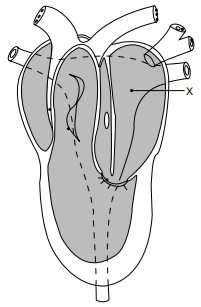
1. Conus arteriosus
2. Left atrium
3. Sinus venosus
4. Left ventricle
In frog:
1. Hemoglobin is present in red blood corpuscles which are biconvex and nucleated.
2. Hemoglobin is present in red blood corpuscles which are biconcave and nucleated.
3. Hemoglobin is present in red blood corpuscles which are biconvex and enucleated.
4. Hemoglobin is present in red blood corpuscles which are biconcave and enucleated.
Male and female frogs are distinguishable externally only during breeding season when:
1. the female develops nuptial pad in the thumb
2. the male develops nuptial pad in the thumb
3. the male develops nuptial pad in the thumb and the female develops a nuptial pad on other digits
4. the male develops large nuptial pad in the thumb while the female develops small nuptial pad in the thumb
Regarding skin of the frog, incorrect statement is:
1. It is made of the epidermis and the dermis
2. Mucous glands are present in the dermis and open at the surface
3. It is soft, moist and slimy
4. It is covered by scales

© 2024 GoodEd Technologies Pvt. Ltd.