
 Q. No.
When the co-factor is removed from the enzyme, the catalytic activity:
1. is lost.
2. is reduced.
3. is increased.
4. is unaffected.


In an average composition of a cell, the maximum % of total cellular mass [after water and protein] is constituted by:
1. Carbohydrates
2. Lipid
3. Nucleic acids
4. Ions
Where would you expect to find serine and alanine amino acids in a globular protein in aqueous solution?
1. Serine would be in the interior, and alanine would be on the exterior of the globular protein.
2. Alanine would be in the interior, and serine would be on the exterior of the globular protein.
3. Both serine and alanine would be in the interior of the globular protein.
4. Both serine and alanine would be on the exterior of the globular protein.


Identify the option, where all the columns are not matched correctly:
| 1. | Abrin | Secondary metabolite | Drug |
| 2. | GLUT-4 | Protein | Transport carrier |
| 3. | Lecithin | Phospholipid | Cell membrane |
| 4. | Thymidylic Acid | Nucleotide | DNA |
The vitamin Niacin functions as a coenzyme in:
| 1. | Nucleoprotein synthesis |
| 2. | Hydrogen transport |
| 3. | Fatty acid synthesis |
| 4. | RBC production |
There cannot be a living state without :
1. Metabolism
2. Capability of reproduction
3. Self-consciousness
4. Presence of DNA in a cell


The six most common atoms in organic molecules are:
| 1. | Carbon, Hydrogen, Oxygen, Helium, Calcium and Sulphur |
| 2. | Carbon, Hydrogen, Oxygen, Calcium, Magnesium and Sulphur |
| 3. | Carbon, Oxygen, Nitrogen, Sulphur, Phosphorous and Magnesium |
| 4. | Carbon, Hydrogen, Oxygen, Nitrogen, Phosphorous and Sulphur |
The unique properties of each amino acid are determined by its particular:
1. R group
2. Amino group
3. Kinds of peptide bonds
4. Number of bonds to other amino acids
Given below is the graph showing the effect of substrate concentration on enzyme activity. In the presence of a competitive inhibitor, when the concentration of the substrate is progressively increased:

| 1. | The Km value increases but the reaction will not achieve Vmax |
| 2. | The Km value increases but the reaction can ultimately achieve Vmax |
| 3. | The Km value decreases but the reaction will not achieve Vmax |
| 4. | The Km value decreases but the reaction can ultimately achieve Vmax |


The compound shown below:
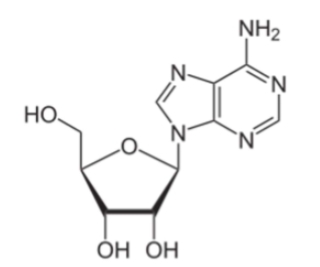
1. is a component of the ATP molecule
2. is most commonly found in ori region of DNA
3. can have enzymatic activity
4. may be a component of the cell membrane

© 2026 GoodEd Technologies Pvt. Ltd.