Select Chapter Topics:

 Q. No.
The restoring force of a spring, with a block attached to the free end of the spring, is represented by:
1.

2.

3.
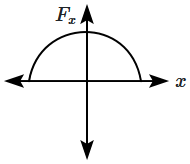
4.


Subtopic: Spring mass system |
65%
From NCERT
NEET - 2022
To view explanation, please take trial in the course.
NEET 2023 - Target Batch - Aryan Raj Singh
Hints
To view explanation, please take trial in the course.
NEET 2023 - Target Batch - Aryan Raj Singh

Match List-I with List-II:
Choose the correct answer from the options given below:
| List-I (x-y graphs) |
List-II (Situations) |
||
| (a) |  |
(i) | Total mechanical energy is conserved |
| (b) |  |
(ii) | Bob of a pendulum is oscillating under negligible air friction |
| (c) |  |
(iii) | Restoring force of a spring |
| (d) |  |
(iv) | Bob of a pendulum is oscillating along with air friction |
Choose the correct answer from the options given below:
| (a) | (b) | (c) | (d) | |
| 1. | (iv) | (ii) | (iii) | (i) |
| 2. | (iv) | (iii) | (ii) | (i) |
| 3. | (i) | (iv) | (iii) | (ii) |
| 4. | (iii) | (ii) | (i) | (iv) |
Subtopic: Spring mass system |
83%
From NCERT
NEET - 2022
To view explanation, please take trial in the course.
NEET 2023 - Target Batch - Aryan Raj Singh
Hints
To view explanation, please take trial in the course.
NEET 2023 - Target Batch - Aryan Raj Singh
Given below are two statements:
| Assertion (A): | In simple harmonic motion, the motion is to and fro and periodic. |
| Reason (R): | Velocity of the particle \((v)=\omega \sqrt {a^2-x^2}\) (where x is the displacement). |
| 1. | Both (A) and (R) are true and (R) is the correct explanation of (A). |
| 2. | Both (A) and (R) are true but (R) is not the correct explanation of (A). |
| 3. | (A) is true but (R) is false. |
| 4. | Both (A) and (R) are false. |
Subtopic: Simple Harmonic Motion |
85%
From NCERT
To view explanation, please take trial in the course.
NEET 2023 - Target Batch - Aryan Raj Singh
Hints
To view explanation, please take trial in the course.
NEET 2023 - Target Batch - Aryan Raj Singh


Given below are two statements:
| Assertion (A): | Acceleration of a particle in SHM is always zero. |
| Reason (R): | Two SHMs must have the same phase if the amplitude is same. |
| 1. | Both (A) and (R) are true and (R) is the correct explanation of (A). |
| 2. | Both (A) and (R) are true but (R) is not the correct explanation of (A). |
| 3. | (A) is true but (R) is false. |
| 4. | Both (A) and (R) are false. |
Subtopic: Simple Harmonic Motion |
82%
From NCERT
To view explanation, please take trial in the course.
NEET 2023 - Target Batch - Aryan Raj Singh
Hints
To view explanation, please take trial in the course.
NEET 2023 - Target Batch - Aryan Raj Singh
Given below are two statements:
| Assertion (A): | The time period of a pendulum, on a satellite orbiting the earth, is infinity. |
| Reason (R): | Time-period of a pendulum is inversely proportional to \(\sqrt g\). |
| 1. | Both (A) and (R) are true and (R) is the correct explanation of (A). |
| 2. | Both (A) and (R) are true but (R) is not the correct explanation of (A). |
| 3. | (A) is true but (R) is false. |
| 4. | Both (A) and (R) are false. |
Subtopic: Angular SHM |
62%
From NCERT
To view explanation, please take trial in the course.
NEET 2023 - Target Batch - Aryan Raj Singh
Hints
To view explanation, please take trial in the course.
NEET 2023 - Target Batch - Aryan Raj Singh
Given below are two statements:
| Assertion (A): | The graph of potential energy and kinetic energy of a particle in SHM with respect to position is a parabola. |
| Reason (R): | Potential energy and kinetic energy do not vary linearly with position. |
| 1. | Both (A) and (R) are true and (R) is the correct explanation of (A). |
| 2. | Both (A) and (R) are true but (R) is not the correct explanation of (A). |
| 3. | (A) is true but (R) is false. |
| 4. | Both (A) and (R) are false. |
Subtopic: Energy of SHM |
From NCERT
To view explanation, please take trial in the course.
NEET 2023 - Target Batch - Aryan Raj Singh
Hints
To view explanation, please take trial in the course.
NEET 2023 - Target Batch - Aryan Raj Singh
Given below are two statements:
| Assertion (A): | When a girl sitting on a swing stands up, the periodic time of the swing decreases. |
| Reason (R): | When a girl stands up, more weight is felt on the string of the swing. |
| 1. | Both (A) and (R) are true and (R) is the correct explanation of (A). |
| 2. | Both (A) and (R) are true but (R) is not the correct explanation of (A). |
| 3. | (A) is true but (R) is false. |
| 4. | Both (A) and (R) are false. |
Subtopic: Angular SHM |
From NCERT
To view explanation, please take trial in the course.
NEET 2023 - Target Batch - Aryan Raj Singh
Hints
To view explanation, please take trial in the course.
NEET 2023 - Target Batch - Aryan Raj Singh
Given below are two statements:
| Assertion (A): | The graph between velocity and displacement for a simple harmonic motion is an ellipse. |
| Reason (R): | Velocity does not change uniformly with displacement in simple harmonic motion. |
| 1. | Both (A) and (R) are true and (R) is the correct explanation of (A). |
| 2. | Both (A) and (R) are true but (R) is not the correct explanation of (A). |
| 3. | (A) is true but (R) is false. |
| 4. | Both (A) and (R) are false. |
Subtopic: Simple Harmonic Motion |
From NCERT
To view explanation, please take trial in the course.
NEET 2023 - Target Batch - Aryan Raj Singh
Hints
To view explanation, please take trial in the course.
NEET 2023 - Target Batch - Aryan Raj Singh
Given below are two statements:
| Assertion (A): | If a pendulum is suspended in a lift and lift is falling freely, then its time period becomes infinite. |
| Reason (R): | Free falling body has acceleration equal to acceleration due to gravity. |
| 1. | Both (A) and (R) are true and (R) is the correct explanation of (A). |
| 2. | Both (A) and (R) are true but (R) is not the correct explanation of (A). |
| 3. | (A) is true but (R) is false. |
| 4. | Both (A) and (R) are false. |
Subtopic: Angular SHM |
82%
From NCERT
To view explanation, please take trial in the course.
NEET 2023 - Target Batch - Aryan Raj Singh
Hints
To view explanation, please take trial in the course.
NEET 2023 - Target Batch - Aryan Raj Singh
Given below are two statements:
| Assertion (A): | When a pendulum is made to oscillate on the surface of the moon, its time period increases. |
| Reason (R): | Moon is much smaller as compared to Earth. |
| 1. | Both (A) and (R) are true and (R) is the correct explanation of (A). |
| 2. | Both (A) and (R) are true but (R) is not the correct explanation of (A). |
| 3. | (A) is true but (R) is false. |
| 4. | Both (A) and (R) are false. |
Subtopic: Angular SHM |
From NCERT
To view explanation, please take trial in the course.
NEET 2023 - Target Batch - Aryan Raj Singh
Hints
To view explanation, please take trial in the course.
NEET 2023 - Target Batch - Aryan Raj Singh
Select Chapter Topics:

© 2024 GoodEd Technologies Pvt. Ltd.