The equation of an SHM is given as \(y = 3\sin\omega t+ 4\cos \omega t\) where \(y\) is in centimeters. The amplitude of the SHM will be?
1. \(3~\text{cm}\) 2. \(3.5~\text{cm}\)
3. \(4~\text{cm}\) 4. \(5~\text{cm}\)
Subtopic:  Linear SHM |
 91%
Level 1: 80%+
Hints

Two simple harmonic motions of angular frequency \(100~\text{rad s}^{-1}\) and \(1000~\text{rad s}^{-1}\) have the same displacement amplitude. The ratio of their maximum acceleration will be:
1. \(1:10\)
2. \(1:10^{2}\)
3. \(1:10^{3}\)
4. \(1:10^{4}\)

Subtopic:  Linear SHM |
 87%
Level 1: 80%+
NEET - 2008
Hints

The amplitude of a simple harmonic oscillator is \(A\) and speed at the mean position is \(v_0\). The speed of the oscillator at the position \(x={A \over \sqrt{3}}\) will be:
1. \(2v_0 \over \sqrt{3}\) 2. \(\sqrt{2}v_0 \over 3\)
3. \({2 \over 3}v_0\) 4. \(\sqrt{\frac{2}{3}}v_0\)
Subtopic:  Linear SHM |
 80%
Level 1: 80%+
Hints

advertisementadvertisement

A point performs simple harmonic oscillation of period \(\mathrm{T}\) and the equation of motion is given by; \(x=a \sin (\omega t+\pi / 6)\)After the elapse of what fraction of the time period, the velocity of the point will be equal to half of its maximum velocity?
1. \( \frac{T}{8} \)

2. \( \frac{T}{6} \)

3. \(\frac{T}{3} \)

4. \( \frac{T}{12}\)

Subtopic:  Linear SHM |
 71%
Level 2: 60%+
AIPMT - 2008
Hints

The amplitude and the time period in an SHM are \(0.5\) cm and \(0.4\) sec respectively. If the initial phase is \(\frac{\pi}{2}\) radian, then the equation of SHM will be:
1. \(y = 0.5\sin(5\pi t)\)
2. \(y = 0.5\sin(4\pi t)\)
3. \(y = 0.5\sin(2.5\pi t)\)
4. \(y = 0.5\cos(5\pi t)\)
Subtopic:  Linear SHM |
 71%
Level 2: 60%+
Hints

premium feature crown icon
Unlock IMPORTANT QUESTION
This question was bookmarked by 5 NEET 2025 toppers during their NEETprep journey. Get Target Batch to see this question.
✨ Perfect for quick revision & accuracy boost
Buy Target Batch
Access all premium questions instantly
If the displacement \(x\) and the velocity \(v\) of a particle executing simple harmonic motion are related through the expression \(4v^2= 25-x^2,\) then its time period will be:
1. \(\pi \) 2. \(2 \pi \)
3. \(4 \pi \) 4. \(6 \pi\)
Subtopic:  Linear SHM |
 68%
Level 2: 60%+
Hints

advertisementadvertisement

premium feature crown icon
Unlock IMPORTANT QUESTION
This question was bookmarked by 5 NEET 2025 toppers during their NEETprep journey. Get Target Batch to see this question.
✨ Perfect for quick revision & accuracy boost
Buy Target Batch
Access all premium questions instantly
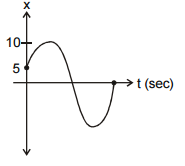
The displacement-time graph of a particle executing SHM is shown in the figure. Its displacement equation will be: (Time period = \(2\) second)


1. \(x= 10\sin\left(\pi t+\frac{\pi}{6}\right)\)
2. \(x= 10\sin\left(\pi t\right)\)
3. \(x= 10\cos\left(\pi t\right)\)
4. \(x= 5\sin\left(\pi t+\frac{\pi}{6}\right)\)

Subtopic:  Linear SHM |
 66%
Level 2: 60%+
Hints

A particle is subjected to two simple harmonic motions in the same direction having equal amplitudes and equal frequency. If the resulting amplitude is equal to the amplitude of individual motions, the phase difference between them will be:
1. \(\frac{\pi}{3}\)
2. \(\frac{2\pi}{3}\)
3. \(\frac{\pi}{6}\)
4. \(\frac{\pi}{2}\)
Subtopic:  Linear SHM |
 62%
Level 2: 60%+
Hints

premium feature crown icon
Unlock IMPORTANT QUESTION
This question was bookmarked by 5 NEET 2025 toppers during their NEETprep journey. Get Target Batch to see this question.
✨ Perfect for quick revision & accuracy boost
Buy Target Batch
Access all premium questions instantly
A body oscillates with SHM according to the equation (in SI units), \(x= 5\cos\left[2\pi t +\dfrac{\pi}{4}\right].\) At \(t = 1.5 \text{ s},\) acceleration of the body will be:
1. \(140 \text{ cm} / \text{s}^2 \)
2. \(160 \text{ m} / \text{s}^2 \)
3. \(140 \text{ m} / \text{s}^2 \)
4. \(14 \text{ m} / \text{s}^2\)

Subtopic:  Linear SHM |
 61%
Level 2: 60%+
Hints

advertisementadvertisement

premium feature crown icon
Unlock IMPORTANT QUESTION
This question was bookmarked by 5 NEET 2025 toppers during their NEETprep journey. Get Target Batch to see this question.
✨ Perfect for quick revision & accuracy boost
Buy Target Batch
Access all premium questions instantly

A particle of mass \(m\) and charge \(\text-q\) moves diametrically through a uniformly charged sphere of radius \(R\) with total charge \(Q\). The angular frequency of the particle's simple harmonic motion, if its amplitude \(<R\), is given by:
1. \(\sqrt{\dfrac{qQ}{4 \pi \varepsilon_0 ~mR} }\)
2. \(\sqrt{\dfrac{qQ}{4 \pi \varepsilon_0 ~mR^2} }\)
3. \(\sqrt{\dfrac{qQ}{4 \pi \varepsilon_0 ~mR^3}}\)
4. \( \sqrt{\dfrac{m}{4 \pi \varepsilon_0 ~qQ} }\)

Subtopic:  Linear SHM |
 61%
Level 2: 60%+
Hints