
 Q. No.
On a rough horizontal surface (coefficient of friction ), a cubical block of side 'a' and mass m is projected horizontally. The net torque on the block about its centre of mass till the block stops is equal to:
1. zero
2.
3. mga
4. mga


An insect, initially on the circumference of a disc, starts moving along a chord of the disc, rotating about an axis passing through the center and perpendicular to the plane of the disc. Its angular speed:
| 1. | increases. | 2. | decreases. |
| 3. | first increases then decreases. | 4. | first decreases then increases. |
For a rigid body rotating about a fixed axis, which of the following quantities is the same at an instant for all the particles of the body?
| 1. | Angular acceleration |
| 2. | Angular velocity |
| 3. | Angular displacement in the given time interval |
| 4. | All of these |


A body of mass M is moving on a circular track of radius r in such a way that its kinetic energy K depends on the distance travelled by the body s according to relation K = s, where is a constant. The angular acceleration of the body is:
1.
2.
3.
4.
If a particle moves in a circle with a constant angular speed \((\omega)\) about the point \(O,\) then its angular speed about the point \(A\) will be:

1. \(2\omega\)
2. \(\dfrac{\omega}{2}\)
3. \(\omega\)
4. \(\dfrac{\omega}{4}\)
Which of the following is the value of the torque of force \(F\) about origin \(O:\)
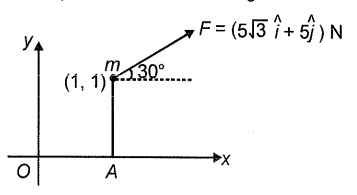
1. \(\vec{\tau}=5(1-\sqrt{3}) \hat{k}\) N-m
2. \(\vec{\tau}=5(1-\sqrt{3}) \hat{j}\) N-m
3. \(\vec{\tau}=5(\sqrt{3}-1) \hat{i}\) N-m
4. \(\vec{\tau}=\sqrt{3} \hat{j}\) N-m


1. \(\frac{5}{3}mL^2\)
2. \(4mL^2\)
3. \(\frac{1}{4}mL^2\)
4. \(\frac{2}{3}mL^2\)
1. \(\vec{\tau}=(-17 \hat{\mathrm{i}}+6 \hat{\mathrm{j}}+4 \widehat{\mathrm{k}})\) N-m
2. \(\vec{\tau}=(-17 \hat{\mathrm{i}}+6 \hat{\mathrm{j}}-4 \widehat{\mathrm{k}}) \) N-m
3. \(\vec{\tau}=(17 \hat{\mathrm{i}}-6 \hat{\mathrm{j}}+4 \widehat{\mathrm{k}})\) N-m
4. \(\vec{\tau}=(-41 \hat{\mathrm{i}}+6 \hat{\mathrm{j}}+16 \hat{\mathrm{k}})\) N-m
In the three figures, each wire has a mass M, radius R and a uniform mass distribution. If they form part of a circle of radius R, then about an axis perpendicular to the plane and passing through the centre (shown by crosses), their moment of inertia is in the order:
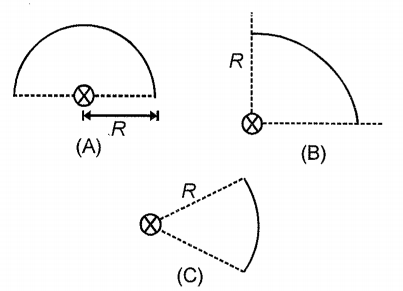
1.
2.
3.
4.


| 1. | \(1\) rad/s | 2. | \(2\) rad/s |
| 3. | \(3\) rad/s | 4. | \(4\) rad/s |

© 2026 GoodEd Technologies Pvt. Ltd.