
 Q. No.
Four masses are joined to light circular frames as shown in the figure. The radius of gyration of this system about an axis passing through the center of the circular frame and perpendicular to its plane would be:
(where '\(a\)' is the radius of the circle)

1. \(\frac{a}{\sqrt{2}}\)
2. \(\frac{a}{{2}}\)
3. \(a\)
4. \(2a\)
(where '\(a\)' is the radius of the circle)
1. \(\frac{a}{\sqrt{2}}\)
2. \(\frac{a}{{2}}\)
3. \(a\)
4. \(2a\)


Five particles of mass \(2\) kg each are attached to the circumference of a circular disc of a radius of \(0.1\) m and negligible mass. The moment of inertia of the system about the axis passing through the centre of the disc and perpendicular to its plane will be:
1. \(1\) kg-m2
2. \(0.1\) kg-m2
3. \(2\) kg-m2
4. \(0.2\) kg-m2
1. \(\frac{3mR^2}{2}\)
2. \(\frac{mR^2}{4}\)
3. \(\frac{mR^2}{2}\)
4. \(\frac{3mR^2}{4}\)


When a uniform rod of length \(l,\) hinged at one end is released from rest while making an angle \(\theta\) with the vertical, what will be the acceleration of its free end at that instant?

| 1. | \(\dfrac{3 g \sin \theta}{4} \) | 2. | \(\dfrac{3 g \cos \theta}{2} \) |
| 3. | \(\dfrac{3 g \sin \theta}{2} \) | 4. | \(\dfrac{3 g \cos \theta}{4}\) |
On a rough horizontal surface (coefficient of friction ), a cubical block of side 'a' and mass m is projected horizontally. The net torque on the block about its centre of mass till the block stops is equal to:
1. zero
2.
3. mga
4. mga
An insect, initially on the circumference of a disc, starts moving along a chord of the disc, rotating about an axis passing through the center and perpendicular to the plane of the disc. Its angular speed:
| 1. | increases. | 2. | decreases. |
| 3. | first increases then decreases. | 4. | first decreases then increases. |


For a rigid body rotating about a fixed axis, which of the following quantities is the same at an instant for all the particles of the body?
| 1. | Angular acceleration |
| 2. | Angular velocity |
| 3. | Angular displacement in the given time interval |
| 4. | All of these |
A body of mass M is moving on a circular track of radius r in such a way that its kinetic energy K depends on the distance travelled by the body s according to relation K = s, where is a constant. The angular acceleration of the body is:
1.
2.
3.
4.
If a particle moves in a circle with a constant angular speed \((\omega)\) about the point \(O,\) then its angular speed about the point \(A\) will be:

1. \(2\omega\)
2. \(\dfrac{\omega}{2}\)
3. \(\omega\)
4. \(\dfrac{\omega}{4}\)
Which of the following is the value of the torque of force \(F\) about origin \(O:\)
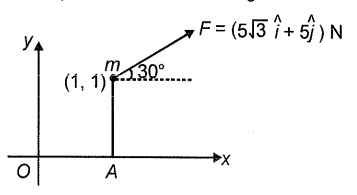
1. \(\vec{\tau}=5(1-\sqrt{3}) \hat{k}\) N-m
2. \(\vec{\tau}=5(1-\sqrt{3}) \hat{j}\) N-m
3. \(\vec{\tau}=5(\sqrt{3}-1) \hat{i}\) N-m
4. \(\vec{\tau}=\sqrt{3} \hat{j}\) N-m

© 2026 GoodEd Technologies Pvt. Ltd.