
 Q. No.
The displacement time graph of a moving particle is shown in the figure below. The instantaneous velocity of the particle is negative at the point:

1.
D
2.
F
3.
C
4.
E


A particle moves along a path \(ABCD\) as shown in the figure. The magnitude of the displacement of the particle from \(A\) to \(D\) is:
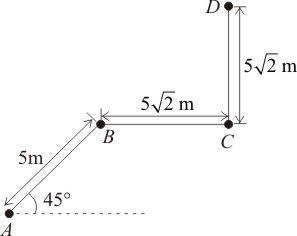
1. m
2. \(10\) m
3. m
4. \(15\) m
Which of the following four statements is false?
| 1. | A body can have zero velocity and still be accelerated. |
| 2. | A body can have a constant velocity and still have a varying speed. |
| 3. | A body can have a constant speed and still have a varying velocity. |
| 4. | The direction of the velocity of a body can change when its acceleration is constant. |


Two cars A and B are travelling in the same direction with velocities v1 and v2 . When the car A is at a distance d behind car B, the driver of the car A applied the brake producing uniform retardation a. There will be no collision when-
1.
2.
3.
4.
A particle moves a distance x in time t according to equation x = (t+5)-1. The acceleration of the particle is proportional to:
| 1. | (velocity)3/2 | 2. | (distance)2 |
| 3. | (distance)-2 | 4. | (velocity)2/3 |
The position x of a particle moving along the x-axis varies with time t as x = , where x is in meters and t is in seconds. The particle reverses its direction of motion at:
1. x = 40 m
2. x = 10 m
3. x = 20 m
4. x = 30 m
A car moves from \(\mathrm{X}\) to \(\mathrm{Y}\) with a uniform speed \(\mathrm{v_u}\) and returns to \(\mathrm{X}\) with a uniform speed \(\mathrm{v_d}.\) The average speed for this round trip is:
1.
2.
3.
4.
A particle of unit mass undergoes one-dimensional motion such that its velocity varies according to where and \(\mathrm{n}\) are constants and \(\mathrm{x}\) is the position of the particle. The acceleration of the particle as a function of \(\mathrm{x}\) is given by:
1.
2.
3.
4.
If the velocity of a particle is \(v=At+Bt^{2},\) where \(A\) and \(B\) are constants, then the distance travelled by it between \(1~\text{s}\) and \(2~\text{s}\) is:
| 1. | \(3A+7B\) | 2. | \(\frac{3}{2}A+\frac{7}{3}B\) |
| 3. | \(\frac{A}{2}+\frac{B}{3}\) | 4. | \(\frac{3A}{2}+4B\) |
A particle moves along a straight line and its position as a function of time is given by\(x= t^3-3t^2+3t+3\)
| 1. | stops at \(t=1~\text{s}\) and reverses its direction of motion |
| 2. | stops at \(t= 1~\text{s}\) and continues further without a change of direction |
| 3. | stops at \(t=2~\text{s}\) and reverses its direction of motion |
| 4. | stops at \(t=2~\text{s}\) and continues further without a change of direction |

© 2024 GoodEd Technologies Pvt. Ltd.