Select Chapter Topics:

 Q. No.
The electrode potential for Mg electrode varies according to the equation
\(E_{Mg^{2+}/Mg}\ = \ E_{Mg^{2+}/Mg}^{o} \ - \ \frac{0.059}{2}log\frac{1}{[Mg^{2+}]}\)
The graph of EMg2+ / Mg vs log [Mg2+] among the following is:
1.
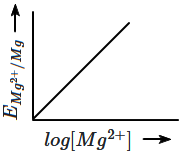
2.

3.

4.

\(E_{Mg^{2+}/Mg}\ = \ E_{Mg^{2+}/Mg}^{o} \ - \ \frac{0.059}{2}log\frac{1}{[Mg^{2+}]}\)
The graph of EMg2+ / Mg vs log [Mg2+] among the following is:


Subtopic: Nernst Equation |
60%
From NCERT
To view explanation, please take trial in the course.
NEET 2023 - Target Batch - Aryan Raj Singh
Hints
To view explanation, please take trial in the course.
NEET 2023 - Target Batch - Aryan Raj Singh

Match the terms given in Column I with the units given in Column II.
|
Column I |
Column II |
|
A. B. Ecell C. D. G* |
1. S cm-1 2. m-1 3. S cm2 mol-1 4. V |
Codes
| Options: | A | B | C | D |
| 1. | 3 | 4 | 1 | 2 |
| 2. | 1 | 2 | 3 | 5 |
| 3. | 5 | 4 | 3 | 2 |
| 4. | 4 | 5 | 3 | 2 |
Subtopic: Conductance & Conductivity |
90%
From NCERT
To view explanation, please take trial in the course.
NEET 2023 - Target Batch - Aryan Raj Singh
Hints
To view explanation, please take trial in the course.
NEET 2023 - Target Batch - Aryan Raj Singh
Match the items of Column I and Column II.
|
Column I |
Column II |
|
A. B. C. D. Q |
1. I x t 2. 3. 4. |
Codes
| Options: | A | B | C | D |
| 1. | 2 | 3 | 4 | 1 |
| 2. | 1 | 2 | 3 | 5 |
| 3. | 5 | 4 | 3 | 2 |
| 4. | 4 | 3 | 2 | 1 |
Subtopic: Conductance & Conductivity |
92%
From NCERT
To view explanation, please take trial in the course.
NEET 2023 - Target Batch - Aryan Raj Singh
Hints
To view explanation, please take trial in the course.
NEET 2023 - Target Batch - Aryan Raj Singh


Match the items of Column I and Column II on the basis of data given below
| Column I | Column II | ||
| A | F2 | 1. | Metal is the strongest reducing agent |
| B | Li | 2. | Metal ion which is the weakest oxidising agent |
| C | Au3+ | 3. | Non-metal which is the best oxidising agent |
| D | Br- | 4. | Unreactive metal |
| E | Au | 5 | Anion that can be oxidised by Au3+ |
| F | Li+ | 6 | Anion which is the weakest reducing agent |
| G | F- | 7 | Metal ion which is an oxidising agent |
| Options: | A | B | C | D | E | F | G |
| 1. | 3 | 1 | 7 | 5 | 4 | 2 | 6 |
| 2. | 1 | 2 | 3 | 5 | 7 | 4 | 6 |
| 3. | 5 | 4 | 3 | 2 | 6 | 5 | 1 |
| 4. | 4 | 5 | 3 | 2 | 1 | 6 | 7 |
Subtopic: Electrochemical Series | Electrode & Electrode Potential |
80%
From NCERT
To view explanation, please take trial in the course.
NEET 2023 - Target Batch - Aryan Raj Singh
Hints
To view explanation, please take trial in the course.
NEET 2023 - Target Batch - Aryan Raj Singh
Given below are two statements:
| Assertion (A): | Cu is less reactive than hydrogen. |
| Reason (R): | E°Cu2+/ Cu is negative. |
| 1. | Both (A) and (R) are true and (R) is the correct explanation of (A). |
| 2. | Both (A) and (R) are true but (R) is not the correct explanation of (A). |
| 3. | (A) is true but (R) is false. |
| 4. | (A) is false but (R) is true. |
Subtopic: Electrochemical Series |
68%
From NCERT
To view explanation, please take trial in the course.
NEET 2023 - Target Batch - Aryan Raj Singh
Hints
To view explanation, please take trial in the course.
NEET 2023 - Target Batch - Aryan Raj Singh
Given below are two statements:
| Assertion (A): | Ecell should have a positive value for the cell to function. |
| Reason (R): | Ecathode < Eanode |
| 1. | Both (A) and (R) are true and (R) is the correct explanation of (A). |
| 2. | Both (A) and (R) are true but (R) is not the correct explanation of (A). |
| 3. | (A) is true but (R) is false. |
| 4. | (A) is false but (R) is true. |
Subtopic: Relation between Emf, G, Kc & pH |
67%
From NCERT
To view explanation, please take trial in the course.
NEET 2023 - Target Batch - Aryan Raj Singh
Hints
To view explanation, please take trial in the course.
NEET 2023 - Target Batch - Aryan Raj Singh
Given below are two statements:
| Assertion (A): | Conductivity of all electrolytes decreases on dilution. |
| Reason (R): | On dilution number of ions per unit volume decreases. |
| 1. | Both (A) and (R) are true and (R) is the correct explanation of (A). |
| 2. | Both (A) and (R) are true but (R) is not the correct explanation of (A). |
| 3. | (A) is true but (R) is false. |
| 4. | (A) is false but (R) is true. |
Subtopic: Conductance & Conductivity |
77%
From NCERT
To view explanation, please take trial in the course.
NEET 2023 - Target Batch - Aryan Raj Singh
Hints
To view explanation, please take trial in the course.
NEET 2023 - Target Batch - Aryan Raj Singh
| Assertion (A): | Λm for weak electrolytes shows a sharp increase when the electrolytic solution is diluted. |
| Reason (R): | For weak electrolytes degree of dissociation increases with a dilution of the solution. |
| 1. | Both (A) and (R) are True and (R) is the correct explanation of (A). |
| 2. | Both (A) and (R) are True but (R) is not the correct explanation of (A). |
| 3. | (A) is True but (R) is False. |
| 4. | Both (A) and (R) are False. |
Subtopic: Kohlrausch Law & Cell Constant |
80%
From NCERT
To view explanation, please take trial in the course.
NEET 2023 - Target Batch - Aryan Raj Singh
Hints
To view explanation, please take trial in the course.
NEET 2023 - Target Batch - Aryan Raj Singh
| Assertion (A): | Mercury cell does not give steady potential. |
| Reason (R): | In the cell reaction, ions are not involved in the solution. |
| 1. | Both (A) and (R) are true and (R) is the correct explanation of (A). |
| 2. | Both (A) and (R) are true but (R) is not the correct explanation of (A). |
| 3. | (A) is true but (R) is false. |
| 4. | (A) is false but (R) is true. |
Subtopic: Batteries & Salt Bridge |
59%
From NCERT
To view explanation, please take trial in the course.
NEET 2023 - Target Batch - Aryan Raj Singh
Hints
To view explanation, please take trial in the course.
NEET 2023 - Target Batch - Aryan Raj Singh
Given below are two statements:
| Assertion (A): | Electrolysis of NaCl solution gives chlorine at anode instead of O2 . |
| Reason (R): | Formation of oxygen at anode requires overvoltage. |
| 1. | Both (A) and (R) are true and (R) is the correct explanation of (A). |
| 2. | Both (A) and (R) are true but (R) is not the correct explanation of (A). |
| 3. | (A) is true but (R) is false. |
| 4. | (A) is false but (R) is true. |
Subtopic: Electrolytic & Electrochemical Cell |
69%
From NCERT
To view explanation, please take trial in the course.
NEET 2023 - Target Batch - Aryan Raj Singh
Hints
To view explanation, please take trial in the course.
NEET 2023 - Target Batch - Aryan Raj Singh
Select Chapter Topics:

© 2024 GoodEd Technologies Pvt. Ltd.