
 Q. No.
Match the following:
Test/Method
Reagent
(i)
Lucas Test
(a)
(ii)
Dumas method
(b)
(iii)
Kjeldahl's method
(c)
(iv)
Hinsberg Test
(d)
(e)
1. (i)-(d). (ii)-(c), (iii)-(e), (iv)-(a)
2. (i)-(b), (ii)-(d), (iii)-(e), (iv)-(a)
3. (i)-(d), (ii)-(c), (iii)-(b), (iv)-(e)
4. (i)-(b), (ii)-(a), (iii)-(c), (iv)-(d)


| Statement I: | A mixture of chloroform and aniline can be separated by simple distillation. |
| Statement II: | When separating aniline from a mixture of aniline and water by steam distillation aniline boils below its boiling point. |
The correct option is:
| 1. | Statement I is false but Statement II is true. |
| 2. | Both Statement I and Statement II are false. |
| 3. | Statement I is true but Statement II is false. |
| 4. | Both Statement I and Statement II are true. |
| Column I (Molecules) |
COLUMN II (Nature of molecule) |
| a. (CH3)3N: | i. Electrophile |
| b. \(H_3C-\overset{+}{C}=O\) | ii. Nucleophile |
| c. \(\overset{+}{N}O_2\) | |
| d. H2N:- |
| a | b | c | d | |
| 1. | ii | ii | ii | i |
| 2. | ii | ii | ii | ii |
| 3. | ii | i | i | ii |
| 4. | ii | i | ii | ii |


Match the items in column I with the items in column II.
| Column I | Column II |
| a. o-Ethylanisole | i.  |
| b. p-Nitroaniline | ii.  |
| c. 2,3 - Dibromo -1 - phenylpentane | iii.  |
| d. 4-Ethyl-1-fluoro-2-nitrobenzene | iv.  |
The correct option is-
1. a=ii; b=iv; c=i; d=iii
2. a=ii; b=i; c=iv; d=iii
3. a=iv; b=i; c=ii; d=iii
4. a=ii; b=iii; c=iv; d=i
Match the structures given in column I with the corresponding IUPAC names given in column II and choose the correct option.
| Column I | Column II |
A.  |
i. Pent-4-en-2-ol |
B.  |
ii. Cyclohex-2-en-1-ol |
C.  |
iii. 6-Hydroxy-heptanal |
D.  |
iv. 2-Chlorohexane |
E.  |
v. 3- Nitrocyclohexene |
1. A=iii; B= iv; C=v; D=ii; E=i
2. A=iii; B= iv; C=ii; D=v; E=i
3. A=iv; B= i; C=v; D=iii; E=ii
4. A=iv; B= i; C=ii; D=v; E=iii
Match the item in column I with the column II
| Column I | Column II | ||
| a. | 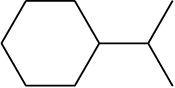 |
i. |  |
| b. |  |
ii. |  |
| c. | 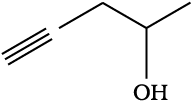 |
iii. |  |
| d. | 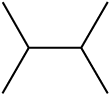 |
iv. |  |
1. a-ii; b-iv; c-i; d-iii
2. a-iii; b-iv; c-ii; d-i
3. a-iv; b-iii; c-i; d-ii
4. a-i; b-iv; c-ii; d-iii
Match the items in column I with the column II.
| Column I | Column II | ||
| a. |  |
i. | 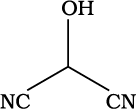 |
| b. |  |
ii. | 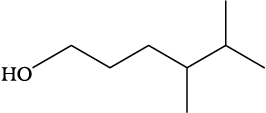 |
| c. |  |
iii. |  |
| d. |  |
iv. |  |
1. a-iv; b-iii; c-i; d-ii
2. a-iii; b-iv; c-i; d-ii
3. a-ii; b-i; c-iv; d-iii
4. a-i; b-iii; c-iv; d-ii
Correct statement among the following is -
| a. | The hybridization of carbon in H2C=O is sp2 and shape is trigonal planar. |
| b. | The hybridization of carbon in CH3F is sp3 and shape is tetrahedral. |
| c. | The hybridization of carbon in HC≡N is sp and shape is linear. |
| 1. | Only a and b statements are correct. |
| 2. | Only b and c statements are correct. |
| 3. | All statements are correct. |
| 4. | None of the statements are correct. |
a. HC≡CCH=CHCH3 contains 10 σ bonds and 3 π bonds.
b. CH2=C=CHCH3 contains 7 σ bonds and 2 π bonds.
Correct among the above mentioned statement is -
1. Only statement 'a' is true.
2. Only statement 'b' is true
3. Both statements are true
4. Both statements are false
Assertion : C6H14 and C5H12 both can show chain isomerism
Reason : C6H14 and C5H12 both form 3 chain isomers each, respectively
1. Both assertion and reason are true, and reason is the correct explanation of the assertion
2. Both assertion and reason are true, but reason is not correct explanation of the assertion
3. Assertion is true but reason is false
4. Both assertion and reason are false

© 2024 GoodEd Technologies Pvt. Ltd.