
 Q. No.
1.0 mol of a monoatomic ideal gas is expanded from state (1) to state (2) as shown in the graph below:

The work done for the expansion of gas from state (1) to state (2) at 298 K will be
1. 1617.6 J
2. -1617.6 J
3. 1717.6 J
4. -1717.6 J


| Column I | Column II | ||
| a. | No heat is absorbed by the system from the surroundings, but work (w) is done on the system. | i. | ∆U = q – w, closed system. |
| b. | No work is done on the system, but q amount of heat is taken out from the system and given to the surroundings. | ii. | ∆U = wad, a wall is adiabatic |
| c. | w amount of work is done by the system and q amount of heat is supplied to the system. | iii. | ∆U = –q, thermally conducting walls |
| 1. | a = i; b=ii; c=iii |
| 2. | a = ii; b=i; c=iii |
| 3. | a = ii; b=iii; c=i |
| 4. | a = iii; b=ii; c=i |
| i. | When liquid crystallizes into a solid, entropy increases. |
| ii. | When the temperature of a crystalline solid is raised from 0 K to 115 K then entropy increases. |
| iii. | 2 NaHCO3 (s) →Na2CO3 (s) +CO2(g)+H2O(g); Entropy increases. |
| iv. | H2(g)→2H(g) ; Entropy decreases. |


For one mole of an ideal gas, which of these statements must be true?
(I) U and H each depend only on temperature.
(II) Compressibility factor z is not equal to 1.
(III) CP, m – CV, m = R
(IV) dU = CVdT for any process.
1. (I), (III) and (IV)
2. (II), (III) and (IV)
3. (III) and (IV)
4. (I) and (III)
An enthalpy diagram for a particular reaction is given below:

The correct statement among the following is-
1. Reaction is spontaneous
2. Reaction is non-spontaneous
3. Cannot predict spontaneity of the reaction from the graph given above
4. None of the above
Consider the following diagram for a reaction

The nature of the reaction is-
| 1. | Exothermic | 2. | Endothermic |
| 3. | Reaction at equilibrium | 4. | None of the above |
Consider the following diagram for a reaction .
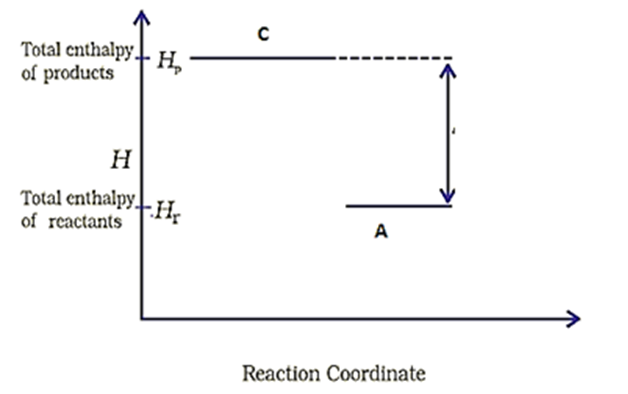
The nature of the reaction is-
1. Exothermic
2. Endothermic
3. Reaction at equilibrium
4. None of the above
Consider the following graph.

The work done shown by the above-mentioned graph is-
| 1. | Positive | 2. | Negative |
| 3. | Zero | 4. | Cannot be determined |
For the graph given below, it can be concluded that work done during the process shown will be-

| 1. | Zero | 2. | Negative |
| 3. | Positive | 4. | Cannot be determined |
The correct statements among the following are :
| a. | The enthalpy of two moles of ZnO is less than the total enthalpy of two moles of Zn and one mole of oxygen by 693.8 kJ |
| b. | The enthalpy of two moles of ZnO is more than the total enthalpy of two moles of Zn and one mole of oxygen by 693.8 kJ |
| c. | 693 . 8 kJ mol -1 energy is evolved in the reaction |
| d. | 693 . 8 kJ mol -1 energy is absorbed in the reaction |
1. (a, b)
2. (b, c)
3. (c, d)
4. (a, c)

© 2024 GoodEd Technologies Pvt. Ltd.