
 Q. No.
A, B, C, D in the following diagram respectively are:-

(1) Hilum, funicle, inner integument, micropyle
(2) Hilum, funicle, outer integument, micropyle
(3) Funicle, outer integument, nucellus, chalazal pole
(4) Funicle, outer integument, nucellus, micropylar end


Microsporangium is generally surrounded by 4 wall layers. Which of the following 3 wall layers perform the function of protection and help in the dehiscence of anther to release the pollen?
(1) Epidermis, tapetum, endothecium
(2) Epidermis, aril, endothecium
(3) Epidermis, endodermis, mesocarp
(4) Epidermis, middle layer and endothecium
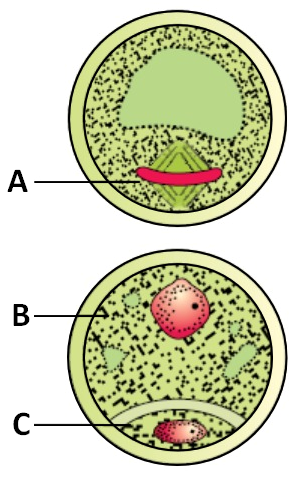
The above diagram shows some stages in microgametogenesis. Identify A, Band C:
| A | B | C | |
| 1. | Symmetric spindle | Generative cell | Vegetative cell |
| 2. | Symmetric spindle | Vegetative cell | Generative cell |
| 3. | Asymmetric spindle | Vegetative cell | Generative cell |
| 4. | Asymmetric spindle | Generative cell | Vegetative cell |


The viability of pollen grains depends upon:
(1) Prevailing temperature
(2) Prevailing humidity
(3) Genetic potentiality of the concerned species
(4) All of the above
Which of the following has the least pollen viability?
(1) Cereals like wheat and rice
(2) Members of Rosaceae
(3) Members of Leguminoseae
(4) Members of Solanaceae
Match the Column-I with Column-II:
Column-I Column-II
A. Funicle I. Mass of cells within ovule with more food
B. Hilum II. Basal part of ovule
C. Integument III. One or 2 protective layers of ovule
D. Chalaza IV. Region where body of ovule fuses with funicle
E. Nucellus V. Stalk of ovule
(1) A - I, B - II, C - III, D - IV, E - V
(2) A - V, B - IV, C - III, D - II, E - I
(3) A - IV, B - II, C - I, D - III, E - V
(4) A - I, B - III, C - V, D - II, E - IV



Identify A, B, C and D structures shown in above diagram of female gametophyte:
| A | B | C | D | |
| 1. | Synergid | Polar nuclei | Central cell | Antipodal cells |
| 2. | Antipodal cells | Polar nuclei | Central cell | Synergids |
| 3. | Antipodal cells | Polar nuclei | Megaspore mother cell | Synergids |
| 4. | Filiform apparatus | Polar nuclei | Central cell | Antipodal cell |
Go through the following statements:
Flowers are bisexual and homogamous maturing anther and stigma of a flower at the same time.
Mechanical devices bringing anthers and stigma close together in a bisexual chasmogamous flower.
Cleistogamy (bisexual flowers remain closed)
Anther and stigma of an intersexual flower mature in bud condition.
The above contrivances favour:
(1) Allogamy
(2) Autogamy
(3) Xenogamy
(4) Cross pollination
Find out the correct option:
(1) Among animals, insects, particularly bees are the dominant biotic pollinating agents
(2) Often flowers of animal- pollinated plants are specially adapted for particular species of animals
(3) In some species floral rewards like edible nectar, pollen grains, shelter for egg laying are given to pollinating animals
(4) All the above are correct


Self-incompatibility:
I. Is a device to prevent inbreeding
II. Provides a biochemical block to self-fertilization.
III. Ensures cross-fertilization.
IV. Is governed by pollen-pistil interaction
V. Is governed by series of multiple alleles.
VI. Prevents self pollen (from the same flower or other flowers of the same plant) from fertilizing the ovules inhibiting pollen germination or pollen tube growth in the pistil.
(1) All are correct
(2) All are wrong
(3) Only I, II, III are correct
(4) IV and V are wrong

© 2025 GoodEd Technologies Pvt. Ltd.