
 Q. No.
Select incorrect statement with respect to the following group
of organisms and their characteristics
1. Chrysophyte – Includes diatoms and
desmids, Planktonic
organism.
2. Dinoflagellate – Mostly marine and
photosynthetic, cell wall has
stiff cellulosic plate
on outer surface.
3. Euglenoids – Majority of them are fresh
water, cell wall is absent.
4. Slime mould – Saprophytic motile spores
with true walls
of organisms and their characteristics
desmids, Planktonic
organism.
2. Dinoflagellate – Mostly marine and
photosynthetic, cell wall has
stiff cellulosic plate
on outer surface.
3. Euglenoids – Majority of them are fresh
water, cell wall is absent.
4. Slime mould – Saprophytic motile spores
with true walls


According to R.H. Whittaker Chlamydomonas and
Chlorella will be kept under
1. Monera
2. Protista
3. Plantae
4. Both 2 & 3
Morels and Agaricus have edible fruiting bodies and
belong to their respective class as.
1. Ascomycetes and Basidiomycetes.
2. Basidiomycetes and Ascomycetes.
3. Ascomycetes and Phycomycetes.
4. Basidiomycetes only


An artificial group within fungi is
1. Ascomycetes
2. Deuteromycetes
3. Basidiomycetes
4. Phycomycetes
After karyogamy followed by meiosis, spores are produced exogenously in
1. Neurospora
2. Saccharomyces
3. Agaricus
4. Alternaria
Heterotrophic, eukaryotic, multicellular organisms lacking a cell wall are included in the kingdom.
1. Protista
2. Fungi
3. Plantae
4. Animalia


Select the correct statement:
| 1. | Cholera, typhoid, tetanus are well-known diseases caused by viruses. |
| 2. | Dinoflagellates, euglenoids and slime moulds are placed under kingdom Monera |
| 3. | Members of kingdom Protista are primarily aquatic |
| 4. | Dinoflagellates are the chief 'producers' in the oceans |
In 1971, T.O. Diener discovered a new infectious agent that was smaller than viruses –
| I. | It causes potato spindle tuber disease. |
| II. | It is free RNA. |
| III. | Molecular wt. of RNA is low. |
The above statements are assigned to –
1. Viruses
2. Viroids
3. Virulent
4. Mycoplasma
Which of the following is correct about class Deuteromycetes?
1. Some members are saprophytes or parasites.
2. A large number of members are decomposers of litter and help in mineral cycling.
3. Alternaria, Colletotrichum and Trichoderma are deuteromycetes.
4. All


Identify the blanks in the following figures –
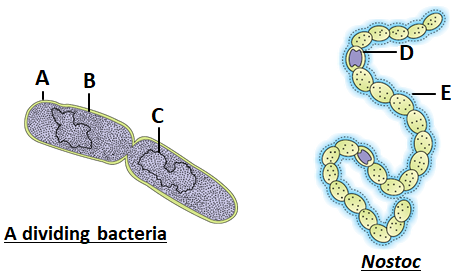
| 1. | A – Cell wall, B – Cell membrane, C – Heterocyst, D – DNA, E – mucilaginous sheath. |
| 2. | A – Cell wall, B – Cell membrane, C – DNA, D – Heterocyst, E – Mucilaginous sheath. |
| 3. | A – Mucilaginous sheath, B – Cell membrane, C – DNA, D – Heterocyst, E – Cell wall. |
| 4. | A – Cell membrane, D – Cell wall, C – DNA, D – Heterocyst, E – Mucilaginous sheath. |

© 2026 GoodEd Technologies Pvt. Ltd.