- 1(current)
 Q. No.
Match List-I with List-II:
Choose the correct answer from the options given below:
| List-I | List-II | ||
| A. | P wave | I. | Heart muscles are electrically silent |
| B. | QRS complex | II. | Depolarization of ventricles. |
| C. | T wave | III. | Depolarization of atria. |
| D. | T-P gap | IV. | Repolarization of ventricles. |
| 1. | A-III, B-II, C-IV, D-I |
| 2. | A-II, B-III, C-I, D-IV |
| 3. | A-IV, B-II, C-I, D-III |
| 4. | A-I, B-III, C-IV, D-II |


Subtopic: ECG & Coronary Artery Disease | Circulatory Pathways |
87%
Level 1: 80%+
NEET - 2024
Hints

In standard ECG diagram, the P-wave represents:
1. Depolarisation of the atria
2. Repolarisation of the ventricle
3. Depolarisation of the ventricle
4. End of systole
1. Depolarisation of the atria
2. Repolarisation of the ventricle
3. Depolarisation of the ventricle
4. End of systole
Subtopic: ECG & Coronary Artery Disease |
94%
Level 1: 80%+
NEET - 2024
Hints
Match List-I with List-II
Choose the correct answer from the options given below:
| List-I | List-II | ||
| A. | P-wave | I. | Beginning of systole |
| B. | Q-wave | II. | Repolarisation of ventricles |
| C. | QRS complex | III. | Depolarisation of atria |
| D. | T-wave | IV. | Depolarisation of ventricles |
Choose the correct answer from the options given below:
| Options: | A | B | C | D |
| 1. | I | II | III | IV |
| 2. | III | I | IV | II |
| 3. | IV | III | II | I |
| 4. | II | IV | I | II |
Subtopic: ECG & Coronary Artery Disease |
89%
Level 1: 80%+
NEET - 2023
Hints


Match List - I with List - II
Choose the correct answer from the options given below:
| List-I (ECG) | List-II (Electrical activity of heart) | ||
| (A) | P-wave | (I) | Depolarisation of ventricles |
| (B) | QRS complex | (II) | End of systole |
| (C) | T wave | (III) | Depolarisation of atria |
| (D) | End of T wave | (IV) | Repolarisation of ventricles |
Choose the correct answer from the options given below:
| Options: | (A) | (B) | (C) | (D) |
| 1. | IV | I | III | II |
| 2. | I | IV | III | II |
| 3. | IV | III | I | II |
| 4. | III | I | IV | II |
Subtopic: ECG & Coronary Artery Disease |
92%
Level 1: 80%+
NEET - 2023
Hints
The QRS complex in a standard ECG represents:
| 1. | Depolarisation of auricles | 2. | Depolarisation of ventricles |
| 3. | Repolarisation of ventricles | 4. | Repolarisation of auricles |
Subtopic: ECG & Coronary Artery Disease |
91%
Level 1: 80%+
NEET - 2020
Hints
Match the Column I and Column II:
| Column I | Column II | ||
| (a) | P-waves | (i) | Depolarisation of ventricles |
| (b) | QRS complex | (ii) | Repolarisation of ventricles |
| (c) | T-wave | (iii) | Coronary ischemia |
| (d) | Reduction in the size of T-wave | (iv) | Depolarisation of atria |
| (v) | Repolarisation of atria |
| Options: | (a) | (b) | (c) | (d) |
| 1. | (ii) | (iii) | (v) | (iv) |
| 2. | (iv) | (i) | (ii) | (iii) |
| 3. | (iv) | (i) | (ii) | (v) |
| 4. | (ii) | (i) | (v) | (iii) |
Subtopic: ECG & Coronary Artery Disease |
75%
Level 2: 60%+
NEET - 2019
Hints


The diagram given here is the standard ECG of a normal person, The P - wave represents the:

1. Initiation of the ventricular contraction
2. Beginning of the systole
3. End of systole
4. Contraction of both the atria
Subtopic: ECG & Coronary Artery Disease |
77%
Level 2: 60%+
AIPMT - 2013
Hints
Given below is the ECG of a normal human. Which one of its components is correctly interpreted below?
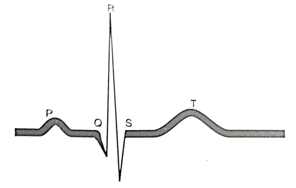
| 1. | Peak P-Initiation of left atrial contraction only |
| 2. | Complex QRS-One complete pulse |
| 3. | Peak T-Initiation of total cardiac contraction |
| 4. | Peak P and Peak R together-systolic and diastolic blood pressures |
Subtopic: ECG & Coronary Artery Disease |
71%
Level 2: 60%+
AIPMT - 2011
Hints
In a standard ECG, which one of the following alphabets is the correct representation of the respective activity of the human heart?
1. R-repolarisation of ventricles
2. S-start of systole
3. T-end of diastole
4. P-depolarisation of the atria
Subtopic: ECG & Coronary Artery Disease |
83%
Level 1: 80%+
AIPMT - 2009
Hints


- 1(current)
Q. No.
© 2026 GoodEd Technologies Pvt. Ltd.