Select Chapter Topics:

 Q. No.
Select the correct option based on the statements given below:
Assertion (A):
Picric acid is more acidic than formic acid.
Reason (R):
Picric acid has three -COOH groups whereas formic acid has one -COOH group.
1.
Both (A) and (R) are True and (R) is the correct explanation of (A).
2.
Both (A) and (R) are True but (R) is not the correct explanation of (A).
3.
(A) is True but (R) is False.
4.
Both (A) and (R) are False.

Subtopic: Phenols: Preparation & Properties |
73%
Level 2: 60%+
Hints

Select the correct option based on statements below:
| Assertion (A): | -OH, -OCH3 groups are o, p-directing. |
| Reason (R): | Ring is activated by the resonance effect of -OH, -OCH3 groups. |
| 1. | Both (A) and (R) are true and (R) is the correct explanation of (A). |
| 2. | Both (A) and (R) are true but (R) is not the correct explanation of (A). |
| 3. | (A) is true but (R) is false. |
| 4. | Both (A) and (R) are false. |
Subtopic: Electrophilic Substitution Reactions, Uses of Phenols |
80%
Level 1: 80%+
Hints
Select the correct option based on statements below:
| Assertion (A): | Phenol does not react with NaHCO3 but 2,4,6-trinitrophenol does react with the evolution of CO2 |
| Reason (R): | 2,4,6-trinitrophenol is a stronger acid than carbolic acid. |
| 1. | Both (A) and (R) are true, and (R) is the correct explanation of (A). |
| 2. | Both (A) and (R) are true, but (R) is not the correct explanation of (A). |
| 3. | (A) is True, but (R) is False. |
| 4. | (A) is False, but (R) is True. |
Subtopic: Phenols: Preparation & Properties |
Level 3: 35%-60%
Hints


Select the correct option based on statements below:
| Assertion (A): | The solubility of alcohols in water decreases with an increase in the number of carbon atoms. |
| Reason (R): | The non-polar alkyl group or the hydrophobic portion supports the solubility of alcohol. |
| 1. | Both (A) and (R) are True and (R) is the correct explanation of (A). |
| 2. | Both (A) and (R) are True but (R) is not the correct explanation of (A). |
| 3. | (A) is True but (R) is False. |
| 4. | Both (A) and (R) are False. |
Subtopic: Alcohols: Preparation & Properties |
68%
Level 2: 60%+
Hints
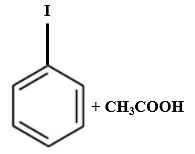
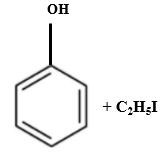
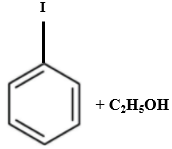
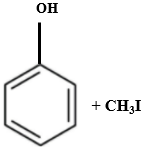
Subtopic: Ethers: Preparation & Properties, Uses |
83%
Level 1: 80%+
NEET - 2020
Hints
Links
A reaction between acetone and methylmagnesium chloride followed by hydrolysis will give:
| 1. | sec-Butyl alcohol | 2. | tert-Butyl alcohol |
| 3. | iso-Butyl alcohol | 4. | iso-Propyl alcohol |
Subtopic: Alcohols: Preparation & Properties |
73%
Level 2: 60%+
NEET - 2020
Hints
Links


Which of the following reagents gives the highest yield of cyclohexene when reacted with cyclohexanol?
1.
2. conc.HCl
3. conc.HBr
4. All of the above
Subtopic: Alcohols: Preparation & Properties |
80%
Level 1: 80%+
Hints
The product that forms when sodium phenoxide is heated with ethyl iodide is:
1. Phenetole
2. Ethyl phenyl alcohol
3. Phenol
4. None of the above
Subtopic: Ethers: Preparation & Properties, Uses |
63%
Level 2: 60%+
Hints
Links
Which of the following reagents can be used to convert ethyl chloride into diethyl ether?
| 1. | Wurtz reaction | 2. | Grignard reaction |
| 3. | Perkin's reaction | 4. | Williamson's synthesis |
Subtopic: Ethers: Preparation & Properties, Uses |
89%
Level 1: 80%+
Hints
Links


Subtopic: Mechanism of Dehydration, Methanol & Ethanol |
60%
Level 2: 60%+
Hints
Select Chapter Topics:

© 2026 GoodEd Technologies Pvt. Ltd.