 Q. No.
Which of the following graph represents the variation of capillary rise of liquid with radius of the capillary tube?
| 1. | 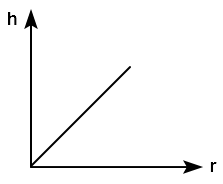 |
2. |  |
| 3. |  |
4. |  |


If the surface tension of water is 0.06 , then the capillary rise in a tube of diameter 1 mm is: \((\theta = 0^{\circ})\)
1. 1.22 cm
2. 2.44 cm
3. 3.12 cm
4. 3.86 cm
The wettability of a surface by a liquid depends primarily on:
| 1. | viscosity |
| 2. | surface tension |
| 3. | density |
| 4. | angle of contact between the surface and the liquid |


Water rises to height h in a capillary tube. If the length of the capillary tube above the surface of water is made less than h, then:
| 1. | water does not rise at all. |
| 2. | water rises up to the top of the capillary tube, then starts overflowing like a fountain. |
| 3. | water rises up to the top of the capillary tube and stays there without overflowing. |
| 4. | water rises up to a point a little below the top and stays there. |
A liquid filled in a container has plane meniscus. If is the angle of contact, then:
1. = \(0^\circ\)
2. = \(90^\circ\)
3. < \(90^\circ\)
4. = \(180^\circ\)
If a capillary tube is partially dipped vertically into liquid and the levels of the liquid inside and outside are same, then the angle of contact is:
| 1. | 90° | 2. | 30° |
| 3. | 45° | 4. | 0° |
Water rises to a height \(\mathrm{h}\) in a capillary at the surface of earth. On the surface of the moon, the height of water column in the same capillary will be:
1. \(\mathrm{6h}\)
2.
3. \(\mathrm{h}\)
4. \(\mathrm{zero}\)
| Assertion (A): | When height of a tube is less than liquid rise in the capillary tube, the liquid does not overflow. |
| Reason (R): | Product of radius of meniscus and height of liquid in capillary tube always remains constant. |
| 1. | Both (A) and (R) are true and (R) is the correct explanation of (A). |
| 2. | Both (A) and (R) are true but (R) is not the correct explanation of (A). |
| 3. | (A) is true but (R) is false. |
| 4. | (A) is false but (R) is true. |
If the capillary experiment is performed in a vacuum, then for a liquid the capillary will:
1. rise
2. remain the same
3. fall
4. rise to the top
Three liquids of densities (with ), having the same value of surface tension T, rise to the same height in three identical capillaries. The angles of contact obey:
| 1. | \(\frac{\pi}{2}>\theta_1>\theta_2>\theta_3 \geq 0\) |
| 2. | \(0 \leq \theta_1<\theta_2<\theta_3<\frac{\pi}{2}\) |
| 3. | \(\frac{\pi}{2}<\theta_1<\theta_2<\theta_3<\pi\) |
| 4. | \(\pi>\theta_1>\theta_2>\theta_3>\frac{\pi}{2}\) |

© 2024 GoodEd Technologies Pvt. Ltd.