
 Q. No.
The equivalent resistance between points \(A\) and \(B\) in the circuit shown in the figure is:

1.
\(6R\)
2.
\(4R\)
3.
\(2R\)
4.
\(R\)


In the circuit shown in the figure below, if the potential difference between \(B\) and \(D\) is zero, then value of the unknown resistance \(X\) is:
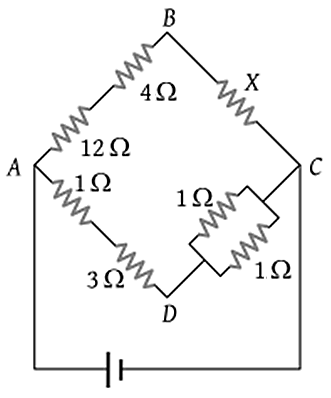
| 1. | \(4~\Omega\) | 2. | \(2~\Omega\) |
| 3. | \(3~\Omega\) | 4. | EMF of a cell is required to find the value of \(X\) |
The figure below shows a network of currents. The current \(i\) will be:

1. \(3~\text{A}\)
2. \(13~\text{A}\)
3. \(23~\text{A}\)
4. \(-3~\text{A}\)



Eels are able to generate current with biological cells called electroplaques. The electroplaques in an eel are arranged in \(100\) rows, each row stretching horizontally along the body of the fish containing \(5000\) electroplaques. The arrangement is suggestively shown below. Each electroplaques has an emf of \(0.15\) V and internal resistance of \(0.25~\Omega\).

The water surrounding the eel completes a circuit between the head and its tail. If the water surrounding it has a resistance of \(500~\Omega\), the current an eel can produce in water is about:
| 1. | \(1.5\) A | 2. | \(3.0\) A |
| 3. | \(15\) A | 4. | \(30\) A |
In the circuit shown in the figure below, the current supplied by the battery is:

1. \(2~\text A\)
2. \(1~\text A\)
3. \(0.5~\text A\)
4. \(0.4~\text A\)
| 1. | \(2~\Omega\) | 2 | \(1~\Omega\) |
| 3. | \(0.5~\Omega\) | 4. | zero |


Power consumed in the given circuit is \(P_1.\) On interchanging the position of \(3~\Omega\) and \(12~\Omega\) resistances, the new power consumption is \(P_2.\) The ratio of \(\dfrac{P_2}{P_1}\) is:
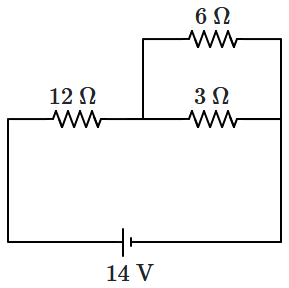
| 1. | \(2\) | 2. | \(\dfrac 12\) |
| 3. | \(\dfrac 35\) | 4. | \(\dfrac 25\) |
| 1. | \(10^{\circ}\text{C}\) | 2. | \(5^{\circ}\text{C}\) |
| 3. | \(20^{\circ}\text{C}\) | 4. | \(15^{\circ}\text{C}\) |
If the potential difference across ends of a metallic wire is doubled, the drift velocity of charge carriers will become:
1. double
2. half
3. four times
4. one-fourth


The resistance between terminals \(A\) and \(B\) is:

| 1. | \(5~\Omega\) | 2. | \(15~\Omega\) |
| 3. | \(10~\Omega\) | 4. | \(20~\Omega\) |

© 2026 GoodEd Technologies Pvt. Ltd.