Select Chapter Topics:

 Q. No.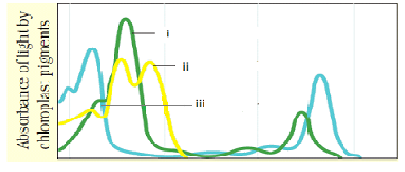
Subtopic: Photosynthetic Pigments |
73%
Level 2: 60%+
Hints

Subtopic: Pigments |
79%
Level 2: 60%+
Hints
Range of wavelength at which chlorophyll-a shows the maximum absorption in blue region:
| 1. | 400-450 nm | 2. | 450-500 nm |
| 3. | 650-700 nm | 4. | 500-600 nm. |


Subtopic: Pigments |
Level 3: 35%-60%
Hints


Which of the following is the chief pigment associated with photosynthesis?
1. chl-a
2. chl-b
3. chl- a and xanthophylls
4. chl-a and carotenoids
Subtopic: Pigments |
93%
Level 1: 80%+
Hints
Which regions of the visible spectrum are responsible for most of the photosynthesis?
| 1. | blue and yellow | 2. | blue and red |
| 3. | blue and green | 4. | green and red |
Subtopic: Photosynthetic Pigments |
92%
Level 1: 80%+
Hints
In photosystem-I, P700 refers to-
| 1. | chl-b |
| 2. | chl-a |
| 3. | number of pigment molecules |
| 4. | absorption peak of chl-a at 700nm. |
Subtopic: Light Reactions :1 | Light Reactions :2 | Light Reactions |
81%
Level 1: 80%+
Hints


Light harvesting complexes are made up of-
1. proteins
2. pigments
3. protein and pigments
4. proteins and lipids.
Subtopic: Light Reactions :1 | Light Reactions |
75%
Level 2: 60%+
Hints
In chloroplast the movement of electrons from PS-II to electron transport system is-
| 1. | uphill in terms of redox potential scale. |
| 2. | downhill in terms of redox potential scale. |
| 3. | from one cytochrome to another |
| 4. | None of the above. |
Subtopic: Light Reactions :2 | Light Reactions :3 | Light Reactions |
60%
Level 2: 60%+
Hints
Subtopic: Light Reactions :1 | Light Reactions :2 | Light Reactions |
69%
Level 2: 60%+
Hints


In the Z-scheme of light reaction, at how many positions an electron is excited by the light?
1. 1
2. 2
3. 3
4. 4
Subtopic: Light Reactions :1 | Light Reactions :2 | Light Reactions |
83%
Level 1: 80%+
Hints
Select Chapter Topics:

© 2026 GoodEd Technologies Pvt. Ltd.