- 1(current)
 Q. No.
Which of the following is a correct example of analogous structures that evolved due to convergent evolution?
| 1. | Wings of bats and wings of birds, as both evolved from a common ancestor. |
| 2. | Flippers of whales and fins of sharks, as both are adaptations for swimming but have different evolutionary origins. |
| 3. | Forelimbs of humans and forelimbs of lizards, as both have the same skeletal structure. |
| 4. | Legs of frogs and hindlimbs of rabbits, as both belong to vertebrates. |


Subtopic: Embryological Evidence of Evolution |
71%
Level 2: 60%+
Please attempt this question first.
Hints
Please attempt this question first.

Match Column-I with Column-II and choose the correct option
1. a(iii), b(ii), c(i)
2. a(iii), b(i), c(ii)
3. a(i), b(ii), c(iii)
4. a(ii), b(iii), c(i)
| Column-I | Column-II | ||
| a. | Vertebrate hearts | (i) | Vestigial organs |
| b. | Eyes of the Octopus and of mammals | (ii) | Homologous organs |
| c. | Auricular muscles and 3rd molar teeth | (iii) | Analogous organs |
1. a(iii), b(ii), c(i)
2. a(iii), b(i), c(ii)
3. a(i), b(ii), c(iii)
4. a(ii), b(iii), c(i)
Subtopic: Embryological Evidence of Evolution |
89%
Level 1: 80%+
Hints
Karl Ernst von Baer:
| 1. | conducted a control experiment to disprove spontaneous generation |
| 2. | proposed the concept of pangenesis as the physical basis of heredity |
| 3. | disapproved the proposal of Ernst Haeckel [Biogenetic law] |
| 4. | was one of the rediscoverers of Mendel’s laws |
Subtopic: Embryological Evidence of Evolution |
89%
Level 1: 80%+
Please attempt this question first.
Hints
Please attempt this question first.


How does homology provide evidence for divergent evolution?
| 1. | Homologous structures indicate that different species evolved from a common ancestor but adapted to different environments over time. |
| 2. | Homologous organs perform the same function in different organisms, showing that all life forms evolved in a similar manner. |
| 3. | Homology refers to similar structures in unrelated species, proving that all organisms evolved independently. |
| 4. | Homologous structures arise due to similar environmental pressures, leading to organisms acquiring identical adaptations. |
Subtopic: Embryological Evidence of Evolution |
87%
Level 1: 80%+
Please attempt this question first.
Hints
Please attempt this question first.
When observed during their early stages of development, the embryos of reptiles, birds, and mammals look very similar. What can be said regarding reptiles, birds, and mammals based on this observation?
1. They have a common ancestor
2. They live in the same types of environments
3. They have undergone parallel evolution
4. They are no longer undergoing evolution
1. They have a common ancestor
2. They live in the same types of environments
3. They have undergone parallel evolution
4. They are no longer undergoing evolution
Subtopic: Embryological Evidence of Evolution |
86%
Level 1: 80%+
Please attempt this question first.
Hints
Please attempt this question first.
Below diagram represent :-
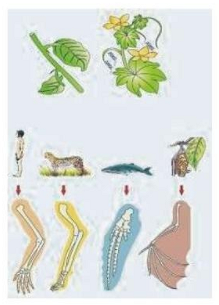
1. Analogous organ
2. Convergent evolution
3. Adaptive radiation
4 Homologous organ
Subtopic: Embryological Evidence of Evolution |
88%
Level 1: 80%+
Please attempt this question first.
Hints
Please attempt this question first.


Embryological support for evolution was proposed by:
1. Ernst Mayr
2. Ernst Haeckel
3. Hugo de Vries
4. Kary Mullis
Subtopic: Embryological Evidence of Evolution |
83%
Level 1: 80%+
Please attempt this question first.
Hints
Please attempt this question first.
Embryological support for evolution is exemplified by
| 1. | Similarities in certain genes and proteins of chimpanzees and humans |
| 2. | Presence of gill slits in embryos of vertebrates |
| 3. | Similarity in the skull of baby chimpanzee and that of adult human skull |
| 4. | Darwin's finches in Galapagos islands |
Subtopic: Embryological Evidence of Evolution |
77%
Level 2: 60%+
Please attempt this question first.
Hints
Please attempt this question first.
- 1(current)
Q. No.
© 2026 GoodEd Technologies Pvt. Ltd.