- 1(current)
 Q. No.


To unlock all the explanations of this course, you need to be enrolled.
To unlock all the explanations of this course, you need to be enrolled.

| 1. |  |
2. |  |
| 3. |  |
4. |  |


To unlock all the explanations of this course, you need to be enrolled.
To unlock all the explanations of this course, you need to be enrolled.
An LED is constructed from a \(\mathrm{p\text{-}n}\) junction diode using \(\mathrm{GaAsP}.\) The energy gap is \(1.9~\text{eV}.\) The wavelength of the light emitted will be equal to:
1. \(10.4 \times 10^{-26}~ \text{m}\)
2. \(654~ \text{nm}\)
3. \(654~ \text{m}\)
4. \(654\times 10^{-11}~\text{m}\)
To unlock all the explanations of this course, you need to be enrolled.
To unlock all the explanations of this course, you need to be enrolled.


The zener breakdown will occur if:
| 1. | the impurity level is low. |
| 2. | the impurity level is high. |
| 3. | the impurity is less on the \(\mathrm{n\text-}\)side. |
| 4. | the impurity is less on the \(\mathrm{p\text-}\)side. |
To unlock all the explanations of this course, you need to be enrolled.
To unlock all the explanations of this course, you need to be enrolled.

1. \(36~\text{mW}\)
2. \(12~\text{mW}\)
3. \(144~\text{mW}\)
4. \(72~\text{mW}\)
To unlock all the explanations of this course, you need to be enrolled.
To unlock all the explanations of this course, you need to be enrolled.
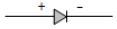
The LED:
| 1. | is reverse-biased. |
| 2. | is forward-biased. |
| 3. | can be made of \(\mathrm{GaAs}.\) |
| 4. | both (2) and (3) are correct. |
To unlock all the explanations of this course, you need to be enrolled.
To unlock all the explanations of this course, you need to be enrolled.


A Zener diode is used to obtain a constant voltage. If the applied voltage \(V\) changes, then:
(\( V\) is more than Zener voltage)

| 1. | \(i_{1}\) and \(i_{2}\) change. |
| 2. | \(i_{2}\) and \( V_{0}\) change and \(i_{3}\) remain constant. |
| 3. | \(i_{2}\) and \(V_{0}\) don't change while \(i_{3}\) changes. |
| 4. | \(i_{3}\) and \( V_{0}\) don't change while \(i_{2}\) changes. |
To unlock all the explanations of this course, you need to be enrolled.
To unlock all the explanations of this course, you need to be enrolled.
The given graph represents the \(V\text-I\) characteristics of a semiconductor device. Which of the following statements is correct?

| 1. | It is a \(V\text-I\) characteristic of a solar cell where the point \(A\) represents open-circuit voltage and the point \(B\) represents short-circuit current. |
| 2. | It is for a solar cell and points \(A\) and \(B\) represents open-circuit voltage and current respectively. |
| 3. | It is for a photodiode and points \(A\) and \(B\) represents open-circuit voltage and current respectively. |
| 4. | It is for an LED and points \(A\) and \(B\) represents open-circuit voltage and short-circuit current respectively. |
To unlock all the explanations of this course, you need to be enrolled.
To unlock all the explanations of this course, you need to be enrolled.
A Zener diode is shown in the following circuit diagram. When the source voltage fluctuates such that \(V>V_z\) then:
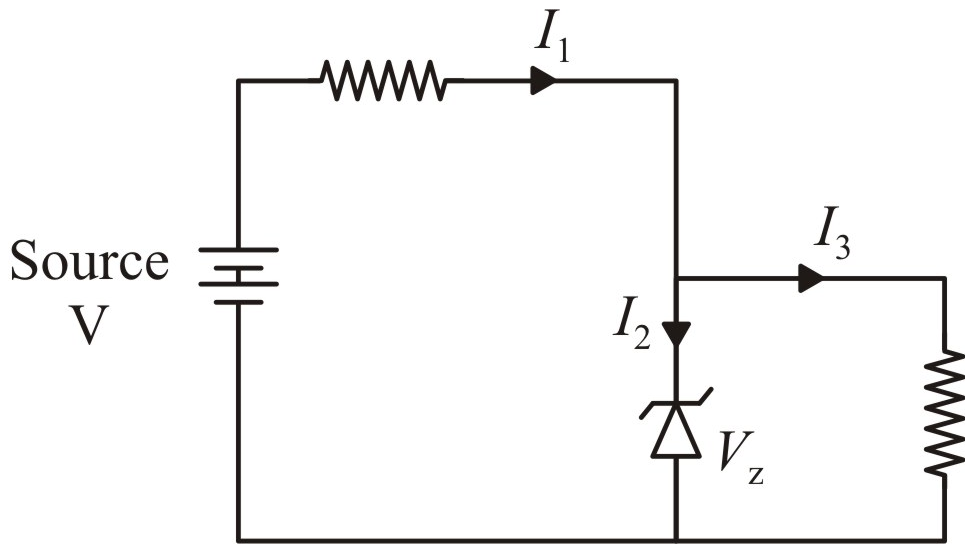
| 1. | all the current \(I_1, I_2~\text{and}~I_3\) change. |
| 2. | only \(I_1\) and \(I_2\) change and \(I_3\) remains constant. |
| 3. | only \(I_1\) and \(I_3\) change and \(I_2\) remains constant. |
| 4. | all the currents remain constant. |
To unlock all the explanations of this course, you need to be enrolled.
To unlock all the explanations of this course, you need to be enrolled.


- 1(current)
Q. No.
© 2026 GoodEd Technologies Pvt. Ltd.