
 Q. No.
Which one of the following options gives the correct categorization of six animals according to the type of nitrogenous wastes (A, B, C) they give out?
A
AMMONOTELIC
B
UREOTELIC
C
URICOTELIC
1.
Frog, Lizards
Aquatic Amphibia, Humans
Cockroach, Pigeon
2.
Aquatic Amphibia
Frog, humans
Pigeon, Lizards, Cockroach
3.
Aquatic Amphibia
Cockroach, Humans
Frog, Pigeon, Lizards
4.
Pigeon, Humans
Aquatic Amphibia, Lizards
Cockroach, Frog
AMMONOTELIC
UREOTELIC
URICOTELIC


Which one of the following characteristics is common in both humans and adult frogs?
1. Internal fertilization
2. Nucleated RBCs
3. Ureotelic mode of excretion
4. Four-chambered heart
Concentration of urine depends upon which organ:
1. Bowman's capsule
2. Length of Henle's loop
3. P.C.T.
4. Network of capillaries arising from glomerulus


Which pair is correct:
1. Sweat = temperature regulation
2. Saliva = sense of food taste
3. Sebum = sexual attraction
4. Humerus = Hind leg
If Henle's loop was absent from mammalian nephron, which of the following is to be expected:
| 1. | There will be no urine formation |
| 2. | There will be hardly any change in the quality and quantity of urine formed |
| 3. | The urine will be more concentrated |
| 4. | The urine will be more diluted |
Ketonuria : Ketone bodies in urine : : Uremia : _______.
Complete the analogy.
1. Elevated urea in circulating blood
2. Excretion of urea in urine
3. Deposits of uric acid in bones
4. Failure of urea production by liver
Substance ‘X’ which converts angiotensinogen to angiotensin I is secreted by
(1) Wall of heart
(2) Adrenal cortex
(3) Liver
(4) JG cells
Which of the parts labeled A–D are correctly identified with their functions?
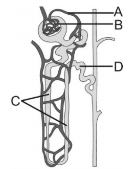
(1) A–Afferent arteriole – Carries the blood away from the glomerulus towards the renal vein
(2) B–Brush border – Create minute spaces epithelium for the filtration of blood into the Bowman’s capsule
(3) C–Henle’s loop – Maximum reabsorption of major substances from glomerular filtrate
(4) D–DCT – Secretion of K+ ions into the filtrate
Read the following statements
a. Glucose is partially absorbed in the PCT.
b. ADH helps in diluting the urine by acting on DCT and collecting ducts
c. In cortical nephrons, vasa recta are absent or highly reduced.
d. In a healthy person, 180 litre glomerular filtrate is formed per day by the kidney.
Which statements are incorrect with respect to a healthy adult human?
(1) c and d only
(2) a and b only
(3) a and c only
(4) b and d only
Micturition does not involve
1. Relaxation of urethral sphincter
2. Contraction of urinary bladder
3. Stretching of transitional epithelium of urinary bladder
4. Contraction of ureters

© 2024 GoodEd Technologies Pvt. Ltd.