
Alcohols are comparatively more soluble in water than hydrocarbons of comparable molecular masses because:
1.
Alcohols form van der waal bonds with water while hydrocarbons do not
2.
Alcohols form covalent bonds with water while hydrocarbons do not
3.
Alcohols form ionic bonds with water while hydrocarbons do not
4.
Alcohols form H-bonds with water while hydrocarbons do not


The hydroboration-oxidation reaction is:
1. The addition of borane followed by oxidation
2. The addition of propane followed by oxidation
3. The addition of propane followed by reduction
4. The addition of borane followed by reduction
Identify the steam-volatile compound among the following.
1. o-Nitrophenol
2. p-Nitrophenol
3. Both 1 and 2
4. None of the above


Ortho nitrophenol is more acidic than ortho methoxy phenol because:
| 1. | The NO2-group increases the electron density in phenol while the methoxy group decreases the electron density in phenol |
| 2. | The nitro-group is an electron-withdrawing group while the methoxy group is an electron-releasing group |
| 3. | The methoxy-group is an electron-withdrawing group while the nitro group is an electron-releasing group |
| 4. | None of the above |
Why is the preparation of ethers from secondary or tertiary alcohols in acidic medium generally not suitable?
| 1. | In case of secondary or tertiary alcohols, ketone is obtained as a product. |
| 2. | In case of secondary or tertiary alcohols, aldehyde is obtained as a product. |
| 3. | In case of secondary or tertiary alcohols, alkene is obtained as a product. |
| 4. | In case of primary alcohols, alkene is obtained as a product. |
What is the IUPAC name of the given compound?
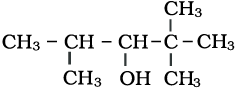
1. 2, 2, 2-Trimethylpentan-3-ol
2. 2, 2, 4-Trimethylpentan-3-ol
3. 2, 2, 3-Trimethylpentan-3-ol
4. 1, 1, 3-Trimethylpentan-3-ol


The IUPAC name of the above compound is -
1. 2-Methylbutan-1-ol
2. 2-Methylbutan-2-ol
3. 1-Methylbutan-2-ol
4. 1-Methylbutan-1-ol
The IUPAC name of the below compound is:

1. 3,4-Dimethylhexane –1,3,5-triol
2. 3,5-Dimethylhexane –1,1,5-triol
3. 3,5-Dimethylhexane –1,3,5-triol
4. 3,1-Dimethylhexane –1,3,5-triol
The IUPAC name of

1. 3,3-Diethylphenol
2. 2,2-Diethylphenol
3. 1,3-Diethylphenol
4. 2,3-Diethylphenol


The IUPAC name of the above compound is:
| 1. | 4 – Ethoxypropane | 2. | 3 – Ethoxypropane |
| 3. | 1 – Ethoxypropane | 4. | 2 – Ethoxypropane |

© 2026 GoodEd Technologies Pvt. Ltd.