 Q. No.
Which stage of the Calvin Cycle utilizes ATP?
(1) Carboxylation
(2) Reduction
(3) Regeneration
(4) Both 2 and 3
केल्विन चक्र का कौन सा चरण एटीपी का उपयोग करता है?
(1) कार्बोक्सिलीकरण
(2) अपचयन
(3) पुनरूद्भवन
(4) २ और ३ दोनों


What does chemiosmosis requires?
a. membrane, cytosol, protonpump, ATPase and proton gradient
b. membrane, cytosol, protonpump and H-ions
c. membrane, protonpump, ATPase and proton gradient
d. membrane, cytosol, protonpump, ATPase and proton gradient and H-ions
रसोपरासरण के लिए क्या आवश्यक होता है?
a. झिल्ली, कोशिकाविलेय, प्रोटोनपम्प, एटीपेस और प्रोटोन प्रवणता
b. झिल्ली, कोशिकाविलेय, प्रोटोनपम्प और एच-आयन
c. झिल्ली, प्रोटोनपम्प, एटीपेस और प्रोटोन प्रवणता
d. झिल्ली, कोशिकाविलेय, प्रोटोनपम्प, एटीपियज और प्रोटोन प्रवणता और एच-आयन
Light harvesting complexes are made up of-
a. proteins
b. pigments
c. protein and pigments
d. proteins and lipids.
प्रकाश संलवन संमिश्र..............के बने होते हैं।
a. प्रोटीन
b. वर्णक
c. प्रोटीन और वर्णक
d. प्रोटीन और वसा


How statements are correct?
i. chlorophyll-a , xanthophylls and carotenoids are called as accessory pigments.
ii. accessory pigments protect chlorophyll-a from photo-oxidation.
iii. chlorophylla are the major pigments responsible for trapping of light
iv. chl-a and chl-b forms the reaction centre
v. chl-a transfers the energy to accessory pigments.
a. 2
b. 3
c. 4
d. 5
कितने कथन सही हैं?
i. क्लोरोफिल-a, जैंथोफिल और कैराटिनॉइड को सहायक वर्णक कहा जाता है।
ii. सहायक वर्णक क्लोरोफिल-a को प्रकाश ऑक्सीकरण से बचाते हैं।
iii. प्रकाश के संपाशन के लिए उत्तरदायी प्रमुख वर्णक पर्णहरित होते हैं।
iv. chl-a और chl-b अभिक्रिया केंद्र बनाते हैं।
v. chl-a सहायक वर्णकों को ऊर्जा को स्थानांतरित करता है।
a. 2
b. 3
c. 4
d. 5
The first carbon dioxide fixation product of C4 plant is
(1) Oxaloacetic acid
(2) ribulose biphosphate
(3) phosphoenol pyruvate
(4) phosphoglyceric acid.
C4 पादप का पहला कार्बन डाइऑक्साइड स्थिरीकृत उत्पाद है:
(1) ऑक्जेलोएसिटिक अम्ल
(2) राइबुलोज बाइफॉस्फेट
(3) फॉस्फेनोल पाइरूवेट
(4) फॉस्फोग्लिसरिक अम्ल।
Absorption spectrum of chlorophyll- ‘a’ is shown by-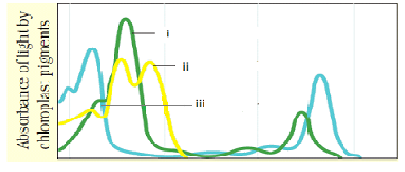
a. i
b. ii
c. iii
d. Not shown.
क्लोरोफिल- ‘a’ का अवशोषण स्पेक्ट्रम.................. द्वारा दिखाया गया है।

हरित लवक वर्णको के प्रकाश की आवश्श्यकता
a. i
b. ii
c. iii
d. नहीं दिखाया गया।


Spliting of water is associated with-
a. PS II
b. PS I
c. PS I AND PS II
d. outer membrane of thylakoid.
जल का विघटन.............. से संबद्ध है-
a. PS II
b. PS I
c. PS I और PS II
d. थायलेकॉइड की बाहरी झिल्ली।
Where does the splitting of water take place?
a. Stroma
b. Cytoplasm
c. Thylakoid lumen
d. Plasma membrane
जल का विखंडन कहाँ होता है?
a. पीठिका
b. कोशिका द्रव्य
c. थाइलेकोइड अवकाशिका
d. प्लाज्मा झिल्ली
Final acceptor in the Z-scheme of light reaction-
a. oxygen
b. NADPH
c. NADP+
d. ferredoxin
प्रकाश अभिक्रिया की Z- योजना में अंतिम ग्राही-
a.ऑक्सीजन
b. NADPH
c. NADP+
d.फेरेडॉक्सिन


Where does oxygen come from during photosynthesis?
a. Oxidation of water
b. Oxidation of glucose
c. Reduction of glucose
d. From CO2.
प्रकाश संश्लेषण के दौरान ऑक्सीजन कहां से प्राप्त होती है?
a. जल के ऑक्सीकरण से
b. ग्लूकोज के ऑक्सीकरण से
c. ग्लूकोज के अपचयन से
d. CO2 से

© 2026 GoodEd Technologies Pvt. Ltd.