
 Q. No.
A particle is moving on a circular path of radius \(R.\) When the particle moves from point \(A\) to \(B\) (angle \( \theta\)), the ratio of the distance to that of the magnitude of the displacement will be:

1. \(\dfrac{\theta}{\sin\frac{\theta}{2}}\)
2. \(\dfrac{\theta}{2\sin\frac{\theta}{2}}\)
3. \(\dfrac{\theta}{2\cos\frac{\theta}{2}}\)
4. \(\dfrac{\theta}{\cos\frac{\theta}{2}}\)
1. \(\dfrac{\theta}{\sin\frac{\theta}{2}}\)
2. \(\dfrac{\theta}{2\sin\frac{\theta}{2}}\)
3. \(\dfrac{\theta}{2\cos\frac{\theta}{2}}\)
4. \(\dfrac{\theta}{\cos\frac{\theta}{2}}\)


The horizontal range of a particle thrown from the ground is four times the maximum height. The angle of projection with the vertical is:
(1) 60°
(2) 30°
(3) 45°
(4) 90°
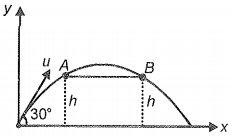
A particle is thrown with a velocity of 40 m/s. If it passes A and B as shown in the figure at time = 1 s and = 3 s. The value of h is:
(1) 15 m
(2) 10 m
(3) 30 m
(4) 20 m


To a stationary man, the rain is falling on his back with a velocity v at an angle with vertical. To make the rain-velocity perpendicular to the man, he:
(1) must move forward with a velocity vsin.
(2) must move forward with a velocity vtan.
(3) must move forward with a velocity vcos.
(4) should move in the backward direction.
A particle is thrown from the ground with a speed of 20 m/s at an angle 60° above the horizontal. Average velocity over its entire journey just before hitting the ground is:
(1) 10 m/s
(2) 20 m/s
(3) Zero
(4) 15 m/s
A person can throw a ball up to a maximum horizontal range of \(400~\text{m}\). The maximum height to which he can throw the ball is:
1. \(200~\text{m}\)
2. \(100~\text{m}\)
3. \(150~\text{m}\)
4. \(250~\text{m}\)


A car is moving along east at \(10\) m/s and a bus is moving along north at \(10\) m/s. The velocity of the car with respect to the bus is along:
| 1. | North-East | 2. | South-East |
| 3. | North-West | 4. | South-West |
A particle is moving on a circular path of radius 1m with a constant speed of 1 m/s. Acceleration of the particle is:
1.
2.
3.
4. 0
A particle starts moving from the origin in the XY plane and its velocity after time \(t\) is given by \(\overrightarrow{{v}}=4 \hat{{i}}+2 {t} \hat{{j}}\). The trajectory of the particle is correctly shown in the figure:
| 1. |  |
2. |  |
| 3. |  |
4. |  |


A particle is moving in the \(XY\) plane such that \(x = \left(t^2 -2t\right)~\text m,\) and \(y = \left(2t^2-t\right)~\text m,\) then:
| 1. | the acceleration is zero at \(t=1~\text s.\) |
| 2. | the speed is zero at \(t=0~\text s.\) |
| 3. | the acceleration is always zero. |
| 4. | the speed is \(3~\text{m/s}\) at \(t=1~\text s.\) |

© 2026 GoodEd Technologies Pvt. Ltd.