An object of mass \(500~\text g\) initially at rest is acted upon by a variable force whose \(x\)-component varies with \(x\) in the manner shown. The velocities of the object at the points \(x=8~\text m\) and \(x=12~\text m\) would have the respective values of nearly:


1. \(18~\text {m/s}\)  and \(22.4~\text {m/s}\)  2. \(23~\text {m/s}\)  and \(22.4~\text {m/s}\) 
3. \(23~\text {m/s}\)  and \(20.6~\text {m/s}\)  4. \(18~\text {m/s}\)  and \(20.6~\text {m/s}\) 

Subtopic:  Work Done by Variable Force |
 60%
Level 2: 60%+
NEET - 2019
Hints
Links

premium feature crown icon
Unlock IMPORTANT QUESTION
This question was bookmarked by 5 NEET 2025 toppers during their NEETprep journey. Get Target Batch to see this question.
✨ Perfect for quick revision & accuracy boost
Buy Target Batch
Access all premium questions instantly
A sphere of mass \(m\) moving horizontally with velocity \(v_0\) collides against a pendulum bob of mass \(m\). If the two masses stick together after the collision, then the maximum height attained is:

            
1. \(\frac{v^2_0}{2g}\)
2. \(\frac{v^2_0}{4g}\)
3. \(\frac{v^2_0}{6g}\)
4. \(\frac{v^2_0}{8g}\)

Subtopic:  Collisions |
 55%
Level 3: 35%-60%
Hints

premium feature crown icon
Unlock IMPORTANT QUESTION
This question was bookmarked by 5 NEET 2025 toppers during their NEETprep journey. Get Target Batch to see this question.
✨ Perfect for quick revision & accuracy boost
Buy Target Batch
Access all premium questions instantly

A ball of mass m moving with a speed u undergoes a head-on elastic collision with a ball of mass nm initially at rest. The fraction of initial energy transferred to the heavier ball is

(1) n1+n

(2) n(1+n)2

(3) 2n(1+n)2

(4) 4n(1+n)2

Subtopic:  Collisions |
 62%
Level 2: 60%+
Hints

advertisementadvertisement

A body of mass m1 moving with uniform velocity of 40 m/s collides with another mass m2 at rest and then the two together begin to move with uniform velocity of 30 m/s. The ratio of their masses m1m2 is

(1) 0.75

(2) 1.33

(3) 3.0

(4) 4.0

Subtopic:  Collisions |
 80%
Level 1: 80%+
Hints

A body of mass \(2~\text{kg}\) moving with a velocity of \(\left(\hat i +2\hat j-3\hat k\right)\text{m/s}\) collides with another body of mass \(3~\text{kg}\) moving with a velocity of \(\left(2\hat i +\hat j +\hat k\right)\text{m/s}.\) If they stick together, the velocity in \(\text{m/s}\) of the composite body will be:
1. \(\frac{1}{5}\left(8\hat i +7\hat j-3\hat k\right)\)
2. \(\frac{1}{5}\left(-4\hat i +\hat j-3\hat k\right)\)
3. \(\frac{1}{5}\left(8\hat i +\hat j-\hat k\right)\)
4. \(\frac{1}{5}\left(-4\hat i +7\hat j-3\hat k\right)\)
Subtopic:  Collisions |
 84%
Level 1: 80%+
Hints
Links

A body of mass 5 kg is moving with a velocity of 10 m/s. Now a force that delivers a constant power of 75 watts is applied to it for 10 s in the same direction. The velocity of the body after 10 s will be

1.  102m/s

2.  20 m/s

3.  40 m/s

4.  252m/s

Subtopic:  Power |
 67%
Level 2: 60%+
Hints

advertisementadvertisement

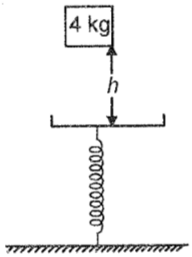
A mass of 4kg falls from a height h on the pan. Initially, the spring is in its natural length and mass of spring and pan are negligible. Spring constant of the spring is 1000 N/m. The mass compresses the spring by 0.5 m. Then the height 'h' is
                                 

1.  2.00 m

2.  1.56 m

3.  4.0 m

4.  2.625 m

Subtopic:  Elastic Potential Energy |
 77%
Level 2: 60%+
Hints

premium feature crown icon
Unlock IMPORTANT QUESTION
This question was bookmarked by 5 NEET 2025 toppers during their NEETprep journey. Get Target Batch to see this question.
✨ Perfect for quick revision & accuracy boost
Buy Target Batch
Access all premium questions instantly

Human heartbeats 72 times per minute. It pumps 1 cc blood in each pulse under the pressure of 2×10⁴N/m2. The power of the heart is 

1.  0.2 watt

2.  0.02 watt 

3.  0.024 watt

4.  2.2×10⁻¹watt

Subtopic:  Concept of Work |
 69%
Level 2: 60%+
Hints

premium feature crown icon
Unlock IMPORTANT QUESTION
This question was bookmarked by 5 NEET 2025 toppers during their NEETprep journey. Get Target Batch to see this question.
✨ Perfect for quick revision & accuracy boost
Buy Target Batch
Access all premium questions instantly

A body having an initial kinetic energy 2 J collides with an identical body at rest. The maximum loss of kinetic energy in the collision will be:

1. 2 J 2. Zero
3. 1 J 4. 1.5 J
Subtopic:  Collisions |
Level 3: 35%-60%
Hints
Links

advertisementadvertisement

premium feature crown icon
Unlock IMPORTANT QUESTION
This question was bookmarked by 5 NEET 2025 toppers during their NEETprep journey. Get Target Batch to see this question.
✨ Perfect for quick revision & accuracy boost
Buy Target Batch
Access all premium questions instantly

A particle is thrown at an acute angle with the horizontal. Select the incorrect statement.

1. Power delivered by gravity is zero at all the point on the trajectory.
2. Power delivered by gravity is zero only at one point.
3. The average power of gravity is zero.
4. During the one-half journey, the power is negative and during the other half, the power is positive.
Subtopic:  Power |
 60%
Level 2: 60%+
Hints





