| Column-I | Column-II | ||
| (a) | Gliding joint | (i) | Between carpal and metacarpal of thumb |
| (b) | Hinge joint | (ii) | Between Atlas and Axis |
| (c) | Pivot joint | (iii) | Between the Carpals |
| (d) | Saddle joint | iv | Between Humerus and Ulna |
Select the correct option from the following:
1. (a)-(iii), (b)-(iv), (c)-(ii), (d)-(i)
2. (a)-(iv), (b)-(i), (c)-(ii), (d)-(iii)
3. (a)-(iv), (b(-(ii), (c)-(iii), (d)-(i)
4. (a)-(i), (b)-(iii), (c)-(ii), (d)-(iv)


Which of the following statements is not correct?
1. An action potential in an axon does not move backward because the segment behind is in a refractory phase.
2. Depolarization of hair cells of cochlea results in the opening of the mechanically gated Potassium- ion channels.
3. Rods are very sensitive and contribute to daylight vision.
4. In the knee-jerk reflex, stimulus is the stretching of muscle and response is its contraction.
Which of the following receptors are specifically responsible for maintenance of balance of body and posture ?
1. Basilar membrane and otoliths
2. Hair cells and organ of corti
3. Tectorial membrane and macula
4. Crista ampullaris and macula


Which of the following hormones is responsible for both the milk ejection reflex and the foetal ejection reflex?
| 1. Oestrogen | 2. Prolactin |
| 3. Oxytocin | 4. Relaxin |
Identify A, B and C in the diagrammatic representation of the mechanism of hormone action.
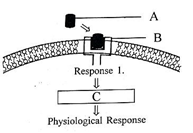

Select the correct option from the following:
1. A = Steroid Hormone; B = Hormone receptor Complex; C = Protein
2. A = Protein Hormone; B = Receptor; C = Cyclic AMP
3. A = Steroid Hormone; B = Receptor; C = Second Messenger
4. A = Protein Hormone; B = Cyclic AMP; C = Hormone-receptor Complex
Artificial light, extended work-time and reduced sleep-time disrupt the activity of
| 1. Thymus gland | 2. Pineal gland |
| 3. Adrenal gland | 4. Posterior pituitary gland |


Which of the following conditions will stimulate parathyroid gland to release parathyroid hormone ?
1. Fall in active Vitamin D levels
2. Fall in blood Ca+2 levels
3. Fall in bone Ca+2 levels
4. Rise in blood Ca+2 levels
Select the correct sequence of events:
| 1. | Gametogenesis → Gamete transfer → Syngamy → Zygote → Cell division (Cleavage) → Cell differentiation → Organogenesis |
| 2. | Gametogenesis → Gamete transfer → Syngamy → Zygote → Cell division (Cleavage) → Organogenesis → Cell differentiation |
| 3. | Gametogenesis → Syngamy → Gamete transfer → Zygote → Cell division (Cleavage) → Cell differentiation → Organogenesis |
| 4. | Gametogenesis → Gamete transfer → Syngamy → Zygote → Cell differentiation → Cell division (Cleavage) → Organogenesis |
What type of pollination takes place in Vallisneria ?
1. Pollination occurs in submerged condition by water.
2. Flowers emerge above surface of Water and pollination occurs by insects.
3. Flowers emerge above water surface and pollen is carried by wind.
4. Male flowers are carried by water currents to female flowers at surface of water.


In which one of the following, both autogamy and geitonogamy are prevented?
1. Wheat
2. Papaya
3. Castor
4. Maize

© 2026 GoodEd Technologies Pvt. Ltd.