Which one of the following aspects is an exclusive characteristic of living things?
| 1. | Increase in mass by the accumulation of material both on the surface as well as internally |
| 2. | Isolated metabolic reactions occurring in vitro |
| 3. | Increase in mass from outside only |
| 4. | Perception of events happening in the environment and their memory |


The type of muscles present in our:
| 1. | upper arms are smooth muscle fibres fusiform in shape |
| 2. | heart is involuntary and unstriated smooth muscles |
| 3. | intestine are striated and involuntary |
| 4. | thighs are striated and voluntary |
The figure shows four animals (a), (b), (c) and (d). Select the correct answer with respect to a common characteristic of two of these animals:
| (a) |  |
(b) |  |
| (c) |  |
(d) |  |
| 1. | (c) and (d) have a true coelom |
| 2. | (a) and (d) respire mainly through body wall |
| 3. | (b) and (c) show radial symmetry |
| 4. | (a) and (b) have cnidoblasts for self-defence |


Which one of the following conditions of the zygotic cell would lead to the birth of a normal human female child?
| 1. | one X and one Y chromosome |
| 2. | two X chromosomes |
| 3. | only one Y chromosome |
| 4. | only one X chromosome |
Test cross in plants or in Drosophila involves crossing:
1. between two genotypes with dominant trait
2. between two genotypes with recessive trait
3. between two F1 hybrids
4. the F1 hybrid with a double recessive genotype
Which one of the following correctly represents the normal adult human dental formula?
1.
2.
3.
4.


The figure below shows the structure of a mitochondrion with its four parts labelled (A), (B), (C) and (D). Select the part correctly matched with its function.

| 1. | Part (A) : Matrix – a major site for respiratory chain enzymes |
| 2. | Part (D) : Outer membrane – gives rise to the inner membrane by splitting |
| 3. | Part (B) : Inner membrane – forms infoldings called cristae |
| 4. | Part (C) : Cristae – possess single circular DNA molecule and ribosome |
Bulk of carbon dioxide (CO2) released from body tissues into the blood is present as:
1. carbaminohaemoglobin in RBCs
2. bicarbonate in blood plasma and RBCs
3. free CO2 in blood plasma
4. 70% carbaminohaemoglobin and 30% as bicarbonate
Given below is the ECG of a normal human. Which one of its components is correctly interpreted below?
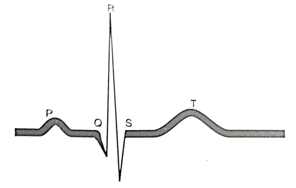
| 1. | Peak P-Initiation of left atrial contraction only |
| 2. | Complex QRS-One complete pulse |
| 3. | Peak T-Initiation of total cardiac contraction |
| 4. | Peak P and Peak R together-systolic and diastolic blood pressures |


Frogs differ from humans in possessing:
| 1. | thyroid as well as parathyroid |
| 2. | paired cerebral hemispheres |
| 3. | hepatic portal system |
| 4. | nucleated red blood cells |

© 2026 GoodEd Technologies Pvt. Ltd.