
 Q. No.
What is the IUPAC name of the given compound?
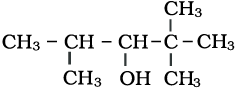
1. 2, 2, 2-Trimethylpentan-3-ol
2. 2, 2, 4-Trimethylpentan-3-ol
3. 2, 2, 3-Trimethylpentan-3-ol
4. 1, 1, 3-Trimethylpentan-3-ol


The IUPAC name of the following compound is:

1. Cyclopent-1-en-3-ol
2. Cyclopent-3-en-1-ol
3. Cyclopent-2-en-1-ol
4. Cyclopent-1-en-2-ol

The IUPAC name of above mentioned compound is:
1. 1-Chloro-3-ethylbutan-3-ol
2. 1-Chloro-3-ethylbutan-1-ol
3. 3-Chloro-3-ethylbutan-1-ol
4. 3-(Chloromethyl)pentan-1-ol


Which of the following is the correct IUPAC name for the given structure.

1. 3,4-Dimethylhexane –1,3,5-triol
2. 3,5-Dimethylhexane –1,1,5-triol
3. 3,5-Dimethylhexane –1,3,5-triol
4. 3,1-Dimethylhexane –1,3,5-triol
The IUPAC name of the below compound is:

| 1. | 1-Phenylpropan-2-ol | 2. | 2-Phenylpropan-2-ol |
| 3. | 1-Phenylpropan-1-ol | 4. | 2-Phenylpropan-1-ol |

The IUPAC name of the above compound is:
| 1. | 4 – Ethoxypropane | 2. | 3 – Ethoxypropane |
| 3. | 1 – Ethoxypropane | 4. | 2 – Ethoxypropane |


The IUPAC name of the following compound is:

1. 1-Ethoxy-3-methylpentane
2. 3-Ethoxy-1-methylpentane
3. 2-Ethoxy-3-methylpentane
4. 3-Ethoxy-2-methylpentane
Find the number of structural isomers of alcohol having molecular formula C₅H₁₂O.
| 1. | 4 | 2. | 6 |
| 3. | 8 | 4. | 10 |
Find the correct reason for the higher boiling point of propanol compared with butane.
1. Butane molecules are held together by strong ionic forces.2. Propanol molecules form intermolecular hydrogen bonds.
3. Propanol molecules form intramolecular hydrogen bonds.
4. Butane molecules form intramolecular hydrogen bonds.


Alcohols are comparatively more soluble in water than hydrocarbons of comparable molecular masses because:
| 1. | Alcohols form van der waal bonds with water while hydrocarbons do not |
| 2. | Alcohols form covalent bonds with water while hydrocarbons do not |
| 3. | Alcohols form ionic bonds with water while hydrocarbons do not |
| 4. | Alcohols form H-bonds with water while hydrocarbons do not |

© 2026 GoodEd Technologies Pvt. Ltd.