
 Q. No.
What is true about RBCs in humans?
1. They carry about 20-25 per cent of CO2
2. They transport 99.5 per cent of O2
3. They transport about 80 per cent oxygen only and the rest 20 per cent of it is
transported in dissolved state in blood plasma
4. They do not carry CO2 at all


What is vital capacity of our lungs?
| 1. | Inspiratory reserve volume plus tidal volume |
| 2. | Total lung capacity minus expiratory reserve volume |
| 3. | Inspiratory reserve volume plus expiratory reserve volume |
| 4. | Total lung capacity minus residual volume |
Which of the following match is correct?
| 1. | Emphysema : reduction of surface area of alveoli and bronchi |
| 2. | Pneumonia : occupational disease with asbestos |
| 3. | Silicosis : inflammation of alveoli |
| 4. | Asthma : excessive secretion of bronchial mucus |


Chemosensitive area of respiratory centre medulla is affected by
| 1. | less CO2 and H+ ions |
| 2. | less O2 and H+ ions |
| 3. | excess CO2 and H+ ions |
| 4. | excess O2 and H+ ions. |
Oxygen binding to haemoglobin in blood is
1. directly proportional to the concentration of CO2 in the medium
2. inversely proportional to the concentration of CO2 in the medium
3. directly proportional to the concentration of CO in the medium
4. independent of the concentration of CO in the medium.


The figure shows a diagrammatic view of human respiratory system with labels A, B, C
and D. Select the option, which gives correct identification and main function and/or
characteristic.
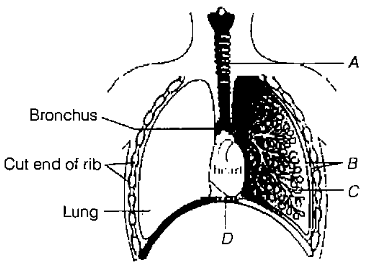
1. A-trachea-long tube supported by complete cartilaginous rings for conducting
inspired air
2. 8-pleural membrane-surround ribs on both sides to provide cushion against rubbing
3. C-alveoli-thin walled vascular bag-like structures for exchange of gases
4. D-lower end of lungs-diaphragm pulls it down during inspiration
Approximately seventy percent of carbon dioxide absorbed by the blood will be
transported to the lungs
1. as bicarbonate ions
2. in the form of dissolved gas molecules
3. by binding to RBC
4. as carbamino-haemoglobin
Name the chronic respiratory disorder caused mainly by cigarette smoking
1. asthma
2. respiratofy acidosis
3. respiratory alkalosis
4. emphysema


The partial pressure of oxygen in the alveoli of the lungs is
| 1. | equal to that in the blood
|
| 2. | more than that in the blood
|
| 3. | less than that in the blood
|
| 4. | less than that of carbon dioxide |

© 2026 GoodEd Technologies Pvt. Ltd.