- 1(current)
 Q. No.
Which of the following statement is incorrect regarding a frog?
| 1. | Digestive system without salivary gland |
| 2. | Respiratory system without intercostal muscles |
| 3. | Circulatory system without SA node. |
| 4. | Reproductive system without copulatory organs. |

Subtopic: Frogs: Anatomy (Circulatory System) |
Level 3: 35%-60%
Hints

A thin-walled, triangular chamber attached dorsally to heart of a frog is known as
| 1. | Truncus arteriosus | 2. | Sinus venosus |
| 3. | Atrium | 4. | Ventricle |
Subtopic: Frogs: Anatomy (Circulatory System) |
86%
Level 1: 80%+
Hints
In a frog, heart is enclosed within a two-layered sac called
| 1. | Mesorchium | 2. | Pericardium |
| 3. | Pleura | 4. | Conus arteriosus |
Subtopic: Frogs: Anatomy (Circulatory System) |
81%
Level 1: 80%+
Hints


In frog:
| 1. | Haemoglobin is present in red blood corpuscles which are biconvex and nucleated. |
| 2. | Haemoglobin is present in red blood corpuscles which are biconcave and nucleated. |
| 3. | Haemoglobin is present in red blood corpuscles which are biconvex and enucleated. |
| 4. | Haemoglobin is present in red blood corpuscles which are biconcave and enucleated. |
Subtopic: Frogs: Anatomy (Circulatory System) |
Level 3: 35%-60%
Hints
In the given diagram of the heart of frog identify X :
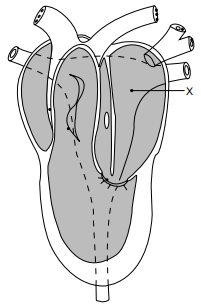
| 1. | Conus arteriosus | 2. | Left atrium |
| 3. | Sinus venosus | 4. | Left ventricle |
Subtopic: Frogs: Anatomy (Circulatory System) |
Level 3: 35%-60%
Hints
Subtopic: Frogs: Anatomy (Circulatory System) |
78%
Level 2: 60%+
Hints


An animal which contains three-chambered heart is ______________.
1. man
2. rabbit
3. fish
4. frog
Subtopic: Frogs: Anatomy (Circulatory System) |
96%
Level 1: 80%+
Hints
Compared to those of humans, the erythrocytes in frogs are:
| 1. | Without nucleus but with haemoglobin |
| 2. | Nucleated and with haemoglobin |
| 3. | Very much smaller and fewer |
| 4. | Nucleated and without haemoglobin |
Subtopic: Frogs: Anatomy (Circulatory System) |
79%
Level 2: 60%+
AIPMT - 2012
Hints
- 1(current)
Q. No.
© 2026 GoodEd Technologies Pvt. Ltd.