Select Chapter Topics:

 Q. No.
Regarding frog:
I. They undergo aestivation and hibernation
II. They are carnivorous
III. They are poikilotherms
1. I, II, III are correct
2. I and II are correct
3. I and III are correct
4. II and III are correct

Subtopic: Frogs | Frogs: Anatomy (Digestive System) |
93%
Level 1: 80%+
Hints

Gas exchange between the air and blood stream occurs in three locations in the frog:
| 1 | the skin |
| 2 | the lining of the mouth |
| 3 | the lungs |
| 1. | (1) and (2) | 2. | (1) and (3) |
| 3. | (2) and (3) | 4. | (1), (2) and (3) |
Subtopic: Frogs: Anatomy (Respiratory System) |
66%
Level 2: 60%+
Hints
Regarding respiration in frogs:
| I. | The skin of a frog is permeable to oxygen and carbon dioxide, as well as to water. |
| II. | When a frog is underwater, oxygen is transmitted through the skin directly into the bloodstream. |
| III. | On land, adult frogs use their lungs to breathe |
The correct statements are:
| 1. | I, II, III | 2. | I and II |
| 3. | I and III | 4. | II and III |
Subtopic: Frogs: Anatomy (Respiratory System) |
70%
Level 2: 60%+
Hints


In the given diagram of the heart of frog identify X :
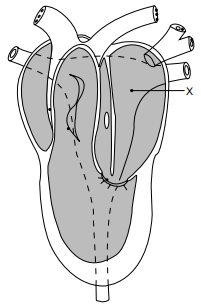
| 1. | Conus arteriosus | 2. | Left atrium |
| 3. | Sinus venosus | 4. | Left ventricle |
Subtopic: Frogs: Anatomy (Circulatory System) |
Level 3: 35%-60%
Hints
In frog:
| 1. | Haemoglobin is present in red blood corpuscles which are biconvex and nucleated. |
| 2. | Haemoglobin is present in red blood corpuscles which are biconcave and nucleated. |
| 3. | Haemoglobin is present in red blood corpuscles which are biconvex and enucleated. |
| 4. | Haemoglobin is present in red blood corpuscles which are biconcave and enucleated. |
Subtopic: Frogs: Anatomy (Circulatory System) |
Level 3: 35%-60%
Hints
Male and female frogs are distinguishable externally only during breeding season when:
| 1. | the female develops nuptial pad in the thumb |
| 2. | the male develops nuptial pad in the thumb |
| 3. | the male develops nuptial pad in the thumb and the female develops a nuptial pad on other digits |
| 4. | the male develops large nuptial pad in the thumb while the female develops small nuptial pad in the thumb |
Subtopic: Frogs: Anatomy (Male Reproductive System) |
81%
Level 1: 80%+
Hints


Regarding skin of the frog, incorrect statement is:
| 1. | It is made of the epidermis and the dermis |
| 2. | Mucous glands are present in the dermis and open at the surface |
| 3. | It is soft, moist and slimy |
| 4. | It is covered by scales |
Subtopic: Frogs: Morphology |
78%
Level 2: 60%+
Hints
In frogs:
| 1. | The dentition is homodont and the upper jaw is toothless. |
| 2. | The dentition is heterodont and the upper jaw is toothless. |
| 3. | The dentition is homodont and the lower jaw is toothless. |
| 4. | The dentition is heterodont and the lower jaw is toothless. |
Subtopic: Frogs: Anatomy (Digestive System) |
Level 3: 35%-60%
Hints
During aestivation and hibernation, frog respires by:
| 1. | Lungs | 2. | Skin |
| 3. | Buccal mucosa | 4. | All of these |
Subtopic: Frogs: Anatomy (Respiratory System) |
83%
Level 1: 80%+
Hints


Subtopic: Frogs: Anatomy (Nervous System) |
87%
Level 1: 80%+
Hints
Select Chapter Topics:

© 2026 GoodEd Technologies Pvt. Ltd.