 Q. No.
Arrange H, CH₃, C₂H₅, and C₃H₇ in order of increasing positive inductive effect:
1. H < CH3 < C2H5 < C3H7
2. H> CH3 <C2H5 > C3H7
3. H < C2H5 < CH3 <C3H7
4. None of the above


The effect that can explain the given order of acidity of the carboxylic acids is:
Cl3CCOOH > Cl2CHCOOH > ClCH2COOH
1. +I effect
2. -I effect
3. +E effect
4. -E effect
| 1. | NO2 shows +I effect |
| 2. | NO2 shows -I effect |
| 3. | NO2 decreases the positive charge on the compound |
| 4. | The ethyl group increases the positive charge on the compound |


The effect that makes 2,3–dimethyl-2-butene more stable than 2-butene is:
1. Resonance
2. Hyperconjugation
3. Steric effect
4. Inductive effect
Which of the following groups exhibits the maximum –I (negative inductive) effect?
1. –C₆H₅
2. –OCH₃
3. –Cl
4. –NO2
The most stable carbocation among the following is:
1. \(({CH_3})_3C\overset{+}{C}H_2\)
2. \(({CH_3})_3\overset{+}{C}\)
3. \({CH_3}CH_2\overset{+}{C}H_2\)
4. \(({CH_3})\overset{+}{C}HCH_2CH_3\)


The most stable carbocation among the following is:
| 1. | \(({CH_3})_3C\overset{+}{C}HCH_3\) | 2. | \({CH_3}CH_2\overset{+}{C}HCH_2CH_3\) |
| 3. | \(({CH_3})_2\overset{+}{C}CH_2CH_2CH_3\) | 4. | \({CH_3}CH_2\overset{+}{C}H_2\) |


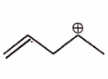
Compare the stability of the two resonating structures given below and mark the correct option:

1. (I) is more stable than (II)
2. (II) is more stable than (I)
3. (I) and (II) both have the same stability
4. None of the above



© 2026 GoodEd Technologies Pvt. Ltd.