 Q. No.
The correct order of acid character of the following compounds is:
 |
 |
 |
 |
| (I) | (II) | (III) | (IV) |
| 1. | III > II > I > IV | 2. | IV > III > II > I |
| 3. | I > II > III > IV | 4. | II > III > IV > I |


Reason(R): +l effect of CH3 makes the acetic acid weaker.
1. Both A and R are true and R is the correct explanation of A.
2. Both A and R are true but R is not the correct explanation of A.
3. A is a true statement but R is false.
4. Both A and R are false statements.

| 1. | c > d > a > b | 2. | b > a > d > c |
| 3. | a > b > c > d | 4. | b > c > a > d |


The final product 'C' of the following sequence of reactions is:

| 1. | \(\mathrm{CH_2-COOH\\ |\\ CH_2-COOH}\) | 2. | \(\mathrm{CH_2-Br\\ |\\ CH_2-Br}\) |
| 3. | \(\mathrm{CH_2-COOH\\ |\\ CH_2-CN}\) | 4. | \(\mathrm{CH_2-CN\\ |\\ CH_2-CN}\) |
| List-I (Substrates of reactions) | List II (Name of reactions) | ||
| (a) |  |
(i) | Hell-Volhard- Zelinsky reaction |
| (b) |  |
(ii) | Gattermann- Koch reaction |
| (c) |  |
(iii) | Haloform reaction |
| (d) |  |
(iv) | Esterification |
Choose the correct answer from the options given below:
| (a) | (b) | (c) | (d) | |
| 1. | (i) | (iv) | (iii) | (ii) |
| 2. | (ii) | (iii) | (iv) | (i) |
| 3. | (iv) | (i) | (ii) | (iii) |
| 4. | (iii) | (ii) | (i) | (iv) |
The reaction scheme below shows some reaction conversions of organic molecules.
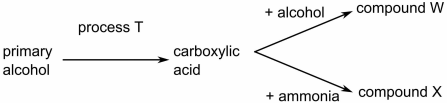
Which is the correct combination of processes and compounds for this scheme?
| 1. | process T: reduction; compound W: ester; compound X: amide |
| 2. | process T: reduction; compound W: ketone; compound X: nitrile |
| 3. | process T: oxidation; compound W: ester; compound X: amide |
| 4. | process T: reduction; compound W: ketone; compound X: amide |


What is Y in the above reaction?
1. (RCOO)2Mg
2. RCOO-Mg+X
3. R3CO-Mg+X
4. RCOO-X+
The compound formed as a result of oxidation of propyl benzene by KMnO4 is –
1. benzophenone
2. acetophenone
3. benzoic acid
4. benzyl alcohol
A: Trichloroacetic acid
B: Trifluoroacetic acid
C: Acetic acid
D: Formic acid
The correct order of decreasing acid strength of the above-given acids is:
| 1. | B > A > D > C |
| 2. | B > D > C > A |
| 3. | A > B > C > D |
| 4. | A > C > B > D |


Benzoic acid gives benzene on being heated with X and phenol gives benzene on being heated with Y. Therefore, X and Y are respectively
1. Sodalime and copper
2. Zn dust and NaOH
3. Cu and sodalime
4. Sodalime and zinc dust

© 2026 GoodEd Technologies Pvt. Ltd.