- 1(current)
 Q. No.
Which of the following species has a bond angle of \(120^\circ\)?
| 1. | \(\mathrm{{SF}_6}\) | 2. | \(\mathrm{NCl_3}\) |
| 3. | \(\mathrm{BCl_3}\) | 4. | \(\mathrm{PH_3}\) |

Subtopic: Hybridisation |
85%
Level 1: 80%+
NEET - 2017
Hints
Links

Subtopic: Hybridisation |
77%
Level 2: 60%+
NEET - 2017
Hints


Subtopic: Hybridisation |
81%
Level 1: 80%+
NEET - 2016
Hints


Subtopic: Hybridisation |
77%
Level 2: 60%+
NEET - 2016
Hints
The hybridisations of atomic orbitals of nitrogen in \(\mathrm{NO}^{+}\), \(N O_3^{-}\) and NH3 respectively are:
1.
2.
3.
4.
Subtopic: Hybridisation |
85%
Level 1: 80%+
NEET - 2016
Hints
In which orbital is the pair of electrons located in the provided carbanion, CH3C≡C– ?
1. sp3
2. sp2
3. sp
4. 2p
Subtopic: Hybridisation | V.S.E.P.R & V.B.T |
82%
Level 1: 80%+
NEET - 2016
Hints


An incorrect statement among the following:
| 1. | The H-O-H bond angle in H2O is larger than the H-C-H bond angle in CH4 |
| 2. | The H-C-H bond angle in CH4 is larger than the H-N-H bond angle in NH3 |
| 3. | The H-C-H bond angle in CH4, the H-N-H bond angle in NH3 and the H-0-H bond angle in H2O are all greater than 90o |
| 4. | The H-O-H bond angle in H2O is smaller than the H-N-H bond angle in NH3 |
Subtopic: Hybridisation | V.S.E.P.R & V.B.T |
74%
Level 2: 60%+
NEET - 2016
Hints
Find the correct geometry and hybridization of XeF₄.
1. Octahedral, sp3d2
2. Trigonal bipyramidal, sp3d3
3. Planar triangle, sp3d3
4. Square planar, sp3d2
Subtopic: Hybridisation |
77%
Level 2: 60%+
NEET - 2016
Hints
Links
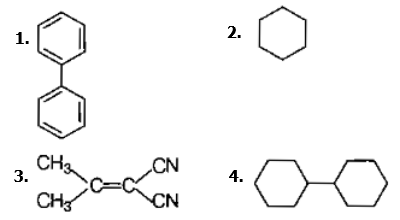
Subtopic: Hybridisation |
57%
Level 3: 35%-60%
NEET - 2016
Hints


The pair of electrons in the given carbanion, CH3C≡C-, is present in which of the following orbitals?
| 1. | sp3 | 2. | sp2 |
| 3. | sp | 4. | 2p |
Subtopic: Hybridisation |
78%
Level 2: 60%+
NEET - 2016
Hints
Links
- 1(current)
Q. No.
© 2026 GoodEd Technologies Pvt. Ltd.