 Q. No.
Where does oxygen come from during photosynthesis?
1. Oxidation of water
2. Oxidation of glucose
3. Reduction of glucose
4. From CO2


In plant cells, synthesis of ATP by the chemiosmotic
mechanism occurs during
| 1. | Photosynthesis only. |
| 2. | Respiration only. |
| 3. | Both photosynthesis and respiration. |
| 4. | Photorespiration only. |
Stroma lamella in plastid lacks
1. PS II and PS I.
2. PS II and NADP reductase.
3. PS I and NAD reductase.
4. PS II only.


According to the chemiosmotic hypothesis, there is a basic difference between respiration and photosynthesis. This is _____
| 1. | In chloroplast, H+ accumulation takes place in the lumen of thylakoid but in mitochondria, this takes place in perimitochondrial space. |
| 2. | Accumulation of H+ in chloroplast takes place in matrix i.e., stroma and in mitochondria, this takes place in cristae. |
| 3. | In both the mitochondria and chloroplast the accumulation of H+ takes place in inter-membranous space but with a high rate in mitochondria |
| 4. | Both 1 and 3 are correct. |
Cyclic photophosphorylation is different from non-cyclic photophosphorylation as the former
1. Is performed by a collaboration of both PS-II and PS-I
2. Does not require any external source of electrons
3. Is connected with photolysis of water
4. Is connected with ATP and NADPH production
Read the following four statements A, B, C and D and select the right option having both correct statements:
STATEMENTS:
| (A) | Z-scheme of light reaction takes place in the presence of PSI only |
| (B) | Only PSI functional in cyclic photophosphorylation |
| (C) | Cyclic photophosphorylation results in a synthesis of ATP and NADPH2 |
| (D) | Stroma lamellae lack PSII as well as NADP |
Options:
| 1. | A and B |
| 2. | B and C |
| 3. | C and D |
| 4. | B and D |


Study the pathway ATP synthesis through chemiosmosis given below –
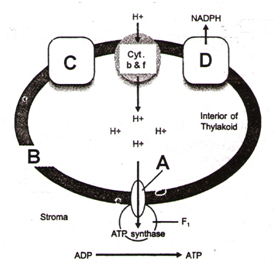
In which of the following options correct words for all the three blanks A, B, C and D are indicated –
| 1. | A – F1, B – Thylakoid membrane, C – Photosystem (I), D – Photosystem (II) |
| 2. | A – F0, B – Thylakoid membrane, C – Photosystem (I), D – Photosystem (II) |
| 3. | A – F1, B – Thylakoid membrane, C – Photosystem (II), D – Photosystem (I) |
| 4. | A – F0, B – Thylakoid membrane, C – Photosystem (II), D – Photosystem (I) |
Proton gradient develops across the thylakoid membrane due to all, except
| 1. | Splitting of water towards lumen side |
| 2. | NADP+ reduction towards stroma side |
| 3. | Movement of protons from lumen to stroma side by PQ |
| 4. | Release of H+ from stroma to lumen side by a H-carrier |
Identify ‘A’ with respect to ATP synthesis through chemiosmosis.

1. Cytochromes b and f
2. Cytochrome a and a3
3. Cytochrome bc1
4. NADP reductase


Chemiosmotic theory of ATP synthesis in the chloroplasts and mitochondria is based on:
1. Membrane potential
2. Accumulation of K ions
3. Proton gradient
4. Accumulation of Na ions

© 2026 GoodEd Technologies Pvt. Ltd.