 Q. No.
The displacement time graph of a moving particle is shown in the figure below. The instantaneous velocity of the particle is negative at the point:

| 1. | D | 2. | F |
| 3. | C | 4. | E |


To unlock all the explanations of this course, you need to be enrolled.
To unlock all the explanations of this course, you need to be enrolled.

In the following graph, the distance travelled by the body in metres is:

| 1. | \(200\) | 2. | \(250\) |
| 3. | \(300\) | 4. | \(400\) |
To unlock all the explanations of this course, you need to be enrolled.
To unlock all the explanations of this course, you need to be enrolled.
Which of the following velocity-time graphs shows a realistic situation for a body in motion?
| 1. |  |
2. |  |
| 3. |  |
4. |  |
To unlock all the explanations of this course, you need to be enrolled.
To unlock all the explanations of this course, you need to be enrolled.


Which one of the following displacement-time graph represents two moving objects \(P\) and \(Q\) with zero relative velocity?
| 1. | 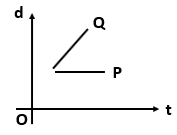 |
2. | 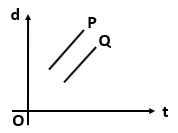 |
| 3. | 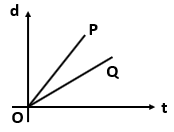 |
4. | 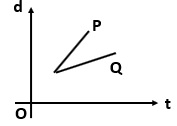 |
To unlock all the explanations of this course, you need to be enrolled.
To unlock all the explanations of this course, you need to be enrolled.
The position (\(x\)) of a particle in a straight line motion is given by \(x = 2 + 10 t - 5 t^{2}~\text{m}\). Its velocity (\(v\)) is best represented by?
| 1. |  |
2. |  |
| 3. |  |
4. |  |
To unlock all the explanations of this course, you need to be enrolled.
To unlock all the explanations of this course, you need to be enrolled.
The velocity-time \((v\text-t)\) graph of a body moving in a straight line is shown in the figure. The displacement and distance travelled by the body in \(6\) s are, respectively:

1. \(8\) m, \(16\) m
2. \(16\) m, \(8\) m
3. \(16\) m, \(16\) m
4. \(8\) m, \(8\) m
To unlock all the explanations of this course, you need to be enrolled.
To unlock all the explanations of this course, you need to be enrolled.


A particle shows distance-time curve as given in this figure. The maximum instantaneous velocity of the particle is around the point:
1. B

2. C
3. D
4. A
To unlock all the explanations of this course, you need to be enrolled.
To unlock all the explanations of this course, you need to be enrolled.
A particle starts from rest. Its acceleration \((a)\) versus time \((t)\) is as shown in the figure. The maximum speed of the particle will be:

1. \(110~\text{m/s}\)
2. \(55~\text{m/s}\)
3. \(550~\text{m/s}\)
4. \(660~\text{m/s}\)
To unlock all the explanations of this course, you need to be enrolled.
To unlock all the explanations of this course, you need to be enrolled.
A lift is going up. The variation in the speed of the lift is as given in the graph. What is the height to which the lift takes the passengers?

| 1. | \(3.6~\text{m}\) |
| 2. | \(28.8~\text{m}\) |
| 3. | \(36.0~\text{m}\) |
| 4. | It cannot be calculated from the above graph. |
To unlock all the explanations of this course, you need to be enrolled.
To unlock all the explanations of this course, you need to be enrolled.


A ball is thrown vertically upwards. Then the velocity-time \((v\text-t)\) graph will be:
| 1. |  |
2. |  |
| 3. |  |
4. |  |
To unlock all the explanations of this course, you need to be enrolled.
To unlock all the explanations of this course, you need to be enrolled.

© 2026 GoodEd Technologies Pvt. Ltd.