 Q. No.
Five particles of mass \(2\) kg each are attached to the circumference of a circular disc of a radius of \(0.1\) m and negligible mass. The moment of inertia of the system about the axis passing through the centre of the disc and perpendicular to its plane will be:
1. \(1\) kg-m2
2. \(0.1\) kg-m2
3. \(2\) kg-m2
4. \(0.2\) kg-m2


To unlock all the explanations of this course, you need to be enrolled.
To unlock all the explanations of this course, you need to be enrolled.

1. \(\frac{3mR^2}{2}\)
2. \(\frac{mR^2}{4}\)
3. \(\frac{mR^2}{2}\)
4. \(\frac{3mR^2}{4}\)
To unlock all the explanations of this course, you need to be enrolled.
To unlock all the explanations of this course, you need to be enrolled.
1. \(\frac{Ml^2}{12}\)
2. \(\frac{Ml^2}{6}\)
3. \(\frac{Ml^2}{4}\)
4. \(\frac{Ml^2}{3}\)
To unlock all the explanations of this course, you need to be enrolled.
To unlock all the explanations of this course, you need to be enrolled.


The moment of inertia of a uniform circular disc of radius '\(R\)' and mass '\(M\)' about an axis touching the disc at its diameter
and normal to the disc will be:
1. \(\frac{3}{2} M R^{2}\)
2. \(\frac{1}{2} M R^{2}\)
3. \(M R^{2}\)
4. \(\frac{2}{5} M R^{2}\)
To unlock all the explanations of this course, you need to be enrolled.
To unlock all the explanations of this course, you need to be enrolled.
The moment of inertia of a uniform circular disc is maximum about an axis perpendicular to the disc and passing through:
1. B
2. C
3. D
4. A

To unlock all the explanations of this course, you need to be enrolled.
To unlock all the explanations of this course, you need to be enrolled.
The moment of inertia of a thin uniform circular disc about one of its diameter is I. Its moment of inertia about an axis perpendicular to the circular surface and passing through its center will be:
1.
2. 2 l
3.
4.
To unlock all the explanations of this course, you need to be enrolled.
To unlock all the explanations of this course, you need to be enrolled.


The ratio of the radii of gyration of a circular disc about a tangential axis in the plane of the disc and of a circular ring of the same radius about a tangential axis in the
plane of the ring will be:
1. \(2:1\)
2. :
3. \(2:3\)
4. \(1:\)
To unlock all the explanations of this course, you need to be enrolled.
To unlock all the explanations of this course, you need to be enrolled.
| 1. | \(\dfrac{m_1m_2}{m_1+m_2}l^2\) | 2. | \(\dfrac{m_1+m_2}{m_1m_2}l^2\) |
| 3. | \((m_1+m_2)l^2\) | 4. | \(\sqrt{(m_1m_2)}l^2\) |
To unlock all the explanations of this course, you need to be enrolled.
To unlock all the explanations of this course, you need to be enrolled.
In the three figures, each wire has a mass M, radius R and a uniform mass distribution. If they form part of a circle of radius R, then about an axis perpendicular to the plane and passing through the centre (shown by crosses), their moment of inertia is in the order:
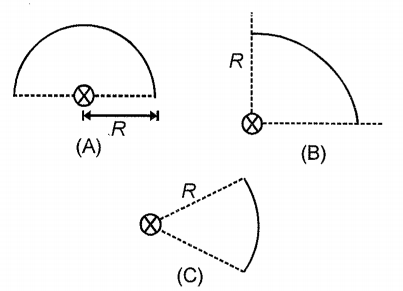
1.
2.
3.
4.
To unlock all the explanations of this course, you need to be enrolled.
To unlock all the explanations of this course, you need to be enrolled.


Three-point masses each of mass \(m,\) are placed at the vertices of an equilateral triangle of side \(a.\) The moment of inertia of the system through a mass \(m\) at \(O\) and lying in the plane of \(COD\) and perpendicular to \(OA\) is:

| 1. | \(2ma^2\) | 2. | \({2 \over 3}ma^2\) |
| 3. | \({5 \over 4}ma^2\) | 4. | \({7 \over 4}ma^2\) |
To unlock all the explanations of this course, you need to be enrolled.
To unlock all the explanations of this course, you need to be enrolled.

© 2026 GoodEd Technologies Pvt. Ltd.