
 Q. No.
The work done in increasing the length of a massless spring from its natural length 15 cm to 15.1 cm is 20 J. Work done in increasing the length from 15.1 cm to 15.2 cm will be:
1.
20 J
2.
40 J
3.
60 J
4.
80 J


A body of mass \(m\) moving at a certain speed suffers a perfectly inelastic collision with a body of mass \(M\) at rest. The ratio of the final kinetic energy of the system to the initial kinetic energy will be:
1. \(\dfrac{m}{m+M}\)
2. \(\dfrac{M}{m+M}\)
3. \(\dfrac{m+M}{m}\)
4. \(\dfrac{m+M}{M}\)
1. \(v=\left(\frac{2Pt}{m}\right)^{1/2}\)
2. \(v=\left(2Ptm\right)^{1/3}\)
3. \(v=\left(\frac{8Pt^3}{9m}\right)^{1/2}\)
4. \(v=\left(2Pt^3m\right)^{1/2}\)


1. \(2\hat i~\text{N}\)
2. \(-4\hat i~\text{N}\)
3. \(5\hat i~\text{N}\)
4. \(4\hat i~\text{N}\)
Work done by frictional force during the walking of a man is:
1. positive
2. negative
3. zero
4. maybe positive or negative
A particle is moving such that the potential energy U varies with position in metre as U (x) = ( - 2x + 50) J. The particle will be in equilibrium at:
1. x = 25 cm
2. x = 2.5 cm
3. x = 25 m
4. x = 2.5 m


Select the incorrect statement about potential energy:
| 1. | A change in potential energy is equal to work done against the internal conservative force.
|
| 2. | A change in potential energy is independent of the reference point.
|
| 3. | A change in potential energy depends on the reference frame.
|
| 4. | The potential energy at a point is not unique. |
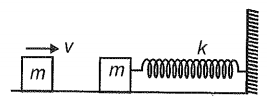
1. \(v\sqrt{\dfrac{m}{k}}\)
2. \(v\sqrt{\dfrac{2m}{k}}\)
3. \(m\sqrt{\dfrac{v}{2k}}\)
4. \(v\sqrt{\dfrac{m}{2k}}\)
The figure shows the potential energy function U of a system in which a particle is in one-dimensional motion. In which region is the magnitude of the force on the particle greatest? (x: position)
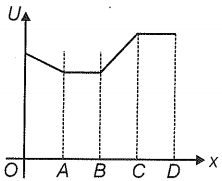
| 1. | OA | 2. | CD |
| 3. | AB | 4. | BC |


© 2026 GoodEd Technologies Pvt. Ltd.