
Identify the maximum number of carbon atoms that can be connected in a linear arrangement within the molecule CH₃–C≡C–CH=CH₂.
1. 3
2. 4
3. 5
4. 6


The designation D-(+)-tartaric acid for optically active tartaric acid indicates:
1. Positive optical rotation and correlation with the D/L system based on glyceraldehyde2. Positive optical rotation and relation with glucose configuration
3. Negative optical rotation and correlation with D-glyceraldehyde
4. No relation between D-configuration and optical rotation direction

The IUPAC name of the above mentioned compound is:
1. p-Phenyl diphenyl
2. 1,1',4',1''-terphenyl
3. p-1-biphenyl benzene
4. Terphenyl


The total number of optically active isomers for is:
1. Sixteen (16)
2. Eight (8)
3. Four (4)
4. Two (2)
If optical rotation produced by compound (i) is 36 then the rotation produced by compound (ii) is
(i) 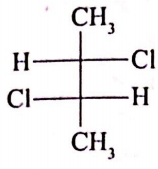
(ii) 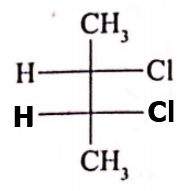
1. -36
2. 0
3. +18
4. +72
What is the total number of structural isomers possible for acyclic compounds with the molecular formula C₅H₁₀?
1. Five (5)
2. Six (6)
3. Seven (7)
4. Four (4)


The IUPAC name of the following compound is
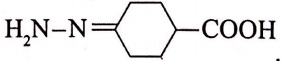
1. 4-hydrazonocyclohexane-1-carboxylic acid
2. 4-hydrazonobenzoic acid
3. 4-hydrazonocyclohexanoic acid
4. 4-(n-amino) benzene carboxylic acid
Consider the following organic compound:
To make it a chiral compound, the attack should be on carbon:
1. 1
2. 4
3. 3
4. 7
Assign the IUPAC name for the following compound.

1. 3, 4-Dichlorobenzene
2. (4-chlorophenyl)(3-chlorophenyl) diazene
3. 3,4-Bis (chlorophenyl) diazene
4. (3-Chlorophenyl)(4-chlorophenyl)diazene


Assign the IUPAC name for the following compound.

1. 3-Methyl hexane -1, 2, 3-tricarbonitrile
2. Hexane-1, 2, 3-tricarbonitrile
3. 1, 2-bis(cyanomethyl) butanenitrile
4. 3-(cyanomethyl)hexane-1,6-dinitrile

© 2026 GoodEd Technologies Pvt. Ltd.