 11 Selected Qs - Oscillations - NCERT Examples & Back ExerciseContact Number: 852752171811 Selected Qs - Oscillations - NCERT Examples & Back ExerciseContact Number: 8527521718
| (a) | \((\sin\omega t+ \cos \omega t)\) |
| (b) | \((\sin\omega t+ \cos 2\omega t+ \sin4\omega t)\) |
| (c) | \(e^{-\omega t}\) |
| (d) | \(\mathrm{log(\omega t)}\) |
| (e) | \(\sin^{2}\omega t\) |
| 1. | (a) only |
| 2. | (a), (b), and (d) only |
| 3. | (a), (b), and (e) only |
| 4. | All of these |
| (a) | \(\sin\omega t+ \cos\omega t\) |
| (b) | \(\sin\omega t+ \cos2\omega t+ \sin4\omega t\) |
Given the following simple harmonic motion.
(A) \(\sin\omega t - \cos\omega t\)
(B) \(\sin^{2}\omega t\)
The time period motions respectively are:
1. \(\dfrac{2 \pi}{\omega} \text{ and } \dfrac{\pi}{\omega}\)
2. \(\dfrac{2 \pi}{\omega} \text{ and }\dfrac{\pi}{2 \omega}\)
3. \(\dfrac{2 \pi}{\omega} \text{ and }\dfrac{4 \pi}{\omega}\)
4. \(\dfrac{\pi}{\omega} \text{ and } \dfrac{3 \pi}{\omega}\)
Which of the following relationships between the acceleration \(a\) and the displacement \(x\) of a particle involves simple harmonic motion?
1. \(a = 0 . 7 x\)
2. \(a = - 200 x^{2} \)
3. \(a = - 10 x\)
4. \(a = 100 x^{3}\)
The figure given below depicts two circular motions. The radius of the circle, the period of revolution, the initial position, and the sense of revolution are indicated in the figures. Equations of the \(x\)-projection of the radius vector of the rotating particle \(\mathrm P\) in each case are, respectively:


| 1. | \(\small{x}({t})={A} \cos \left(\dfrac{2 \pi}{4} {t}+\dfrac{\pi}{4}\right)\text{ and }{x}({t})={B} \cos \left(\dfrac{\pi}{15} {t}-\dfrac{\pi}{2}\right)\) |
| 2. | \(\small{x}({t})={A} \cos \left(\dfrac{2 \pi}{4} {t}+\dfrac{\pi}{4}\right)\text{ and }{x}({t})={B} \sin \left(\dfrac{\pi}{15} {t}-\dfrac{\pi}{2}\right)\) |
| 3. | \(\small{x}({t})={A} \cos \left(\dfrac{2 \pi}{4} {t}+\dfrac{\pi}{4}\right)\text{ and }{x}({t})={B} \cos \left(\dfrac{\pi}{15} {t}-\dfrac{\pi}{4}\right)\) |
| 4. | \(\small{x}({t})={A} \sin \left(\dfrac{2 \pi}{4} {t}+\dfrac{\pi}{4}\right)\text{ and }{x}({t})={B} \cos \left(\dfrac{\pi}{15} {t}-\dfrac{\pi}{2}\right)\) |
A simple pendulum of length l and having a bob of mass M is suspended in a car. The car is moving on a circular track of radius R with a uniform speed v. If the pendulum makes small oscillations in a radial direction about its equilibrium position, what will be its time period?
1. \(\mathrm{T}=2 \pi \sqrt{\frac{1}{\sqrt{\mathrm{g}^2+\frac{\mathrm{v}^4}{\mathrm{R}^2}}}}\)
2. \(\mathrm{T}=4 \pi \sqrt{\frac{\mathrm{l}}{\mathrm{g}^2+\frac{\mathrm{v}^4}{\mathrm{R}^2}}}\)
3. \(\mathrm{T}=2 \pi \sqrt{\frac{\mathrm{l}}{\mathrm{g}^2+\frac{\mathrm{v}^3}{\mathrm{R}^2}}}\)
4. \(\mathrm{T}=4 \pi \sqrt{\frac{1}{\sqrt{\mathrm{g}^2+\frac{\mathrm{v}^4}{\mathrm{R}^4}}}}\)
A cylindrical piece of cork of density and base area A and height h floats in a liquid of density . The cork is depressed slightly and then released. If the cork oscillates up and down simple harmonically then its period is
1. \(\mathrm{T}=\frac{1}{2 \pi} \sqrt{\frac{\mathrm{h} \rho}{\rho_1 \mathrm{~g}}}\)
2. \(\mathrm{T}=2 \pi \sqrt{\frac{\mathrm{h} \rho}{\rho_{\mathrm{l}} \mathrm{g}}}\)
3. \(\mathrm{T}=2 \pi \sqrt{\frac{\mathrm{h} \rho_1}{\rho \mathrm{g}}}\)
4. \(\mathrm{T}=\frac{1}{2 \pi} \sqrt{\frac{\mathrm{h} \rho_1}{\rho \mathrm{g}}}\)
A mass attached to a spring is free to oscillate, with angular velocity \(\omega\), in a horizontal plane without friction or damping. It is pulled to a distance
1. \(\sqrt{\left(2x_0^2+\frac{v_0^2}{\omega^2}\right)} \)
2. \(\sqrt{\left(x_0^2+\frac{v_0^2}{\omega^2}\right)} \)
3. \(\sqrt{\left(x_0^2+\frac{v_0^2}{2\omega^2}\right)} \)
4. \(\sqrt{\left( x_0^2+\frac{v_0^2}{\pi\omega^2}\right)} \)
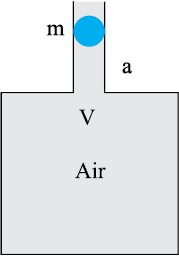
An air chamber of volume V has a neck area of cross-section 'a' into which a ball of mass 'm' just fits and can move up and down without any friction (as shown in the figure). When the ball is pressed down a little and released, it executes SHM. The time period of oscillations is:
(assuming pressure-volume variations of air to be isothermal)
1. \(\mathrm{T}=\frac{1}{2 \pi} \sqrt{\frac{\mathrm{Vm}_{\mathrm{m}}}{\mathrm{Ba}^3}}\)
2. \(\mathrm{T}=\pi \sqrt{\frac{\mathrm{Vm}_{\mathrm{m}}}{\mathrm{Ba}^2}}\)
3. \(\mathrm{T}=2 \pi \sqrt{\frac{\mathrm{Vm}_{\mathrm{m}}}{\mathrm{Ba}^2}}\)
4. \(\mathrm{T}=3 \pi \sqrt{\frac{\mathrm{Vm}_{\mathrm{m}}}{\mathrm{Ba}^2}}\)
The figure shows the circular motion of a particle. The radius of the circle, the period, the sense of revolution, and the initial position are indicated in the figure. The simple harmonic motion of the \({x\text-}\)projection of the radius vector of the rotating particle \(P\) will be:

1. \(x \left( t \right) = B\text{sin} \left(\dfrac{2 πt}{30}\right)\)
2. \(x \left( t \right) = B\text{cos} \left(\dfrac{πt}{15}\right)\)
3. \(x \left( t \right) = B\text{sin} \left(\dfrac{πt}{15} + \dfrac{\pi}{2}\right)\) \(\)
4. \(x \left( t \right) = B\text{cos} \left(\dfrac{πt}{15} + \dfrac{\pi}{2}\right)\)