Biology
1. The term 'polyadelphous' is related to?
| 1. |
gynoecium
|
2. |
androecium
|
| 3. |
corolla
|
4. |
calyx
|
2. Regarding the arrangement and functions of the floral whorls?
| 1. |
The calyx is the innermost whorl, providing support for the ovary. |
| 2. |
The corolla is the outermost whorl, primarily involved in reproduction. |
| 3. |
The androecium and gynoecium are the reproductive whorls located at the center of the flower. |
| 4. |
The calyx and corolla are collectively known as the essential organs of the flower. |
3. Moss sporophyte does not possess
1. Elaters
2. Seta
3. Foot
4. Capsule
4. Algae are useful because they
| 1. |
are large in number |
| 2. |
are used in alcoholic fermentation |
| 3. |
purify the atmosphere |
| 4. |
are used in curdling of milk |
5. Gymnosperms are also called soft wood spermatophytes because they lack :
1. Cambium
2. Phloem fibres
3. Thick-walled tracheids
4. Xylem fibres
6. Identify the option where the features are correctly matched to the types with respect to mustard:
|
Flower symmetry |
Ovary position |
Androecium |
Gynoecium |
| 1. |
Zygomorphic |
Inferior |
Variable length stamens within a flower |
Parietal placentation |
| 2. |
Zygomorphic |
Inferior |
Polyadelphous |
Marginal placentation |
| 3. |
Actinomorphic |
Superior |
Polyadelphous |
Axile placentation |
| 4. |
Actinomorphic |
Superior |
Variable length stamens within a flower |
Parietal placentation |
7. The spreading of living pteridophyte is limited and is restricted to narrow geographical region because of
1. Growth requirements of gametophyte (cool, damp and shady places).
2. Requirement of water for fertilisation.
3. Absence of stomata in leaf and absence of vascular tissue.
4. Both 1. and 2..
8. Bryophytes are often referred to as "amphibians of the plant kingdom" due to their dependence on water. Which of the following statements correctly describes the reason for this dependence?
| 1. |
Water is essential for bryophytes only during the sporophytic phase, as gametophytes are independent and produce seeds without water. |
| 2. |
Water is required for the movement of motile male gametes (antherozoids) to reach the archegonium for fertilization, as bryophytes lack vascular tissue for fluid transport. |
| 3. |
Bryophytes rely on water for absorbing nutrients directly from soil through specialized roots and not for fertilization. |
| 4. |
Water in bryophytes serves the same function as in gymnosperms, facilitating pollen transfer from male to female cones. |
9. Carlous Linnaeus system is an artificial system because it is
| 1. |
Phylogenetic.
|
| 2. |
Based on evolutionary trends.
|
| 3. |
Based on number of characters.
|
| 4. |
Based on a few characters of superficial similarities and dissimilarities on morphology. |
10. Identify the correct statement:
| 1. |
Monocotyledonous plants generally have taproot systems with one or more primary and secondary roots. |
| 2. |
The root hair zone develops in the region of elongation. |
| 3. |
Roots that develop from a stem, leaf, or other plant part are called adventitious roots. |
| 4. |
Apical meristem is found in the region of maturation. |
11. Consider the two statements:
| Statement I: |
The mode of arrangement of sepals or petals in floral bud with respect to the other members of the same whorl is known as aestivation. |
| Statement II: |
The arrangement of ovules inside the ovary in an angiosperm is called as placentation. |
1.
Statement I is correct;
Statement II is correct
2.
Statement I is correct;
Statement II is incorrect
3.
Statement I is incorrect;
Statement II is correct
4.
Statement I is incorrect;
Statement II is incorrect
12. The algae shown in the diagram below belongs to the class which has:

1. 2-8 equal and apical flagella
2. 2 unequal and lateral flagella
3. 2 unequal and apical flagella
4. 2-8 equal and lateral flagella
13. In the given diagrams, some of the algae have been labelled as A, B, C, D and E. Choose the correct option to identify these algae.
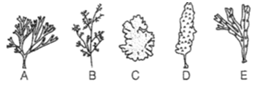
|
A |
B |
C |
D |
E |
| 1. |
Dictyota |
Polysiphonia |
Porphyra |
Fucus |
Laminaria |
| 2. |
Porphyra |
Dictyota |
Laminaria |
Fucus |
Polyspiphonia |
| 3. |
Dictyota |
Polysiphonia |
Porphyra |
Laminaria |
Fucus |
| 4. |
Fucus |
Porphyra |
Dictyota |
Polysiphonia |
Laminaria |
14. The stems of maize and sugarcane have:
| 1. |
stilt roots that are hanging and supporting structures |
| 2. |
prop roots that are hanging and supporting structures |
| 3. |
prop roots coming out from the nodes in upper stem |
| 4. |
supporting stilt roots coming out of the lower nodes of the stem |
15. Besides starch, pyrenoids in many members of Chlorophyceae, contain:
| 1. |
Double-stranded DNA |
| 2. |
A low molecular weight RNA |
| 3. |
Protein |
| 4. |
Lipids |
16. Which one of the following statements is wrong?
| 1. |
Algae increases the level of dissolved oxygen in the immediate environment |
| 2. |
Algin is obtained from red algae and carrageen from brown algae |
| 3. |
Agar-agar is obtained from Gelidium and Gracilaria |
| 4. |
Laminaria and Sargassum are used as food |
17. Radial symmetry is found in the flowers of?
1. Brassica
2. Trifolium
3. Pisum
4. Cassia
18. Artificial systems gave equal weightage to
1. Morphological and anatomical characters.
2. Vegetative and sexual characters.
3. Vegetative and anatomical characters.
4. Morphological and sexual characters.
19. Select incorrect option with respect to given diagram

1. Heterosporous.
2. Aquatic fern.
3. Belongs to class Pteropsida.
4. Gametophytic main plant body.
20. Select an incorrect match
| 1. |
Taxus - Anticancerous compound |
| 2. |
Ephedra - Antiasthmatic drug |
| 3. |
Cedrus - Cedar wood oil |
| 4. |
Pinus - Edible seed |
21. Red algae are mostly found in A with abundance in the B .
A B
1. Freshwater habitats Warmer areas
2. Marine habitats Colder areas
3. Freshwater habitats Colder areas
4. Marine habitats Warmer areas
22. Identify the incorrectly matched pair regarding floral characters of the family Solanaceae:
| 1. |
Calyx |
sepals five, united, persistent, valvate aestivation |
| 2. |
Corolla |
petals five, united; valvate aestivation |
| 3. |
Androecium |
stamens five, epipetalous |
| 4. |
Gynoecium |
bicarpellary obliquely placed, syncarpous, inferior ovary |
23. In a moss, the sporophyte:
1. is partially parasitic on the gametophyte
2 . produces gametes that give rise to the gametophyte
3. arises from a spore produced from the gametophyte
4. manufactures food for itself, as well as for the gametophyte
24. In pteridophytes, the sporophylls often form distinct compact structures called strobili or cones. Which of the following genera demonstrates this feature?
1. Equisetum
2. Chara
3. Spirogyra
4. Funaria
25. Which of the following characteristics is unique to monocotyledonous seeds like maize?
| 1. |
Presence of an aleurone layer separating the endosperm and embryo. |
| 2. |
Presence of two cotyledons for storage of food reserves. |
| 3. |
Ovules develop into seeds with a superior embryo. |
| 4. |
The seed coat is free from the fruit wall. |
26. Match the following placentation types with their correct examples:
|
Placentation Type |
|
Example |
| (a) |
Marginal |
(i) |
Lemon |
| (b) |
Axile |
(ii) |
Pea |
| (c) |
Parietal |
(iii) |
Dianthus |
| (d) |
Free Central |
(iv) |
Mustard |
| (e) |
Basal |
(v) |
Sunflower |
Options:
1. (a)-(i), (b)-(ii), (c)-(iv), (d)-(v), (e)-(iii)
2. (a)-(v), (b)-(iv), (c)-(iii), (d)-(ii), (e)-(i)
3. (a)-(iii), (b)-(v), (c)-(i), (d)-(iv), (e)-(ii)
4. (a)-(ii), (b)-(i), (c)-(iv), (d)-(iii), (e)-(v)
27. What defines an epigynous flower?
| 1. |
The ovary is positioned above the other floral parts and an example is the rose. |
| 2. |
The ovary is positioned below the other floral parts and an example is the cucumber. |
| 3. |
The ovary is positioned above the other floral parts and an example is the peach. |
| 4. |
The ovary is positioned below the other floral parts and an example is the mustard. |
28. China rose shows all the floral characters except:
1. Hypogynous flower
2. Alternate phyllotaxy
3. Vexillary aestivation of corolla
4. Monoadelphous stamens
29. Roots in gymnosperms exhibit special associations. Pinus forms a symbiotic relationship with fungi called mycorrhiza, whereas in Cycas, special coralloid roots associate with:
| 1. |
Rhizobium bacteria |
| 2. |
Fungi for nitrogen fixation |
| 3. |
Cyanobacteria for nitrogen fixation |
| 4. |
Archaea for nitrogen fixation |
30. In vexillary aestivation:
| 1. |
the smallest petal, called the vexillum, overlaps two smaller lateral petals, called wings. The wings then overlap two smaller posterior petals, called keels |
| 2. |
four petals are present in the shape of a cross |
| 3. |
the largest petal, called the vexillum, overlaps two smaller lateral petals, called wings which then overlap two smaller anterior petals, called keels |
| 4. |
there is no overlap between any petals |
31. Match each item in
Column-I with one item in
Column-II.
|
Column-I |
|
Column-II |
| A. |
Marginal placentation |
P. |
Tomato |
| B. |
Axile placentation |
Q. |
Pea |
| C. |
Free central placentation |
R. |
Mustard |
| D. |
Parietal placentation |
S. |
Dianthus |
| Options |
A |
B |
C |
D |
| 1 |
R |
S |
Q |
P |
| 2 |
S |
R |
P |
Q |
| 3 |
Q |
S |
R |
P |
| 4 |
Q |
P |
S |
R |
32. Green algae usually have a rigid cell wall made of an inner layer of ….…. and outer layer of ………
| 1. |
Pectose, Cellulose |
| 2. |
Cellulose, Pectose |
| 3. |
Algin, carrageenan |
| 4. |
Carrageen, Algin |
33. Match the plant with the kind of life cycle it exhibits:
|
List-I |
|
List-II |
| (a) |
Spirogyra |
(i) |
Dominant diploid sporophyte vascular plant, with highly reduced male or female gametophyte |
| (b) |
Fern |
(ii) |
Dominant haploid free-living gametophyte |
| (c) |
Funaria |
(iii) |
Dominant diploid sporophyte alternating with reduced gametophyte called prothallus |
| (d) |
Cycas |
(iv) |
Dominant haploid leafy gametophyte alternating with partially dependent multicellular sporophyte |
Choose the correct answer from the options given below:
|
(a) |
(b) |
(c) |
(d) |
| 1. |
(ii) |
(iv) |
(i) |
(iii) |
| 2. |
(iv) |
(i) |
(ii) |
(iii) |
| 3. |
(ii) |
(iii) |
(iv) |
(i) |
| 4. |
(iii) |
(iv) |
(i) |
(ii) |
34. Match each item in Column I with one in Column II and select the correct match from the codes given below:
|
Column I |
|
Column II |
| A |
Ashwagandha |
P |
Ornamental |
| B |
Petunia |
Q |
Dilation of pupil |
| C |
Fumigatory |
R |
Medicine |
| D |
Atropa |
S |
Tobacco |
Codes:
|
A |
B |
C |
D |
| 1. |
R |
P |
S |
Q |
| 2. |
R |
S |
P |
Q |
| 3. |
P |
R |
S |
Q |
| 4. |
Q |
P |
R |
S |
35. How many of the floral characters of plants belonging to Family Solanaceae are correctly matched to their description?
| I: |
Flower |
Zygomorphic |
| II: |
Calyx |
Valvate aestivation |
| III: |
Androecium |
Epiphyllous |
| IV: |
Ovary |
Inferior |
| V: |
Fruits |
Berry or capsule |
1. 1
2. 2
3. 4
4. 5
36. Floridian starch has structure similar to :
1. Amylopectin and glycogen
2. Mannitol and algin
3. Laminarin and cellulose
4. Starch and cellulose
37. The underground modification of stems of certain plants like ginger, turmeric, and Colocasia:
| 1. |
Helps in sexual reproduction |
| 2. |
Provides support for climbing |
| 3. |
Serves as organs of perennation |
| 4. |
Absorbs water and minerals |
38. Which one of the following plants shows vexillary aestivation and diadelphous stamens?
1. Solanum nigrum
2. Colchicum autumnale
3. Pisum sativum
4. Allium cepa
39. A bud is present in:
| I: |
the axil of petiole in simple leaf |
| II: |
the axil of petiole in compound leaf |
| III: |
the axil of leaflets of the compound leaf |
1. Only I and II are correct
2. Only I is correct
3. Only II and III are correct
4. Only II is correct
40. Ovary is one chambered but it becomes two chambered due to the formation of a false septum in:
| 1. |
Mustard and Argemone |
2. |
Argemone and Dianthus |
| 3. |
Mustard and Primrose |
4. |
Argemone and Primrose |
41. All the following would be true for a typical leaf in flowering plants except:
| 1. |
The leaf develops at the node and bears a bud in its axil. |
| 2. |
Leaves originate from shoot apical meristems. |
| 3. |
Leaves are arranged in a basipetal order. |
| 4. |
Leaves are the most important vegetative organs for photosynthesis. |
42. Which of the following Algae shows anisogamy?
1. Volvox.
2. Eudorina.
3. Spirogyra.
4. Ulothrix.
43. Which of the following is responsible for peat formation?
1. Marchantia
2. Riccia
3. Funaria
4. Sphagnum
44. Which group of plants is characterized by the presence of naked seeds, typically found on cones, and
lacks fruits and flowers?
1. Angiosperms
2. Pteridophytes
3. Gymnosperms
4. Bryophytes
45. If we want to know evolutionary relationships between organisms then which classification will resolve it :
1. Artificial classification
2. Natural classification
3. Cytotaxonomy
4. Phylogenetic classification
46. The most primitive among the living vascular plants are the
| 1. |
ferns |
2. |
brown algae |
| 3. |
mosses |
4. |
cycads |
47. Which one of the following is a correct statement?
| 1. |
Pteridophyte gametophyte has a protonemal and leafy stage |
| 2. |
In gymnosperms female gametophyte is free-living |
| 3. |
Antheridiophores and archegoniophores are present in pteridophytes |
| 4. |
Origin of seed habit can be traced in pteridophytes |
48. How many of the given statements are correct?
| I: |
Mosses and liverworts are examples of Bryophytes. |
| II: |
Pteridophytes include horsetails and ferns. |
| III: |
The plant body of angiosperms is differentiated into roots, stems, and leaves. |
| IV: |
Algae can be found in both freshwater and marine habitats. |
1. 1
2. 2
3. 3
4. 4
49. Cell wall of green algae is made up of
| 1. |
Inner layer of chitin and outer layer of pectose. |
| 2. |
Inner layer of cutin and outer layer of pectin. |
| 3. |
Inner layer of pectose and outer layer of cellulose. |
| 4. |
Inner layers of cellulose and outer layer of pectose. |
50. What is the name given to the swollen leaf base found in some legumes?
1. Pulvinus
2. Lamina
3. Ligule
4. Stipule
51. In which type of placentation do the ovules develop on the inner wall of the ovary or on peripheral part, making the ovary one-chambered but appearing two-chambered due to the formation of the false septum?
1. Axile
2. Basal
3. Parietal
4. Free central
52. How many of the given statements regarding leaves of angiosperms are true?
| I: |
Leaves originate from shoot apical meristems and are arranged in a basipetal order |
| II: |
Pulvinus is seen in some leguminous plants |
| III: |
Parallel venation is characteristic of most dicots |
| IV: |
A bud is present in the axil of petiole of both simple and compound leaves |
| V: |
Palmately compound leaves are seen in neem |
1. 5
2. 4
3. 3
4. 2
53. A and B in the given diagram respectively show:

| 1. |
Male thallus of Marchantia and Female thallus of Marchantia |
| 2. |
Female thallus of Marchantia and Male thallus of Marchantia |
| 3. |
Male thallus of Funaria and Female thallus of Funaria |
| 4. |
Female thallus of Funaria and Male thallus of Funaria |
54. Identify the correct statements amongst the following:
| I: |
When a shoot tip transforms into a flower, it is always solitary |
| II: |
In racemose inflorescence, the main axis continues to grow and flowers are borne in basipetal order |
| III: |
In cymose inflorescence, the main axis terminates in a flower and flowers are borne in basipetal order |
| 1. |
Only I |
2. |
Only I and II |
| 3. |
Only I and III |
4. |
Only II and III |
55. Isogamous means
| 1. |
Both the gametes are equally motile |
| 2. |
Both the gametes are unequal in terms of motility |
| 3. |
Both the gametes are similar in size |
| 4. |
All of these |
56. Epigynous flowers are not seen in:
| 1. |
Ray florets of sunflower |
2. |
Guava |
| 3. |
Cucumber |
4. |
Mustard |
57. Identify the incorrect match regarding the floral characters of Solanaceae:
|
Floral Character |
Description |
| 1. |
Inflorescence |
Solitary, axillary, or cymose as in Solanum |
| 2. |
Calyx |
Sepals five, free, deciduous, imbricate aestivation |
| 3. |
Androecium |
Stamens five, epipetalous |
| 4. |
Gynoecium |
Bicarpellary, syncarpous, superior ovary, bilocular, axile placentation |
58. Consider the following five statements regarding the root and its regions:
| Statement A: |
The root cap is a cup-shaped structure that absorbs water and minerals from the soil. |
| Statement B: |
The region of meristematic activity consists of small, thin-walled cells with dense protoplasm that divide repeatedly. |
| Statement C: |
The region of elongation is responsible for the increase in length of the root due to rapid cell elongation and enlargement. |
| Statement D: |
The region of maturation is located distal to the region of elongation and consists of actively dividing cells. |
| Statement E: |
Some epidermal cells in the region of maturation develop into root hairs, which help in the absorption of water and minerals. |
How many of the above statements are correct?
1. Only two statements
2. Only three statements
3. Only four statements
4. All five statements
59. Consider the given two statements:
| Statement I: |
Phyllotaxy is the arrangement of flowers on the stem. |
| Statement II: |
Placentation is the arrangement of ovules within the ovary. |
1.
Statement I is correct;
Statement II is correct
2.
Statement I is correct;
Statement II is incorrect
3.
Statement I is incorrect;
Statement II is correct
4.
Statement I is incorrect;
Statement II is incorrect
60. Consider the two statements:
| Statement I: |
When a flower has both androecium and gynoecium, it is dioecious. |
| Statement II: |
Androecium and gynoecium are accessory organs of a flower. |
| 1. |
Only Statement I is correct |
| 2. |
Only Statement II is correct |
| 3. |
Both Statement I and Statement II are correct |
| 4. |
Both Statement I and Statement II are incorrect |
61. Regarding a flower exhibiting actinomorphic symmetry:
| I: |
The flower can be divided into two equal halves along any radial plane passing through the center. |
| II: |
The flower can be divided into two equal halves only in one vertical plane. |
| III: |
Examples include mustard, datura, and chilli. |
| IV: |
Radial symmetry is a feature of such flowers. |
1. Only
I,
II and
III are correct
2. Only
I,
III and
IV are correct
3. Only
II,
III and
IV are correct
4.
I,
II,
III and
IV are correct
62. Identify the correct statements related to the androecium in the flower.
| (a) |
The sterile stamens are called staminodes |
| (b) |
When stamens are attached to petals they are called epipetalous |
| (c) |
Monadelphy is seen in China-rose |
| (d) |
Polyadelphy is seen in Pea |
| (e) |
Variation in the length of anther filaments is seen in Mustard |
Choose the correct answer from the options given below:
1. (a), (c), (d) and (e) only
2. (a) , (b), (c) and (e) only
3. (a) , (b) and (c) only
4. (b) , (c) and (d) only
63. The fruit in mango and coconut is called as:
1. Aril
2. Drupe
3. Berry
4. Samara
64. Match List I with List II
|
List I |
|
List II |
| A. |
China rose |
I. |
Free central |
| B. |
Mustard |
II. |
Basal |
| C. |
Primrose |
III. |
Axile |
| D. |
Marigold |
IV. |
Parietal |
Choose the correct answer from the options given below:
1. A- IV, B-III, C-II, D-I
2. A- II, B-III, C-IV, D-I
3. A- III, B-IV, C-I, D-II
4. A- III, B-VI, C-II, D-I
65. Which one of the following statements is wrong?
1. Algin and carrageenan are products of algae
2. Agar-agar is obtained from Gelidium and Gracilaria
3. Chlorella and Spirulina are used as space food
4. Mannitol is stored food in Rhodophyceae
66. In gymnosperms:
| 1. |
gametophytes have an independent free-living existence |
| 2. |
pollen grains are transported by water |
| 3. |
pollen tubes are not seen |
| 4. |
seeds are not covered |
67. Following diagram represents a class of algae.

Find out odd statements related to this class of algae.
1. In protoplast a centrally located vacuole is present.
2. Body color depends upon concentration of fucoxanthin.
3. Pyriform zoospore with laterally inserted unequal flagella.
4. Food is stored in form of simple carbohydrates.
68. Regarding plants of economic importance in Family Solanaceae:
| I: |
Ashwagandha is an ornamental plant. |
| II: |
Tobacco has fumigatory properties. |
1. Only
I is correct
2. Only
II is correct
3. Both
I and
II are correct
4. Both
I and
II are incorrect
69. Which of the given figures shows the aestivation of corolla as seen in
Calotropis?
70. Match each item in
Column-I with one item in
Column-II.
|
Column-I |
|
Column-II |
| A. |
Twisted aestivation |
P. |
Pea |
| B. |
Valvate aestivation |
Q. |
Cassia |
| C. |
Vexillary aestivation |
R. |
China rose |
| D. |
Imbricate aestivation |
S. |
Calotropis |
| Options |
A |
B |
C |
D |
| 1 |
R |
S |
P |
Q |
| 2 |
Q |
R |
S |
P |
| 3 |
S |
Q |
R |
P |
| 4 |
P |
Q |
S |
R |
71. One of the commercial products obtained from Gelidium and Gracilaria and which is used to grow microbes and in preparations of ice-creams and jellies is:
1. Agar
2. Algin
3. Carrageen
4. Inulin
72. Although pteridophytes are first land vascular plant but its distribution is restricted to few geographical areas because?
1. Restricted requirement for growth of gametophyte.
2. Need of H2O for fertilization
3. Dominant sporophytic phase
4. Both 1 and 2
73. Identify the incorrect statement regarding Chlorophyceae.
| 1. |
The major photosynthetic pigments are Chlorophyll a and Chlorophyll b |
| 2. |
The stored food is in the form of starch |
| 3. |
The cell wall is made of cellulose |
| 4. |
Flagella are 2–8 in number, unequal, and always apical. |
74. Under natural system of classification which of the following character is not considered?
1. External features
2. Phylogeny
3. Anatomy, Embryology
4. Phytochemistry
75. The structure that covers the shoot apex in a monocot seedling and provides protection as it pushes through the soil is known as what?
1. Coleoptile
2. Coleorhiza
3. Plumule
4. Radicle
76. Rearrange the following zones as seen in the root in the vertical section and choose the correct option:
| I: |
Root hair zone |
| II: |
Zone of meristems |
| III: |
Root cap zone |
| IV: |
Zone of maturation |
| V: |
Zone of elongation |
Codes:
1. III, II, V, I, IV
2. I, II, III, IV, V
3. IV, V, I, III, II
4. V, IV, III, II, I
77. Sporophyte in bryophytes is
1. Parasitic on gametophyte
2. Formed by germination of meiospore
3. Specialized to produce gametes
4. Haploid phase
78. Which of the following angiosperms has an actinomorphic flower?
1. Pea
2. Cassia
3. Canna
4. Mustard
79. Archegoniophore is present in
1. Chara
2. Adiantum
3. Funaria
4. Marchantia
80. In a longitudinal section of a root, starting from the tip upward, the four zones occur in the following order:
| 1. |
Root cap, cell division, cell maturation, cell enlargement |
| 2. |
Cell division, cell enlargement, cell maturation, root cap |
| 3. |
Cell division, cell maturation, cell enlargement, root cap |
| 4. |
Root cap, cell division, cell enlargement, cell maturation |
81. Anisogamous
| 1. |
Gametes dissimilar in size |
| 2. |
Gametes are similar in size but not in motility |
| 3. |
Gametes are similar in motility but not in size |
| 4. |
Gametes are similar in size and motility |
82. Match each item in
Column-I with one item in
Column-II and select the best match from the codes given:
|
Column-I |
|
Column-II |
| A. |
Monocarpellary ovary |
P. |
Pea |
| B. |
Bicarpellary ovary |
Q. |
Mustard |
| C. |
Syncarpous ovary |
R. |
Tomato |
| D. |
Apocarpous ovary |
S. |
Rose |
| Options |
A |
B |
C |
D |
| 1. |
P |
Q |
R |
S |
| 2. |
S |
R |
Q |
P |
| 3. |
P |
R |
S |
Q |
| 4. |
Q |
S |
P |
R |
83. Algae are useful to man in a variety of ways. Identify the correct statements:
| I: |
At least a half of the total carbon dioxide fixation on earth is carried out by algae through photosynthesis. |
| II: |
They are of paramount importance as primary producers of energy-rich compounds which form the basis of the food cycles of all aquatic animals. |
| III: |
Many species of Porphyra, Laminaria and Sargassum are among the 70 species of marine algae used as food. |
| IV: |
Agar, one of the commercial products obtained from Gelidium and Gracilaria, are used to grow microbes and in preparations of ice-creams and jellies. |
| V: |
Chlorella, a multicellular alga rich in proteins, is used as food supplement even by space travellers. |
1. Only
I,
II,
III and
IV
2. Only
I,
II,
IV and
V
2. Only
I,
II and
III
4. Only
II,
III and
IV
84. In gymnosperms, the ovule is naked because
1. Ovary wall is absent
2. Integuments are absent
3. Perianth is absent
4. Nucellus is absent
85. Identify the correct statements:
| I: |
Leaves originate from shoot apical meristem and are arranged in an acropetal order. |
| II: |
Monocotyledonous plants generally possess reticulate venation. |
| III: |
A bud is present in the axil of petiole in simple leaf but not in compound leaf. |
| IV: |
In cymose inflorescence, flowers are borne in a basipetal order. |
| 1. |
I and II |
2. |
I and IV |
| 3. |
II and III |
4. |
III and IV |
86. Mannitol is a sugar alcohol. It is as stored food in:
1. Fucus
2. Gracillaria
3. Chara
4. Porphyra
87. Consider the two statements:
| I: |
Pinnately compound leaves have all of their leaflets attached at the same point at the end of the petiole. |
| II: |
Reticulate venation refers to the branching arrangement of veins in dicot leaves. |
1. Only
I is correct
2. Only
II is correct
3. Both
I and
II are correct
4. Both
I and
II are incorrect
88. Match the following types of aestivation with their corresponding examples:
|
Aestivation Type |
|
Example |
| A. |
Valvate |
1. |
Pea, Bean |
| B. |
Twisted |
2. |
Calotropis |
| C. |
Imbricate |
3. |
Cassia, Gulmohur |
| D. |
Vexillary |
4. |
China rose, Lady’s finger, Cotton |
Which of the following correctly matches the pairs?
1. A-1, B-3, C-2, D-4
2. A-3, B-1, C-4, D-2
3. A-4, B-2, C-1, D-3
4. A-2, B-4, C-3, D-1
89. Read the following statements :
| A. |
The male or female cones or strobili may be borne on same tree in Pinus. |
| B. |
In Cycas male cones and megasporophylls are borne on different trees. |
| C. |
Stem of Cycas is branched and of Pinus and Cedrus is unbranched. |
| D. |
In gymnosperms generally tap roots are found. |
Select the correct statements.
1. A, B
2. A, B, D
3. A, B, C
4. C, D
90. What term is used to describe the diploid, spore-producing phase of the plant life cycle that alternates with the haploid, gamete-producing phase?
| 1. |
Gametophyte |
2. |
Sporophyte |
| 3. |
Protonema |
4. |
Thallus |
*If above link doesn't work, please go to test link from where you got the pdf and fill OMR from there
CLICK HERE to get FREE ACCESS for 2 days of ANY NEETprep course
 Custom Practice Test - 08-DecContact Number: 8527521718


