 Physics #restart (Thermal Properties of Matter SET A -Easy)Contact Number: 8527521718Physics #restart (Thermal Properties of Matter SET A -Easy)Contact Number: 8527521718
On a new scale of temperature, which is linear and called the \(\text{W}\) scale, the freezing and boiling points of water are \(39^\circ ~\text{W}\) and \(239^\circ ~\text{W}\) respectively. What will be the temperature on the new scale corresponding to a temperature of \(39^\circ ~\text{C}\) on the Celsius scale?
1. \(78^\circ ~\text{W}\)
2. \(117^\circ ~\text{W}\)
3. \(200^\circ ~\text{W}\)
4. \(139^\circ ~\text{W}\)
The coefficients of linear expansion of brass and steel rods are \(\alpha_1\) and \(\alpha_2\), lengths of brass and steel rods are \(l_1\) and \(l_2\) respectively. If (\(l_2-l_1\)) is maintained the same at all temperatures, Which one of the following relations holds good?
1. \(\alpha_1 l_2^2=\alpha_2l_1^2\)
2. \(\alpha_1^2 l_2=\alpha_2^2l_1\)
3. \(\alpha_1 l_1=\alpha_2l_2\)
4. \(\alpha_1 l_2=\alpha_2l_1\)
The temperature of a wire of length \(1~\text{m}\) and an area of cross-section \(1~\text{cm}^2\) is increased from \(0^{\circ} \text {C}\) to \(100^{\circ} \text {C}.\) If the rod is not allowed to increase in length, the force required will be:
\((\alpha = 10^{-5}/ ^{\circ} \text {C} ~\text{and} ~Y = 10^{11} ~\text{N/m}^2)\)
| 1. | \(10^3 ~\text{N} \) | 2. | \(10^4~\text{N} \) |
| 3. | \(10^5 ~\text{N} \) | 4. | \(10^9~\text{N} \) |
Liquid oxygen at \(50~\text K\) is heated up to \(300~\text K\) at a constant pressure of \(1~\text{atm}.\) The rate of heating is constant. Which one of the following graphs represents the variation of temperature with time?
| 1. |  |
2. | 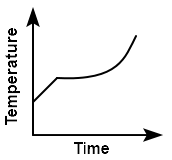 |
| 3. |  |
4. |  |
The two ends of a metal rod are maintained at temperatures \(100^{\circ}\mathrm{C}\) and \(110^{\circ}\mathrm{C}\). The rate of heat flow in the rod is found to be 4.0 J/s. If the ends are maintained at temperatures \(200^{\circ}\mathrm{C}\) and \(210^{\circ}\mathrm{C}\), the rate of heat flow will be:
1. 44.0 J/s
2. 16.8 J/s
3. 8.0 J/s
4. 4.0 J/s
| Assertion (A): | While measuring the thermal conductivity of liquid experimentally, the upper layer is kept hot and the lower layer is kept cold. |
| Reason (R): | This avoids the heating of liquid by convection. |
| 1. | Both (A) and (R) are True and (R) is the correct explanation of (A). |
| 2. | Both (A) and (R) are True but (R) is not the correct explanation of (A). |
| 3. | (A) is True but (R) is False. |
| 4. | Both (A) and (R) are False. |
According to Wein's law:
1. = constant
2. = constant
3. = constant
4. = constant
A black body has a maximum wavelength at a temperature of \(2000~\text K.\) Its corresponding wavelength at temperatures of \(3000~\text K\) will be:
| 1. | \(\dfrac{3}{2} \lambda_m\) | 2. | \(\dfrac{2}{3} \lambda_m\) |
| 3. | \(\dfrac{4}{9} \lambda_m\) | 4. | \(\dfrac{9}{4} \lambda_m\) |
| 1. | \(\dfrac{Q}{4\pi R^2\sigma}\) | 2. | \(\left(\dfrac{Q}{4\pi R^2\sigma}\right )^{\dfrac{-1}{2}}\) |
| 3. | \(\left(\dfrac{4\pi R^2 Q}{\sigma}\right )^{\dfrac{1}{4}}\) | 4. | \(\left(\dfrac{Q}{4\pi R^2 \sigma}\right)^{\dfrac{1}{4}}\) |
The temperature of a body falls from \(50^{\circ}\text{C}\) to \(40^{\circ}\text{C}\) in \(10\) minutes. If the temperature of the surroundings is \(20^{\circ}\text{C},\)hen the temperature of the body after another \(10\) minutes will be:
1. \(36.6^{\circ}\text{C}\)
2. \(33.3^{\circ}\text{C}\)
3. \(35^{\circ}\text{C}\)
4. \(30^{\circ}\text{C}\)