 Physics #restart (Mechanical Properties of Fluids SET A -Easy)Contact Number: 8527521718Physics #restart (Mechanical Properties of Fluids SET A -Easy)Contact Number: 8527521718
For the figures given below, the correct observation is:
| 1. | pressure at the bottom of the tank (a) is greater than at the bottom of the tank (b). |
| 2. | pressure at the bottom of the tank (a) is lesser than at the bottom of (b). |
| 3. | pressure depends upon the shape of the container. |
| 4. | pressure at the bottom of (a) and (b) are the same. |
Which of the following diagrams does not represent a streamline flow?
| 1. |  |
2. |  |
| 3. | 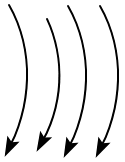 |
4. |  |
A spherical drop of water has a radius of 1 mm. If the surface tension of water is N/m, the difference in pressures inside and outside the spherical drop is:
| 1. | 35 N / m2 | 2. | 70 N / m2 |
| 3. | 140 N / m2 | 4. | Zero |
An iceberg of density \(900 ~\text{kg/m}^ 3\) is floating in the water of density \(1000 ~\text{kg/m}^ 3.\) The percentage of the volume of ice cube outside the water is:
1. \(20\% \)
2. \(35\% \)
3. \(10\% \)
4. \(25\% \)
If an incompressible liquid is flowing through a horizontal pipe having branches of area \({A},\) \(0.4{A},\) and \(0.5{A}\) as shown in the figure, then the value of \({v}\) is:

1. \(3.2~\text{m/s}\)
2. \(6.4~\text{m/s}\)
3. \(1.6~\text{m/s}\)
4. \(0.8~\text{m/s}\)
The pressure of water in a water pipe when tap is opened and closed are respectively \(3\times10^5\) Nm–2 and \(3.5\times10^5\) Nm–2. With open tap, the velocity of water flowing is:
1. \(10\) ms–1
2. \(5\) ms–1
3. \(20\) ms–1
4. \(15\) ms–1
The relative velocity of two adjacent layers of a liquid is \(6~\text{cm/s}\) and the perpendicular distance between layers is \(0.1~\text{mm}.\) The velocity gradient for liquid (in per second) is:
1. \(6\)
2. \(0.6\)
3. \(0.06\)
4. \(600\)
A spherical ball of radius \(r\) is falling in a viscous fluid of viscosity \(\eta\) with a velocity \(v.\) The retarding viscous force acting on the spherical ball is:
| 1. | inversely proportional to \(r\) but directly proportional to velocity \(v.\) |
| 2. | directly proportional to both radius \(r\) and velocity \(v.\) |
| 3. | inversely proportional to both radius \(r\) and velocity \(v.\) |
| 4. | directly proportional to \(r\) but inversely proportional to \(v.\) |
The property of surface tension of the liquid is due to:
| 1. | the gravitational force of attraction between the molecules. |
| 2. | the cohesive forces between the molecules. |
| 3. | the adhesive force between the molecules. |
| 4. | the formation of ionic bonds between the molecules. |
Which of the following graphs best represents the variation of capillary rise of a liquid with the radius of the capillary tube?
| 1. |  |
2. |  |
| 3. | 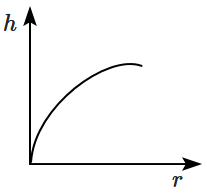 |
4. |  |

