 Physics #restart (Work, Energy & Power SET D - Hard)Contact Number: 8527521718Physics #restart (Work, Energy & Power SET D - Hard)Contact Number: 8527521718
Four situations are shown in the following options. In each situation, planes are equally rough and the block begins with the same speed and slides until the kinetic frictional force has stopped it. In which of the following cases increase in thermal energy due to sliding is least?
| 1. |  |
2. |  |
| 3. | 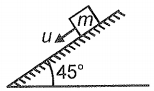 |
4. | 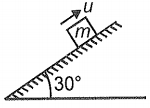 |
The work done in increasing the length of a massless spring from its natural length 15 cm to 15.1 cm is 20 J. Work done in increasing the length from 15.1 cm to 15.2 cm will be:
| 1. | 20 J | 2. | 40 J |
| 3. | 60 J | 4. | 80 J |
A particle is suspended by a light rod of length l. The minimum speed at which the particle should be projected, so that it moves in a vertical circle, is:
| 1. | \(3 \sqrt{g l} \) | 2. | \(\sqrt{2 g l} \) |
| 3. | \(2 \sqrt{g l} \) | 4. | \(\sqrt{5 g l}\) |
If a 50 kg mass is swinging in a vertical plane on a string at rest then the power delivered by gravity when the mass is moving with a velocity of 2 m/sec upwards in a direction, making an angle of with the vertical will be: (g = 9.8 m/)
| 1. | \(980 \mathrm{~W} \) | 2. | \(490 \mathrm{~W} \) |
| 3. | \(490 \sqrt{3}~ W \) | 4. | \(245 \mathrm{~W}\) |
Block A moves on a smooth surface and collides with block B at rest. The maximum energy stored in the spring will be:
| 1. | \(\frac{1}{8} m v^2 \) | 2. | \(\frac{1}{4} \mathrm{~m} v^2 \) |
| 3. | \(\frac{1}{3} m v^2 \) | 4. | \(\frac{1}{2} m v^2\) |
