1. If
\(F=\alpha t^2-\beta t \) is the magnitude of the force acting on a particle at an instant
\(t,\) then the time at which the force becomes constant is (where
\(\alpha \) and
\(\beta \) are constants):
| 1. |
\(\dfrac{\beta}{\alpha}\) |
2. |
\(\dfrac{\beta}{2\alpha}\) |
| 3. |
\(\dfrac{2\beta}{\alpha}\) |
4. |
zero |
2. A metal sphere is suspended from a wall by a string. The forces acting on the sphere are shown in the figure. Which of the following statements is NOT correct?

| 1. |
\(\overrightarrow N+\overrightarrow T+\overrightarrow W=0\)
|
2. |
\(T^2=N^2+W^2\) |
| 3. |
\(T = N + W\) |
4. |
\(N = W \tan \theta\) |
3. Given below are two statements:
| Assertion (A): |
A standing bus suddenly accelerates. If there was no friction between the feet of a passenger and the floor of the bus, the passenger would move back. |
| Reason (R): |
In the absence of friction, the floor of the bus would slip forward under the feet of the passenger. |
| 1. |
(A) is True but (R) is False. |
| 2. |
(A) is False but (R) is True. |
| 3. |
Both (A) and (R) are True and (R) is the correct explanation of (A). |
| 4. |
Both (A) and (R) are True but (R) is not the correct explanation of (A). |
4. A person holding a rifle (mass of person and rifle together is \(100\) kg) stands on a smooth surface and fires \(10\) shots horizontally, in \(5\) s. Each bullet has a mass of \(10~\mathrm{g}\) with a muzzle velocity of \(800\) ms-1. The final velocity acquired by the person and the average force exerted on the person are:
1. \(-0.08~ \text{ms}^{-1} ; 16~ \text{N} \)
2. \(-0.8~ \text{ms}^{-1} ; 16~ \text{N} \)
3. \(-1.6~ \text{ms}^{-1} ; 16~ \text{N} \)
4. \(-1.6 ~\text{ms}^{-1} ; 8 ~\text{N}\)
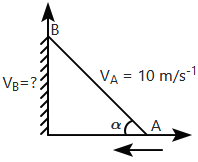
5. A rigid rod is placed against the wall as shown in the figure. When the velocity at its lower end is \(10\) ms-1 and its base makes an angle \(\alpha=60^\circ\) with horizontal, then the vertical velocity of its end \(\mathrm{B}\) (in ms-1) will be:
| 1. |
\(10\sqrt{3}\) |
2. |
\(\frac{10}{\sqrt{3}}\) |
| 3. |
\(5\sqrt{3}\) |
4. |
\(\frac{5}{\sqrt{3}}\) |
6. If \(\mu\) between block \(A\) and inclined plane is \(0.5\) and that between block \(B\) and the inclined plane is \(0.8,\) then the normal reaction between blocks \(A\) and \(B\) will be:

1. \(180~\text N\)
2. \(216~\text N\)
3. \(0\)
4. none of these
7.
The reading of spring balance in the depicted figure will be:

| 1. |
\(0\) N |
2. |
\(20\) N |
| 3. |
\(10\) N |
4. |
\(5\) N |
8. A tube of length \( L\) is filled completely with an incompressible liquid of mass \(M\) and closed at both ends. The tube is then rotated in a horizontal plane about one of its ends with a uniform angular velocity \(\omega\). The force exerted by the liquid at the other end is:
| 1. |
\(ML \omega^2 \over 2\) |
2. |
\(ML^2 \omega \over 2\) |
| 3. |
\(ML \omega^2 \) |
4. |
\(ML^2 \omega^2 \over 2\) |
9. A car is moving on a circular track of radius \(50~\text{cm}\) with coefficient of friction being \(0.34.\) On this horizontal track, the maximum safe speed for turning is equal to:
(take \(g=10~\text{m/s}^2\) )
1. \(1.03~\text{m/s}\)
2. \(1.7~\text{m/s}\)
3. \(1.3~\text{m/s}\)
4. \(1.8~\text{m/s}\)
10. Given below are two statements:
| Assertion (A): |
Centripetal forces and centrifugal forces never cancel out. |
| Reason (R): |
They do not act at the same time. |
| 1. |
Both (A) and (R) are True and (R) is the correct explanation of (A). |
| 2. |
Both (A) and (R) are True but (R) is not the correct explanation of (A). |
| 3. |
(A) is True but (R) is False. |
| 4. |
(A) is False but (R) is True. |
*If above link doesn't work, please go to test link from where you got the pdf and fill OMR from there
CLICK HERE to get FREE ACCESS for 2 days of ANY NEETprep course
 Physics #restart (Laws of Motion SET C -Medium)Contact Number: 8527521718