1.
| Assertion (A): |
Displacement of a body may be zero when distance travelled by it is not zero. |
| Reason (R): |
The displacement is the longest distance between initial and final position. |
| 1. |
Both (A) and (R) are True and (R) is the correct explanation of (A). |
| 2. |
Both (A) and (R) are True but (R) is not the correct explanation of (A). |
| 3. |
(A) is True but (R) is False. |
| 4. |
Both (A) and (R) are False. |
2. An object moves along a straight line. It travels \(30\) m in \(5\) s and \(60\) m in the next \(10\) seconds. The average speed of the object is:
1. \(6\) m/s
2. \(10\) m/s
3. \(12\) m/s
4. \(9\) m/s
3. If the velocity of a particle is \(v=At+Bt^{2},\) where \(A\) and \(B\) are constants, then the distance travelled by it between \(1~\text{s}\) and \(2~\text{s}\) is:
| 1. |
\(3A+7B\) |
2. |
\(\frac{3}{2}A+\frac{7}{3}B\) |
| 3. |
\(\frac{A}{2}+\frac{B}{3}\) |
4. |
\(\frac{3A}{2}+4B\) |
4. The motion of a particle is given by the equation \(S = \left(3 t^{3} + 7 t^{2} + 14 t + 8 \right) \text{m} ,\) The value of the acceleration of the particle at \(t=1~\text{s}\) is:
| 1. |
\(10\) m/s2 |
2. |
\(32\) m/s2 |
| 3. |
\(23\) m/s2 |
4. |
\(16\) m/s2 |
5. A stone is thrown vertically downwards with an initial velocity of \(40\) m/s from the top of a building. If it reaches the ground with a velocity of \(60\) m/s, then the height of the building is: (take \(g=10\) m/s2)
| 1. |
\(120\) m |
2. |
\(140\) m |
| 3. |
\(80\) m |
4. |
\(100\) m |
6. The position-time
\((x\text-t)\) graph for positive acceleration is:
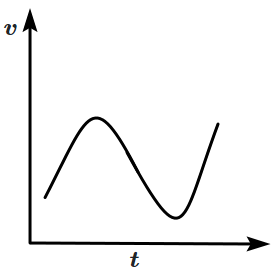
7. Which of the following velocity-time graphs shows a realistic situation for a body in motion?
8. A thief is running away on a straight road in a jeep moving with a speed of \(9\) m/s. A policeman chases him on a motorcycle moving at a speed of \(10\) m/s. If the instantaneous separation of the jeep from the motorcycle is \(100\) m, how long will it take for the policeman to catch the thief?
1. \(1\) s
2. \(19\) s
3. \(90\) s
4. \(100\) s
9. The ratio of the distances travelled by a freely falling body in the
\(1\)st,
\(2\)nd,
\(3\)rd and
\(4\)th second is:
| 1. |
\(1:1:1:1\) |
2. |
\(1:2:3:4\) |
| 3. |
\(1:4:9:16\) |
4. |
\(1:3:5:7\) |
10. If a body is thrown up with the velocity of \(15\) m/s, then the maximum height attained by the body is: (assume \(g = 10\) m/s2)
1. \(11.25\) m
2. \(16.2\) m
3. \(24.5\) m
4. \(7.62\) m
*If above link doesn't work, please go to test link from where you got the pdf and fill OMR from there
CLICK HERE to get FREE ACCESS for 2 days of ANY NEETprep course
 Physics #restart (Motion in A Straight Line SET B - Easy)Contact Number: 8527521718