Physics-Section-A
1. Two long straight wires carrying currents
\(i_1, i_2\) are placed as shown in the figure, just avoiding contact. The separation between the wires is negligible, and the wires are aligned along
\(x\) &
\(y\) axes respectively.

The wire along the
\(x\text-\)axis experiences:
| 1. |
a force along \(+y\) axis only. |
| 2. |
a force along \(-y\) axis. |
| 3. |
zero force, but a torque. |
| 4. |
no force and no torque. |
2. Two very long wires of length
\(L\) are placed parallel to each other separated by a distance
\(r(r << L) . \) The wires carry equal currents
\(i .\) The force between the two wires is nearly:
| 1. |
\(\dfrac{\mu_{0} i^{2} L}{2 \pi r}\) |
2. |
\(\dfrac{\mu_{0} i^{2} L}{4 \pi r}\) |
| 3. |
\(\dfrac{\mu_{0} i^{2} L}{2 r}\) |
4. |
\(\dfrac{\mu_{0} i^{2} L}{4 r}\) |
3. The net resistance of a voltmeter should be large to ensure that:
| 1. |
It does not get overheated. |
| 2. |
It does not draw excessive current. |
| 3. |
It can measure large potential differences. |
| 4. |
It does not appreciably change the potential difference to be measured. |
4. A long solenoid consists of circular turns of wire wrapped around a cylindrical frame; the axial length of the solenoid being \(L,\) its total number of turns \(N,\) and the radius of each turn \(r.\) The magnetic field produced by a single turn of radius \(r,\) at its centre, is \(B_0\text -\) when it carries a current \(i.\) The field at the centre of the solenoid, due to the same current \(i,\) is:
1. \(B_0\)
2. \(N.\)\(\Large\frac{2r}{L}\)\(B_0\)
3. \(N.\)\(\Large\frac{L}{2r}\)\(B_0\)
4. \(N.\)\(\Large\frac{L}{2\pi r}\)\(B_0\)
5. An infinitely long straight conductor carries a current of \(5~\text{A}\) as shown. An electron is moving with a speed of \(10^5~\text{m/s}\) parallel to the conductor. The perpendicular distance between the electron and the conductor is \(20~\text{cm}\) at an instant. Calculate the magnitude of the force experienced by the electron at that instant.

1. \(4\pi\times 10^{-20}~\text{N}\)
2. \(8\times 10^{-20}~\text{N}\)
3. \(4\times 10^{-20}~\text{N}\)
4. \(8\pi\times 10^{-20}~\text{N}\)
6. A straight vertical conductor carries a current vertically upwards. A point
\(P\) lies to the east of it at a small distance and another point
\(Q\) lies to the west at the same distance. The magnetic field at
\(P\) is:
| 1. |
greater than at \(Q\) |
| 2. |
same as at \(Q\) |
| 3. |
less than at \(Q\) |
| 4. |
greater or less than at \(Q\) depending upon the strength of current |
7. A strong magnetic field is applied along the direction of the velocity of an electron. The electron would move along:
| 1. |
a parabolic path |
| 2. |
the original path |
| 3. |
a helical path |
| 4. |
a circular path |
8. At what distance from a long straight current-carrying wire will the magnetic field have the same magnitude as that at the centre of a circular wire of radius
\(r,\) if both wires carry the same current?
| 1. |
\(2\pi r\) |
2. |
\(\pi r\) |
| 3. |
\(\Large\frac{r}{\pi}\) |
4. |
\(\Large\frac{r}{2\pi}\) |
9. A cylindrical conductor of radius \(R\) is carrying a constant current. The plot of the magnitude of the magnetic field \(B\) with the distance \(d\) from the centre of the conductor is correctly represented by the figure:
10. An electron is moving in a circular path under the influence of a transverse magnetic field of
\(3.57\times 10^{-2}~\text{T}\). If the value of
\(\frac{e}{m}\) is
\(1.76\times 10^{11}~\text{C/kg}\), what will be the frequency of revolution of the electron?
| 1. |
\(1~\text{GHz}\) |
2. |
\(100~\text{MHz}\) |
| 3. |
\(62.8~\text{MHz}\) |
4. |
\(6.28~\text{MHz}\) |
11. Two toroids \(1\) and \(2\) have total no. of turns \(200\) and \(100\) respectively with average radii \(40~\text{cm}\) and \(20~\text{cm}\) respectively. If they carry the same current \(i,\) what will be the ratio of the magnetic fields along the two loops?
1. \(1:1\)
2. \(4:1\)
3. \(2:1\)
4. \(1:2\)
12. The ratio of the radii of two circular coils is \(1:2.\) The ratio of currents in the respective coils such that the same magnetic moment is produced at the centre of each coil is:
| 1. |
\(4:1\) |
2. |
\(2:1\) |
| 3. |
\(1:2\) |
4. |
\(1:4\) |
13. A long straight wire of radius a carries a steady
current \(I\). The current is uniformly distributed over its
cross-section. The ratio of the magnetic fields
\(B\) and
\(B'\) at radial distances
\(\frac{a}{2}\) and
\(2a\) respectively, from the axis of the wire, is:
| 1. |
\(\dfrac{1}{2}\) |
2. |
\(1\) |
| 3. |
\(4\) |
4. |
\(\dfrac{1}{4}\) |
14. A long wire carrying a steady current is bent into a circular loop of one turn. The magnetic field at the centre of the loop is \(B\). It is then bent into a circular coil of \(n\) turns. The magnetic field at the centre of this coil of \(n\) turns will be:
1. \(nB\)
2. \(n^2B\)
3. \(2nB\)
4. \(2n^2B\)
Physics-Section-B
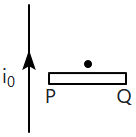
15. A metal rod
\(PQ\) (carrying current from
\(P\) to
\(Q\)) is placed perpendicular to the infinite long wire carrying current
\(i_0\). If this arrangement lies in a horizontal plane; then the rod
\(PQ\) will rotate:
| 1. |
clockwise |
2. |
anticlockwise |
| 3. |
along \(PQ\) |
4. |
does not rotate |
16. A current
\(i\) is distributed uniformly over the cross-section of a cylindrical wire of radius
\(R,\) as shown in the diagram. The magnetic field at the surface is
\(B_s.\) The magnetic field at the point
\(P\) inside the cross-section equals:
\(\left(OP =\dfrac{R}{2}\right )\)

| 1. |
\(\dfrac{B_s}{2}\) |
2. |
\(2 B_s\) |
| 3. |
\(\dfrac{B_s}{4}\) |
4. |
\(4 B_s\) |
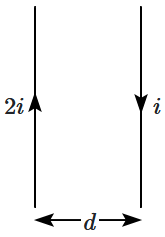
17. Two long parallel current-carrying wires carrying unequal currents
\((i, 2i)\) in opposite directions are placed a short distace
\(d\) from each other. The magnetic field, exactly midway between the wires, is:
| 1. |
into the page |
| 2. |
out of the page |
| 3. |
towards the larger current \((2i)\) |
| 4. |
away from the larger current \((2i)\) |
18. The radius of the helical path for a proton moving with a velocity
\({3}\times{10}^{5}~\text{m/s}\), which enters in a magnetic field of
\(0.3\) T at an angle
\(\theta\) with the field, is
\(0.5\) cm. The value of
\(\theta\) is:
(
\(e/m\) for proton =
\(10^8\) C/kg)
| 1. |
\(30^\circ\) |
2. |
\(45^\circ\) |
| 3. |
\(60^\circ\) |
4. |
\(90^\circ\) |
19. The magnitude of the integral of the quantity
\(\int\vec B\cdot d\vec{ l}\) around the loop
\(PQR\) of the equilateral triangle is
\(K.\) The field at the centre of the long solenoid is:

| 1. |
\(\dfrac{K}{a}\) |
2. |
\(\dfrac{K}{b}\) |
| 3. |
\(\dfrac{K}{a-b}\) |
4. |
\(\dfrac{K}{a+b}\) |
20. The magnetic moment of atomic neon is equal to:
1. zero
2. \({\mathit{\mu}}_{B}/2\)
3. \({\mathit{\mu}}_{B}\)
4. \(3{\mathit{\mu}}_{B}/2\)
(where \({\mathit{\mu}}_{B}\) = Bohr magneton)
Chemistry-Section-A
21. Consider the following reaction:
A2(g) + B2(g) ⇋ 2AB(g)
At equilibrium, the concentrations of A2 = 3.0×10⁻³ M; B2 = 4.2×10⁻³ M and AB = 2.8×10⁻³M.
The value \(K_C\) for the above-given reaction in a sealed container at 527°C is:
| 1. |
3.9 |
2. |
0.6 |
| 3. |
4.5 |
4. |
2.0 |
22. Match the compounds in column I with the oxidation states of Cl in column II.
| Column I(Compound) |
Column II(Oxidation state) |
| a. Cl2O7 |
i. +4 |
| b. NaClO3 |
ii. +1 |
| c. Cl2O |
iii. +5 |
| d. ClO2 |
iv. +7 |
Options:
|
a |
b |
c |
d |
| 1. |
iii |
iv |
ii |
i |
| 2. |
ii |
iii |
iv |
i |
| 3. |
iv |
iii |
ii |
i |
| 4. |
iv |
i |
iii |
ii |
23. The ratio of F- and HCOO- in a mixture of 0.1 M HF and 0.2 M HCOOH
| 1. |
2 : 2.3 |
2. |
1 : 3.3 |
| 3. |
3.3 : 2 |
4. |
3.3 : 1 |
24. What is the oxidation number of Cl in \(\text{CaOCl}_2\) (bleaching powder)?
1. Zero, because it contains Cl2
2. -1, because it contains Cl-
3. +1, because it contains ClO-
4. +1 and -1 because it contains ClO- and Cl-
25. What is the alteration in the oxidation state of carbon in the given reaction?
\(\mathrm{{CH_4}_{(g)} + 4{Cl_2}_{(g)} \rightarrow {CCl_4}_{(l)} + 4 HCl_{(g)}}\)
| 1. |
0 to +4 |
2. |
–4 to +4 |
| 3. |
0 to –4 |
4. |
+4 to +4 |
26. An aqueous solution contains 0.10 M H2S and 0.20 M HCl. If the equilibrium constant for the formation of HS– from H2S is 1.0 × 10⁻⁷ and that of S2– from HS– ions is 1.2 × 10⁻¹³ then the concentration of S2– ions in aqueous solution will be:
1. 5 × 10⁻⁸ M
2. 3 × 10–20 M
3. 6 × 10–21 M
4. 5 × 10–19 M
27. Which of the following salts will give the highest pH in water?
1. KCl
2. NaCl
3. Na2CO3
4. CuSO4
28. Which one of the following acts as a reducing agent only?
1. SO2
2. HNO3
3. MnO2
4. H2S
29. If an alcoholic beverage has a pH of 4.7, what is the concentration of OH- ions in the solution?
\((\text {Given:} ~K_w=10^{-14}~mol^2L^{-2})\)
1. \(3 \times 10^{-10}\)
2. \(5 \times 10^{-10} \)
3. \(1 \times 10^{-10}\)
4. \(5 \times 10^{-8}\)
30. Among the given compounds, which one would have the lowest value of the hydrolysis constant \((K_H)\) ?
1. \(AlCl_3\)
2. \(CuSO_4\)
3. \(NH_4Cl\)
4. \(CH_3COONa\)
31. What is the number of moles of electrons gained by one-mole of oxidizing agent in the following redox reaction?
\( \mathrm{Zn}_{(s)} + \mathrm{2HCl}_{(aq)} \rightarrow \mathrm{ZnCl_2}_{(aq)}+\mathrm {H_2} _{(g)}\)
1. Four (4)
2. Three (3)
3. Two (2)
4. One (1)
32. Which of the following cannot act as an oxidizing agent?
| 1. |
\(S^{2-}\) |
2. |
\(B r_2\) |
| 3. |
\(\mathrm{HSO}_4^{-}\) |
4. |
\(\mathrm{SO}_3^{2-}\) |
33. The reaction,
is balanced if:
1. 𝑋 = 5, 𝑌 = 2
2. 𝑋 = 2, 𝑌 = 5
3. 𝑋 = 4, 𝑌 = 10
4. 𝑋 = 5, 𝑌 = 5
34. Which of the following solutions acts as a buffer?
1. \(HCl+NH_4Cl\)
2. \(CH_3COONH_4+H_2O\)
3. \(NaOH+CH_3COONa\)
4. \(HNO_3+NaNO_3\)
Chemistry-Section-B
35. The oxidation number of Cl in
\(CaOCl_2\) is :
1. Zero
2. -1
3. +1
4. -1 as well as +1
36. Given below are two statements:
| Statement I: |
According to Lewis's concept, H2O acts as an amphoteric substance. |
| Statement II: |
H2O act as an acid on reaction with NH3, while it acts as a base on reaction with H2S. |
In light of the above statements choose the correct answer from the options given below:
| 1. |
Both Statement I and Statement II are correct. |
| 2. |
Both Statement I and Statement II are incorrect. |
| 3. |
Statement I is correct and Statement II is incorrect. |
| 4. |
Statement I is incorrect and Statement II is correct. |
37. Which of the following neutralisation reactions will have the highest rise in temperature of the solution?
1. 100 ml 0.1 M HCl + 150 ml 0.1 M NaOH
2. 50 ml 0.1 M HCl + 50 ml 0.1 M NaOH
3. 300 ml 0.1 M HCl + 400 ml 0.1 M NaOH
4. 75 ml 0.1 M HCl + 50 ml 0.1 M NaOH
38. Consider the given reaction:
a K2Cr2O7 + b HCl \(\rightarrow\) c KCl + d CrCl3 + e H2O + f Cl2
The value of a,d & f, respectively, are:
| 1. |
2, 4, 8 |
2. |
1, 2, 3 |
| 3. |
2, 2, 3 |
4. |
1, 2, 4 |
39. The process associated with the following conversion is:
\(H_2SO_4 \rightarrow H_2S_2O_8\)
1. Oxidation
2. Reduction
3. Oxidation as well as reduction
4. Neither oxidation nor reduction
40. What substance could be added to one liter of water to serve as a buffer?
1. One mole of \(CH_
3
COO
H\) and 0.5 moles of \(NaOH\)
2. One mole of \(NH_4Cl\) and one mole of \(HCl\)
3. One mole of \(NH_4OH\) and one mole of \(NaOH\)
4. One mole of \(CH_
3
COO
H\) and one mole of \(HCl\)
Biology-I-Section-A
41. Conversion of glucose to glucose-6-phosphate, the first irreversible reaction of glycolysis, is catalyzed by:
| 1. |
Phosphofructokinase |
2. |
Aldolase |
| 3. |
Hexokinase |
4. |
Enolase |
42. Consider the given two statements:
| Assertion (A): |
The protons or hydrogen ions that are produced by the splitting of water accumulate within the lumen of the thylakoids. |
| Reason (R): |
The splitting of water is associated with the PS II. |
| 1. |
Both (A) and (R) are True and (R) correctly explains the (A). |
| 2. |
Both (A) and (R) are True but (R) does not correctly explain the (A). |
| 3. |
(A) is True but (R) is False. |
| 4. |
Both (A) and (R) are False. |
43. Consider the given two statements:
| Assertion (A): |
During oxidation within a cell, all the energy contained in respiratory substrates is released free into the cell, in a single step. |
| Reason (R): |
The energy released by oxidation in respiration is not (or rather cannot be) used directly but is used to synthesise ATP. |
| 1. |
Both (A) and (R) are True and (R) correctly explains (A). |
| 2. |
Both (A) and (R) are True but (R) does not correctly explain (A). |
| 3. |
(A) is True but (R) is False. |
| 4. |
(A) is False but (R) is True. |
44. Consider the two statements:
| Assertion (A): |
Higher rate of photosynthesis is seen when plants are provided with blue and red regions of wavelengths of visible light. |
| Reason (R): |
There is maximum absorption by chlorophyll a in the blue and the red regions of the visible light. |
| 1. |
(A) is True but (R) is False |
| 2. |
Both (A) and (R) are True and (R) explains (A) |
| 3. |
Both (A) and (R) are True but (R) does not explain (A) |
| 4. |
Both (A) and (R) are False |
45. Regarding the thylakoid membrane:
| I: |
Plastoquinone is located within the membrane |
| II: |
Plastocyanin is located on the inner lumen side of the membrane |
| III: |
NADP reductase is located on the stroma side of the membrane |
| 1. |
Only I and II are correct |
| 2. |
Only I and III are correct |
| 3. |
Only II and III are correct |
| 4. |
I, II and III are correct |
46. In the mitochondrial ETS, cytochrome c:
1. is located on the outer surface of the inner mitochondrial membrane and gets oxidised when it passes electrons to Fe-s component of either Complex I or Complex II
2. is located on the inner surface of the outer mitochondrial membrane and gets reduced when it receives electrons from Fe-s component of either Complex I or Complex II
3. is located on the inner surface of the outer mitochondrial membrane and gets reduced when it receives electrons from Cua component of Complex IV
4. is located on the outer surface of the inner mitochondrial membrane and gets oxidised when it passes electrons to Cua component of Complex IV
47. Calvin cycle is described under three stages – I: Carboxylation; II: Reduction and III: Regeneration. ATP is required during stage/s:
| 1. |
Only I |
2. |
Only I and III |
| 3. |
Only II and III |
4. |
Only IV |
48. Production of the most ATP molecules during aerobic cellular respiration of one glucose molecule is in:
1. EMP pathway
2. Citric acid cycle
3. Electron transport system
4. Lactate fermentation
49. Oxidative phosphorylation is
| 1. |
formation of ATP by transfer of phosphate group from a substrate to ADP |
| 2. |
oxidation of phosphate group in ATP |
| 3. |
addition of phosphate group to ATP |
| 4. |
formation of ATP by energy released from electrons removed during substrate oxidation |
50. For every NADH that enters the electron transport system, the resulting number of ATP will be:
1. 1
2. 2
3. 3
4. 5
51. Both ATP and NADPH, the products from the light-dependent reactions, are required during which of the following stages of the Calvin cycle?
1. carbon dioxide fixation
2. carbon dioxide reduction
3. regeneration of RuBP
4. cyclic electron pathway
52. The energy-releasing metabolic process in which substrate is oxidized without an external electron acceptor is called:
1. glycolysis
2. fermentation
3. aerobic respiration
4. photorespiration
53. Kranz anatomy is not characterised by the presence of:
1. Bundle sheath
2. Palisade mesophyll
3. Spongy mesophyll
4. Stomata
54. Consider the two statements:
| Assertion (A): |
Cyclic photophosphorylation results only in the synthesis of ATP, but not of NADPH + H+. |
| Reason (R): |
Cyclic photophosphorylation occurs only when light of wavelengths beyond 680 nm are available for excitation. |
| 1. |
(A) is True but (R) is False |
| 2. |
Both (A) and (R) are True and (R) correctly explains (A) |
| 3. |
Both (A) and (R) are True but (R) does not correctly explain (A) |
| 4. |
Both (A) and (R) are False |
Biology-I-Section-B
55. Regarding ATP synthase involved in chemiosmosis in chloroplasts:
| I: |
The component CF0 is embedded in the thylakoid membrane. |
| II: |
The component CF1 protrudes on the outer surface of the thylakoid membrane on the side that faces the stroma. |
| 1. |
Only I is correct |
| 2. |
Only II is correct |
| 3. |
Both I and II are correct |
| 4. |
Both I and II are incorrect |
56. NADH + H
+ is reoxidised to NAD+ in:
| I: |
Ethanol fermentation |
| II: |
Lactic acid fermentation |
1. Only
I
2. Only
II
3. Both
I and
II
4. Neither
I nor
II
57. Consider the given two statements:
| Statement I: |
Succinate dehydrogenase is an enzyme complex found in the inner mitochondrial membrane of eukaryotes. |
| Statement II: |
Succinate dehydrogenase is the only enzyme that participates in both the citric acid cycle and the electron transport chain. |
1.
Statement I is correct;
Statement II is correct
2.
Statement I is incorrect;
Statement II is correct
3.
Statement I is correct;
Statement II is incorrect
4.
Statement I is incorrect;
Statement II is incorrect
58. Study the pathway given below:

In which of the following options, correct words for all the three blanks A, B and C are indicated?
|
A |
B |
C |
| 1. |
Fixation |
Transamination |
Regeneration |
| 2. |
Fixation |
Decarboxylation |
Regeneration |
| 3. |
Carboxylation |
Decarboxylation |
Reduction |
| 4. |
Decarboxylation |
Reduction |
Regeneration |
59. Consider the two statements:
| Statement I: |
Photosynthesis involves two sets of reactions known as the light-dependent reactions and the light-independent reactions. |
| Statement II: |
The thylakoid membrane contains enzymes that participate in photosynthesis. |
| 1. |
Statement I is correct; Statement II is incorrect |
| 2. |
Statement I is incorrect; Statement II is correct |
| 3. |
Statement I is incorrect; Statement II is incorrect |
| 4. |
Statement I is correct; Statement II is correct |
60. The process of ‘cellular respiration’ functions in:
| 1. |
exchange of respiratory gases between cells and their environment |
| 2. |
making ATP, the usable chemical energy |
| 3. |
getting rid of glucose |
| 4. |
transport of gases of importance, to and from the cells |
Biology-II-Section-A
61. In humans, urea is produced in the:
1. liver and eliminated by the kidneys
2. kidneys and eliminated by the kidneys
3. liver and eliminated by the intestines
4. intestines and eliminated by the kidneys
62. The atrial systole increases the flow of blood into the ventricles by about:
| 1. |
10 percent |
2. |
30 percent |
| 3. |
50 percent |
4. |
70 percent |
63.
| Assertion(A): |
Absence of mitochondria in mature human RBCs increases the efficiency of oxygen delivery at tissues by them. |
| Reason (R): |
RBCs do not need ATP |
| 1. |
Both (A) and (R) are True but (R) does not correctly explain (A). |
| 2. |
(A) is True but (R) is False. |
| 3. |
Both (A) and (R) are True and (R) correctly explains (A). |
| 4. |
(A) is False but (R) is True. |
64. Identify the incorrect statement regarding micturition reflex?
| 1. |
Signal for the reflex is initiated by the stretching of the urinary bladder as it gets filled with urine. |
| 2. |
The stretch receptors on the walls of the bladder send signals to the CNS. |
| 3. |
The CNS passes on motor messages leading to the relaxation of smooth muscles of the bladder. |
| 4. |
There is simultaneous relaxation of the urethral sphincter causing the release of urine. |
65. What percentage of the ventricular filling is contributed by the atrial contraction?
1. 30
2. 50
3. 70
4. 100
66. Juxta glomerular apparatus is a special sensitive region formed by cellular modifications in the:
| 1. |
proximal convoluted tubule and the afferent arteriole at the point of their contact. |
| 2. |
distal convoluted tubule and the afferent arteriole at the point of their contact. |
| 3. |
proximal convoluted tubule and the efferent arteriole at the point of their contact. |
| 4. |
distal convoluted tubule and the efferent arteriole at the point of their contact. |
67. Which of the following is a powerful vasoconstrictor that increases the glomerular blood pressure and thereby the GFR?
1. Renin
2. Angiotensin-II
3. Aldosterone
4. ANF
68. The chamber of the human heart with the thickest musculature is the:
| 1. |
Right atrium |
2. |
Right ventricle |
| 3. |
Left atrium |
4. |
Left ventricle |
69. Identify the correct statement:
1. Both heparin and streptokinase are anticoagulants
2. Both heparin and streptokinase are thrombolytics
3. Heparin is an anticoagulant and streptokinase is a thrombolytic
4. Heparin is a thrombolytic and streptokinase is an anticoagulant
70. Identify the correctly matched pairs regarding an ECG tracing:
| I: |
P wave - atrial depolarization |
| II: |
QRS complex - ventricular depolarization |
| III: |
T wave - atrial repolarization |
1. Only
I and
II
2. Only
I and
III
3. Only
II and
III
4.
I,
II and
III
71. The left atrium of the human heart:
| 1. |
receives deoxygenated blood from the body through superior and inferior vena cavae |
| 2. |
receives oxygenated blood from the body through superior and inferior vena cavae |
| 3. |
receives deoxygenated blood from the body through pulmonary veins |
| 4. |
receives oxygenated blood from the body through pulmonary veins |
72. Consider the given two statements:
| Assertion (A): |
As the filtrate moves down the descending limb of loop of Henle, it gets more diluted. |
| Reason (R): |
The descending limb of loop of Henle is permeable to water but almost impermeable to electrolytes. |
| 1. |
(A) is True but (R) is False |
| 2. |
Both (A) and (R) are True and (R) correctly explains (A) |
| 3. |
(A) is False but (R) is True |
| 4. |
Both (A) and (R) are True but (R) does not correctly explain (A) |
73. What physiological change is brought about by the Renin Angiotensin Aldosterone System in the end?
1. a reduced blood volume
2. an increased blood glucose level
3. a reduced blood pressure
4. an increased blood pressure
74. GFR in a healthy individual is approximately 125 ml/minute. A 20% reduction of GFR will reduce the amount of the filtrate formed by the kidneys per day by:
| 1. |
10 % |
2. |
20 % |
| 3. |
30 % |
4. |
40 % |
Biology-II-Section-B
75. Consider the given statements:
| I: |
The opening between the right atrium and the right ventricle is guarded by the tricuspid valve. |
| II: |
A bicuspid or mitral valve guards the opening between the left atrium and the left ventricle. |
| III: |
The openings of the right and the left ventricles into the pulmonary artery and the aorta respectively are provided with the semilunar valves. |
1. Only
I and
II are correct
2. Only
I and
III are correct
3. Only
II and
III are correct
4.
I, II and
III are correct
76. Identify the incorrect statement:
| 1. |
An adult human excretes, on an average, 1 to 1.5 litres of urine per day. |
| 2. |
The urine formed is slightly basic (pH-7.5). |
| 3. |
On an average, 25-30 gm of urea is excreted out per day. |
| 4. |
Presence of glucose (Glycosuria) and ketone bodies (Ketonuria) in urine are indicative of diabetes mellitus. |
77. How many of the given blood parameters are matched to a value that will be considered normal for a healthy human being?
I: RBC count – 5.0 million per cubic mm
II: Neutrophils – 60% of total WBCs
III: Platelets – 200000 per cubic mm
1. Only I and II
2. Only I and III
3. Only II and III
4. I, II and III
78. Consider the given two statements:
| Assertion (A): |
Atrial Natriuretic Factor (ANF) mechanism acts as a check on the renin-angiotensin mechanism. |
| Reason (R): |
An increase in blood flow to the atria of the heart can cause the release of ANF. |
| 1. |
Both (A) and (R) are True and (R) correctly explains (A). |
| 2. |
Both (A) and (R) are True but (R) does not correctly explain (A). |
| 3. |
(A) is True; (R) is False. |
| 4. |
Both (A) and (R) are False. |
79. A combination of flame cell and a tube cell, a protonephridium, is the osmoregulatory and excretory structure in:
| 1. |
Platyhelminthes |
2. |
Annelids |
| 3. |
Aschelminthes |
4. |
Echinoderms |
80. Identify the incorrect statement:
| 1. |
Mollusks and arthropods have closed circulatory system |
| 2. |
All vertebrates possess a muscular chambered heart |
| 3. |
In fishes, the heart pumps out deoxygenated blood |
| 4. |
The left atrium receives oxygenated blood in amphibians and reptiles |
*If above link doesn't work, please go to test link from where you got the pdf and fill OMR from there
CLICK HERE to get FREE ACCESS for 2 days of ANY NEETprep course
 Custom Practice Test - 27-JanContact Number: 8527521718


