1. The only type of pollination that brings genetically different types of pollen grains to the stigma is:
1. Chasmogamy
2. Cleistogamy
3. Geitonogamy
4. Xenogamy
2. The following diagram shoes:
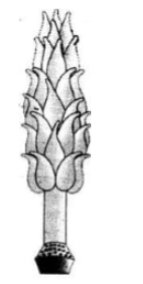
1. Multicarpellary, syncarpus pistil of Papaver
2. Multicarpellary, apocarpus pistil of Papaver
3. Multicarpellary, apocarpus gynoecium of Michelia
4. Multicarpellary, syncarpus gynoecium of Michelia
3. Tapetum is a part of
1. Male gametophyte
2. Female gametophyte
3. Ovary wall
4. Anther wall
4. Double fertilization is a characteristic of
(1) Gymnosperms
(2) Bryophytes
(3) Angiosperms
(4) Pteridophytes
5. Which among the following is not true about pollen grain?
1. Rich in nutrients.
2. Many species cause severe allergies and bronchial afflictions in some people often leading to chronic respiratory disorders– asthma, bronchitis, etc.
3. Pollen consumption has been claimed to increase the performance race horses.
4. Parthenium is used against pollen allergy.
6. Read the statements and select option representing correct statements with respect to stamen.
A. The distal end of filament is attached to thalamus.
B. A typical anther is dithecous and bisporangiate.
C. Connective is sterile vasculated tissue.
D. Microsporangia develop further and become pollen sacs.
1. A & B
2. A & C
3. B & C
4. C & D
7. Both chasmogamous and cleistogamous flowers, are produced by
1. Pea and Zostera.
2. Bean and Vallisneria.
3. Maize and bamboo.
4. Oxalis and Commelina.
8. Which one of the following statements regarding post-fertilization development in flowering plants is incorrect?
| 1. |
Ovules develop into an embryo sac |
| 2. |
Ovary develops into fruit |
| 3. |
Zygote develops into an embryo |
| 4. |
Central cell develops into endosperm |
9. Which of the following is not used by flowering plants as an outbreeding device?
| 1. |
Lack of synchronization between pollen release and stigma receptivity. |
| 2. |
Anther and Stigma placed at different levels. |
| 3. |
Self-incompatibility. |
| 4. |
Production of bisexual flowers. |
10. In angiosperms, triple fusion results in the formation of:
| 1. |
Zygote |
2. |
Endosperm |
| 3. |
Nucellus |
4. |
PEC |
11. Which of the following statements is false?
| I: |
Vallisneria and Hydrilla are freshwater plants while sea-grasses (e.g., Zostera) are marine plants. |
| II: |
Pollination in water lily / Lotus (Nymphea) and Eichhornia (water hyacinth) takes place by insects. |
| III: |
In majority of aquatic plants, flowers emerge above the level of water and are pollinated by insects or wind. |
| IV: |
In most of the water-pollinated species, pollen grains are protected from wetting due to presence of a mucilaginous covering. |
| V: |
In hydrophilous plants, pollen grains are spherical. |
| 1. |
All |
2. |
None |
| 3. |
V |
4. |
IV |
12. A typical angiospermic embryo sac is:
| 1. |
8 - nucleate, 8 - celled |
| 2. |
7 - nucleate, 8 - celled |
| 3. |
8 - nucleate, 7 - celled |
| 4. |
7 - nucleate, 6 - celled |
13. Find the incorrect statement with respect to Commelina
1. Cleistogamous flowers
2. Assured seed set
3. Abiotic pollinators
4. No anthesis
14. Which of the following structure is not associated with megasporangium in angiosperms?
1. Integuments
2. Funicle
3. Micropyle
4. Tapetum
15. Apomixis is:
| I: |
production of seeds without fertilization |
| II: |
production of fruits without fertilization |
| III: |
a form of asexual reproduction that mimics sexual reproduction |
1. Only I and II are correct
2. Only I is correct
3. Only III is correct
4. Only I and III are correct
16. Consider the following statements:
| I: |
In angiosperms, the female gametophyte is a large multicellular structure producing one to five archegonia, each carrying one egg cell. |
| II: |
In gymnosperms, the large female gametophyte nourishes the developing embryo after fertilization. |
| III: |
In gymnosperms, the female gametophytes are embedded within ovules that in turn are harbored in the ovary, which develops into the fruit after fertilization. |
The correct statements are:
1. I alone
2. II alone
3. III alone
4. I, II, and III
17. Find the right combination for P, Q, R and S with respect to gametophyte development in flowering plants.
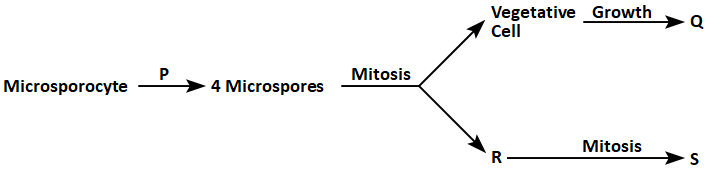
| 1. |
P-Meiosis, Q-Generative cell, R-Pollen Tube, S-2 Sperm Cells |
| 2. |
P-Meiosis, Q-Pollen Tube, R-Generative Cell, S-2 Sperm Cells |
| 3. |
P-Mitosis, Q-Generative Cell, R-Pollen Tube, S-2 Sperm Cells |
| 4. |
P-Growth, Q-2 Sperm Cells, R-Pollen Tubes, S-Generative Cell |
18. In an angiosperm, viability of pollen grains depend on
1. Pressure and humidity
2. Temperature and humidity
3. Temperature and pressure
4. Structure of pollen
19.
What functions as the embryonic root of the plant?

20. The generative cell of male angiosperm gametophytes is haploid. This cell divides to produce two haploid sperm cells. What type of cell division does the generative cell undergo to produce these sperm cells?
1. binary fission
2. mitosis
3. meiosis
4. mitosis without subsequent cytokinesis
21. The diagram of NCERT given below shows two types of flowers in a certain plant:

| Statement I: |
Cleistogamous flowers have an advantage and a disadvantage over chasmogamous flowers. |
| Statement II: |
Seed set is assured even in the absence of pollinators but the amount of genetic variations is less in cleistogamous flowers when compared to the chasmogamous flowers. |
| 1. |
Statement I is correct; Statement II is correct but Statement II does not explain Statement I. |
| 2. |
Statement I is correct; Statement II is correct and Statement II explains Statement I. |
| 3. |
Statement I is correct but Statement II is not correct. |
| 4. |
Both Statement I and Statement II are not correct. |
22. Assertion(A): Sporopollenin is one of the most resistant organic materials, and protects the pollen grain.
Reason(R): Pollen grains are well preserved as fossils.
Choices for Assertions and reasons:
1. Both (A) and (R) are true and (R) is the correct explanation of (A).
2. Both (A) and (R) are true, but (R) is not the correct explanation of (A).
3. (A) is true, but (R) is false.
4. (A) is false, but (R) is true.
23. Cells of which of the following wall layer of microsporangium possess dense cytoplasm and generally have more than one nucleus?
| 1. |
epidermis |
2. |
endothecium |
| 3. |
middle layers |
4. |
tapetum |
24. Match each item in
Column-I with one in
Column-II and select the correct match from the codes given:
|
Column-I |
|
Column-II |
| A. |
Pollen viability for months |
P. |
Prevents both autogamy and geitonogamy |
| B. |
Pollen viability for less than 30 minutes |
Q. |
Rosaceae and Solanaceae |
| C. |
Monoecious condition |
R. |
Prevents autogamy but not geitonogamy |
| D. |
Dioecious condition |
S. |
Rice and Wheat |
Codes:
|
A |
B |
C |
D |
| 1. |
S |
Q |
R |
P |
| 2. |
S |
Q |
P |
R |
| 3. |
Q |
S |
P |
R |
| 4. |
Q |
S |
R |
P |
25. Geitonogamy
| I: |
is the transfer of pollen grains from the anther to the stigma of another flower of the same plant. |
| II: |
is genetically cross-pollination involving a pollinating agent |
| III: |
functionally is similar to autogamy |
1. Only
I is correct
2. Only
II and
III are correct
3.
I,
II and
III are correct
4.
I,
II and
III are incorrect
26. Consider the given two statements:
| Statement I: |
In water pollinated plants such as seagrasses, female flowers remain submerged in water. |
| Statement II: |
Pollen grains in such plants are released on to the surface of water. |
| 1. |
Statement I is correct; Statement II is correct |
| 2. |
Statement I is incorrect; Statement II is correct |
| 3. |
Statement I is correct; Statement II is incorrect |
| 4. |
Statement I is incorrect; Statement II is incorrect |
27. Consider the given two statements:
| Assertion (A): |
Pollen grain exine has prominent apertures called germ pores where sporopollenin is absent. |
| Reason (R): |
Germ pore is the structure through which the germ tube or pollen tube makes its exit on germination. |
| 1. |
(A) is True but (R) is False |
| 2. |
Both (A) and (R) are True and (R) does not explain (A) |
| 3. |
Both (A) and (R) are True and (R) explains (A) |
| 4. |
(A) is False but (R) is True |
28. Pollen grains:
| I: |
of carrot grass causes severe allergies and bronchial afflictions in some people, often leading to chronic respiratory disorders– asthma, bronchitis, etc. |
| II: |
are rich in nutrients. |
| III: |
maintain viability for many months in cereals such as rice and wheat. |
| IV: |
unlike seeds, they cannot be preserved in liquid nitrogen (-196°C). |
1. Only
I and
II are correct
2. Only
III and
IV are correct
3. Only
I and
III are correct
4. Only
II and
IV are correct
29. Which alphabets represent scutellum, epiblast, and coleorhiza in the given figure?
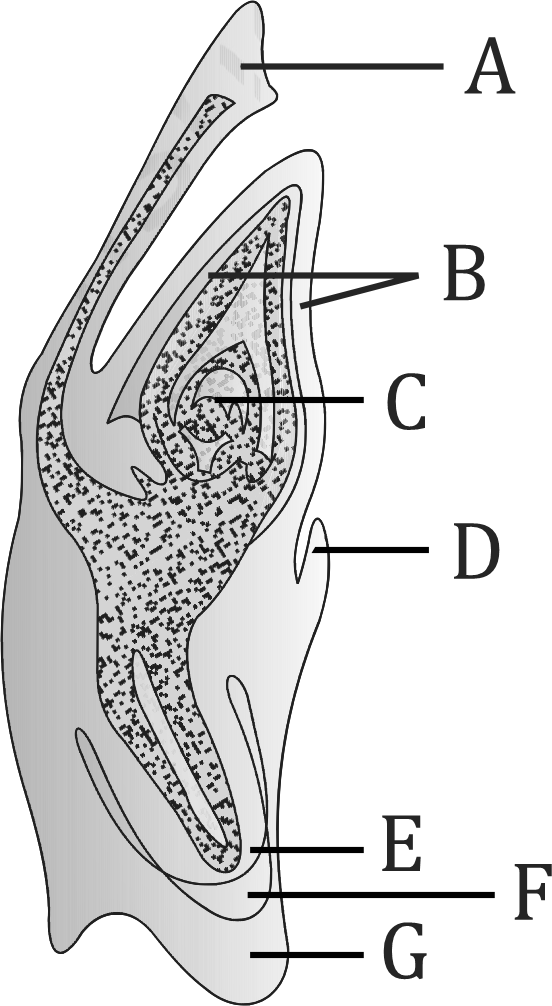
|
Scutellum |
Epiblast |
Coleorhiza |
| 1. |
A |
D |
G |
| 2. |
B |
C |
E |
| 3. |
A |
D |
F |
| 4. |
B |
D |
G |
30. The number of successive mitotic division(s) that the functional megaspore undergoes to produce the
embryo sac in angiosperms is:
*If above link doesn't work, please go to test link from where you got the pdf and fill OMR from there
CLICK HERE to get FREE ACCESS for 2 days of ANY NEETprep course
 Target DPP TestContact Number: 8527521718