 Revision DPP - 12-Jan-25Contact Number: 8527521718Revision DPP - 12-Jan-25Contact Number: 8527521718
A rigid body rotates about a fixed axis with a variable angular velocity equal to \(\alpha -\beta t\), at the time \(t\), where \(\alpha , \beta\) are constants. The angle through which it rotates before it stops is:
| 1. | \(\frac{\alpha^{2}}{2 \beta}\) | 2. | \(\frac{\alpha^{2} -\beta^{2}}{2 \alpha}\) |
| 3. | \(\frac{\alpha^{2} - \beta^{2}}{2 \beta}\) | 4. | \(\frac{\left(\alpha-\beta\right) \alpha}{2}\) |
Ozonolysis of 2,3-dimethylbut-1-ene followed by reduction with zinc and water gives
1. methanoic acid and 3-methyl-2-butanone
2. methanal and 3-methyl-2-butanone
3. methanal and 2-methyl-3-butanone
4. methanoic acid and 2-methyl-3-butanone
If vector be a force acting on a particle having the position vector and be the torque of this force about the origin, then
1.
2.
3.
4.
Which of the following compounds can be best prepared by Wurtz-reaction ?
(1) Iso-butane
(2) n-butane
(3) n-pentane
(4) Iso-pentane
The correct IUPAC name of the given compound is:
1. Methyl 2-ethylbutanoate
2. 1-Methoxy-2-ethylbutanone
3. 3-Methoxycarbonylpentane
4. 1-methoxy-2-ethylbutanal
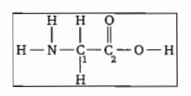
What is the hybridization of the carbon atoms labeled and respectively in glycine?
2.
s
If and then variation of EMF of a cell E, with temperature T, is given by
1.
2.
3.
4.
The type of epithelial cells which line the inner
surface of fallopian tubes, bronchioles and small
bronchi are known as :-
1. Squamous epithelium
2. Columnar epithelium
3. Ciliated epithelium
4. Cubical epithelium
If the equation for the displacement of a particle moving on a circular path is given by () = , where is in radian and t in second, then the angular velocity of the particle after 2 s from its start is :
1. 8 rad/s
2. 12 rad/s
3. 24 rad/s
4. 36 rad/s
Two particles of equal mass go round a circle of radius R under the action of their mutual gravitational attraction. The speed of each particle is:
1.
2. v
3. v
4. v
A block \(B\) of mass \(3\) kg is kept on block \(A\) of mass \(5\) kg in a lift accelerating upward with an acceleration of \(g.\) The reaction by \(A\) on \(B\) is:
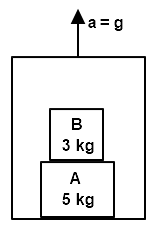
| 1. | \(10g\) | 2. | \(16g\) |
| 3. | \(4g\) | 4. | \(6g\) |
Eukaryotic cells considered as more efficient than prokaryotic cells, due to -
| 1. | compartmentalisation of cytoplasm |
| 2. | Infolding of membrane |
| 3. | Presence of cell wall |
| 4. | Aerobic respiration |
Which epithelium is found in the inner surface of stomach and gall bladder?
1. Simple squamous
2. Simple cuboidal
3. Simple columnar
4. Ciliated
If a certain reaction has \(\Delta_r H = 30 \, \text{kJ mol}^{-1}\) at \( 450~ K\), what value of \(\Delta_r S\) (in \(\mathrm{JK}^{-1} \mathrm{~mol}^{-1}\)) is required for the reaction to be spontaneous at the same temperature?
1. +70
2. –33
3. +33
4. –70
Contractile proteins are found in
1. Bone
2. Blood
3. Cartilage
4. Muscles
Geometrical isomerism can be shown by:
| 1. |  |
| 2. |  |
| 3. |  |
| 4. |  |
Conservation of momentum in a collision between particles can be understood from:
| 1. | conservation of energy |
| 2. | newton's first law only |
| 3. | newton's second law only |
| 4. | both Newton's second and third law |
Match the statements given in column 1 with corresponding characteristics given in column II and choose the correct option:
| Column -I | Column -II | ||
| A. | Entropy of vaporization | 1. | Decreases |
| B. | K for a spontaneous process | 2. | Is always positive |
| C. | Crystalline solid state | 3. | Lowest entropy |
| D. | \(\Delta U\) in an adiabatic expansion of ideal gas | 4. | \(\Delta H_{vap} \over T_b\) |
Codes:
| Options: | A | B | C | D |
| 1. | 2,4 | 2 | 3 | 1 |
| 2. | 1 | 2 | 3 | 4 |
| 3. | 1 | 4,3 | 3 | 2 |
| 4. | 4 | 3 | 3,1 | 2 |
Diamagnetic species are those which contain no unpaired electrons. Among the following, diamagnetic species are
| (a) | (b) | ||
| (C) | (d) |
Choose the correct option:
| 1. | (a), (d) | 2. | (b), (c) |
| 3. | (c), (d) | 4. | (b), (d) |
Statement - 1 : Respiration is amphibolic pathway.
Statement - 2 : Pure fat & pure protein can never be
respiratory substrate.
Option :
1. Only second statement is correct.
2. Both statements are correct.
3. Neither first nor second is correct.
4. Only first statement is correct
If the potential energy between two molecules is given by \(U = -\dfrac{A}{r^6}+ \dfrac{B}{r^{12}}, \) then the potential energy at equilibrium separation between molecules is:
1. \(\dfrac{-A^{2}}{2B}\)
2. \(\dfrac{-A^{2}}{4B}\)
3. \(0\)
4. \(\dfrac{-A^{2}}{3B}\)
The potential energy due to a force is given by:
\(U(x,y)= -3xy+2y^2\) (in joule)
where \(x,y\) are in metres.
The force acting when \(x=0,y=1\) (m) is: (in magnitude)
1. \(2~\text{N}\)
2. \(1~\text{N}\)
3. \(3~\text{N}\)
4. \(5~\text{N}\)
Match the placental types (Column-I) with their examples (Column-II)
| Column-I | Column-II | ||
| (a) | Basal | (i) | Mustard |
| (b) | Axile | (ii) | China rose |
| (c) | Parietal | (iii) | Dianthus |
| (d) | Free central | (iv) | Sunflower |
Choose the correct answer from the following options:
| 1. | (a)-(ii), (b)-(iii),(c)-(iv), (d)-(i) |
| 2. | (a)-(i), (b)-(ii), (c)-(iii), (d)-(iv) |
| 3. | (a)-(iv), (b)-(ii), (c)-(i), (d)-(iii) |
| 4. | (a)-(iii), (b)-(iv), (c)-(i), (d)-(ii) |
| Assertion (A): | If polar ice melts, days will be longer. |
| Reason (R): | Moment of inertia increases and thus angular velocity decreases. |
| 1. | Both (A) and (R) are True and (R) is the correct explanation of (A). |
| 2. | Both (A) and (R) are True but (R) is not the correct explanation of (A). |
| 3. | (A) is True but (R) is False. |
| 4. | Both (A) and (R) are False. |
| 1. | Dinitrogenase | 2. | Succinic dehydrogenase |
| 3. | Amylase | 4. | Lipase |
| 1. | a pair of olfactory lobes |
| 2. | paired cerebral hemispheres |
| 3. | unpaired diencephalon |
| 4. | a pair of optic lobes |
| Assertion (A): | In the following chemical reaction between \(H_2S(g)\) and \(Cl_2(g)\), \(H_2S(g)\) is oxidized to \(S(s)\) \(H_2S(g) +Cl_2(g) \rightarrow 2HCl(g) +S(s) \) |
| Reason (R): | Electropositive element, hydrogen has been removed from S. |
| 1. | Both (A) and (R) are True and (R) is the correct explanation of (A). |
| 2. | Both (A) and (R) are True but (R) is not the correct explanation of (A). |
| 3. | (A) is True but (R) is False. |
| 4. | Both (A) and (R) are False. |
| 1. | \(\sqrt{5gR}\) | 2. | \(\sqrt{3gR}\) |
| 3. | \(\sqrt{2gR}\) | 4. | infinite |