 Target DPP TestContact Number: 8527521718Target DPP TestContact Number: 8527521718
The sensory neuron enters the spinal cord through:
| 1. | The dorsal root of the spinal nerve |
| 2. | The ventral root of the spinal nerve |
| 3. | Either dorsal or ventral root depending on the point of origin |
| 4. | Both dorsal and ventral roots of the spinal nerves |
One common example of simplex reflex is
(1) tying your shoe laces while talking to another person and not looking at them
(2) watering of mouth at the sight of a favourite food
(3) climbing up a stairs in dark without stumbling
(4) closing of eyes when strong light is flashed across them.
Reflex action does not involve
1. Conscious thought
2. PNS
3. Involuntary response
4. Both B and C
The ……. receive signals from …….and transmit it via …….nerve root
1. Afferent neurons, sensory organs, dorsal
2. Afferent neurons, effector organs, ventral
3. Efferent neurons, sensory organs, ventral
4. Efferent neurons, effector organs, dorsal
Which of the following is a reflex action?
| 1. | Sudden withdrawal of body part, when it comes in contact of hot body. |
| 2. | Knee jerk reflex. |
| 3. | Controlling sleep pattern. |
| 4. | More than one options are correct. |
The reflex arc ends at:
1. sensory neuron
2. motor neuron
3. effector
4. receptor
Consider the following statements.
(a) Occurs involuntarily and without conscious effort.
(b) At least no afferent and two efferent neuron required.
(c) Only motor neuron is involved in the action.
(d) Polysynaptic and conditional reflex.
(e) Regulated by the spinal cord.
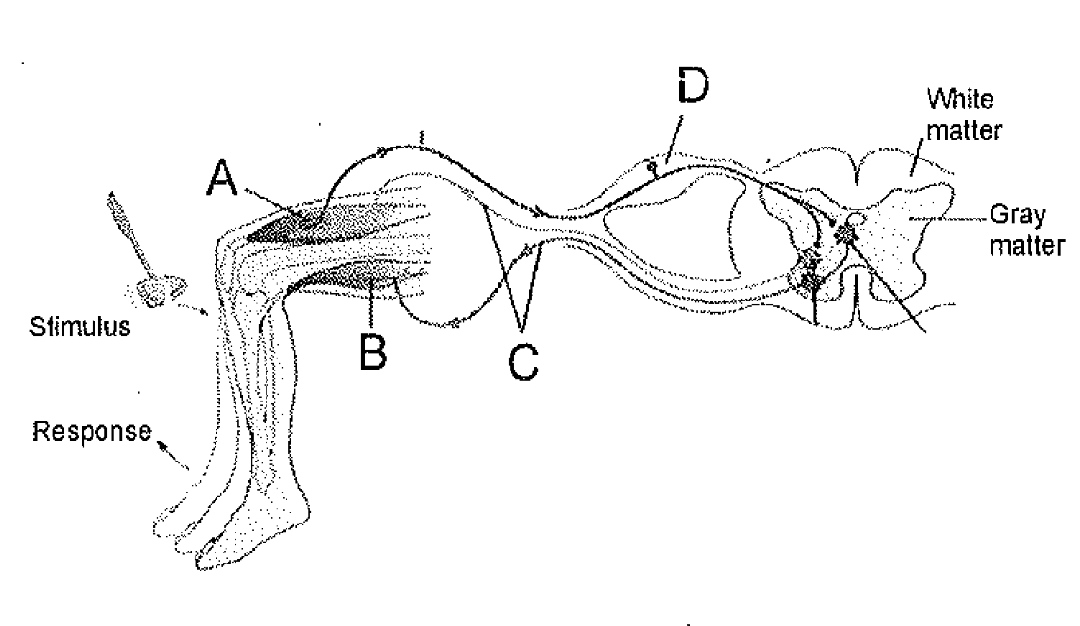
Which of the above statements are correct for the reflex shown in the above figure?
1. a and e
2. b, c and d
3. a, b, d and e
4. a, b, c, d and e
Which type of reflex is represented by the following diagram when the doctor taps the knee with rubber headed hammer? Which of the following is absent in this reflex (Muscle spindle, Interneuron, Afferent pathway, Efferent pathway)?
1. Simple reflex, muscle spindle
2. knee jerk reflex, interneuron
3. Monosynaptic reflex, muscle spindle
4. Polysynaptic, interneuron
Which amongst the following actions cannot be classified as simple reflex actions?
1. Dancing
2. Knee jerk
3. Blinking
4. Coughing
Given below is a diagrammatic representation of reflex action showing knee jerk
Identify the structures labelled as A, B, C & D and choose the incorrect option with respect to their function
1. A. Muscle spindles - Receptors
2. B. Motor end plate - Effector
3. C. Efferent pathway - It carries the impulse towards nervous system
4. D. Dorsal root - Pseudounipolar ganglion neuron
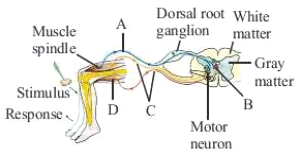
Given below is a diagrammatic presentation of knee jerk reflex, select the option with correct identification of the structures labelled as A, B, C and D in the same:-
1. A-Afferent fibre, B-Interneuron, C-Sensory fibre
2. B-Interneuron, C-Efferent fibre, D-Receptor
3. A-Sensory fibre, C-Afferent fibre, D-Motor endplate (Effector)
4. A-Afferent fibre, B-Interneuron, D-Motor end plate (Effector)
_________ neurons located in the CNS project their axons outside the CNS and directly or indirectly control muscles.
(1) association
(2) sensory
(3) motor
(4) ganglion
Study the transverse section of the spinal cord given below:
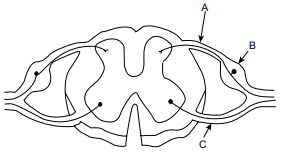
The structures marked A, B, and C are respectively:
(1) Ventral root, ventral root ganglion, dorsal root
(2) Dorsal root, dorsal root ganglion, ventral root
(3) Dorsal root, dorsal horn, ventral root
(4) Ventral root, ventral horn, dorsal root
End of spinal cord is
1. Cauda equina
2. Conus terminalis
3. Filum terminalis
4. Funiculus
Which of the following is not involved in knee-jerk reflex?
1. Muscle spindle
2. Motor neuron
3. Brain
4. Inter neurons
The simplest reflex action in humans is:
1. Mono synaptic
2. Bi-synaptic
3. Tri-synaptic
4. Poly-synaptic
In knee jerk reflex, afferent neuron synapses with motor neuron within
(1) Gray matter of spinal cord
(2) White matter of spinal cord
(3) Gray matter of brain
(4) White matter of brain
Motor neuron in the efferent pathway of knee jerk reflex carry impulses to
(1) Skeletal muscle (effector)
(2) Sensory organ
(3) Dorsal root ganglion
(4) Spinal cord
In a monosynaptic reflex action such as knee jerk reflex,
(1) Sensory and motor neuron is in 1 : 1 organisation pattern
(2) Sensory and motor neuron is in 1 : 4 organisation pattern
(3) Sensory and interneuron is in 1 : 1 organisation pattern
(4) Motor and interneuron is in 1 : 1 organisation pattern
Select the odd one with respect to knee jerk reflex
(1) Excitor neuron
(2) Sensory neuron
(3) Interneuron
(4) Receptor
Patellar tendon stretch reflex involves all except
(1) Afferent neuron
(2) Efferent neuron
(3) CNS
(4) Interneurons
| Assertion (A): | In a reflex pathway, efferent neuron passes signal from receptor organ to dorsal root ganglion |
| Reason (R): | Impulse transmitted by a motor neuron is carried by dorsal root ganglion towards CNS |
| 1. | Both (A) and (R) are true and (R) is the correct explanation of (A). |
| 2. | Both (A) and (R) are true but (R) is not the correct explanation of (A). |
| 3. | (A) is true but (R) is false. |
| 4. | Both (A) and (R) are false. |
| a. | Receptor → afferent neuron →CNS → efferent neuron → effector organ |
| b. | Receptor → afferent neuron →interneuron → efferent neuron → effector |
| c. | Receptor → afferent neuron →connecting neuron → effector organ → motor neuron |
| d. | Muscle spindle → efferent neuron →CNS → efferent neuron → motor endplate |
| 1. | Effector → Afferent neuron → Spinal cord v→ Efferent neuron → Receptor |
| 2. | Receptor → Afferent neuron → Ventral root ganglion of spinal cord → Efferent neuron → Effector |
| 3. | Receptor → Afferent neuron → Dorsal root ganglion → Efferent neuron → Effector |
| 4. | Effector → Efferent neuron → Ventral root ganglion → Afferent neuron → Receptor |