 Target DPP TestContact Number: 8527521718Target DPP TestContact Number: 8527521718
The partial pressure of ethane over a saturated solution containing 6.56 X 10⁻² g of ethane is 1 bar. If the solution contains 5.00 X 10⁻² g of ethane, then what shall be the partial pressure of the gas?
1. 0.76 bar
2. 0.16 bar
3. 1.16 bar
4. 3.12 bar
The boiling point of an azeotropic mixture of water and ethanol is less than that of water and ethanol. The mixture shows
(1) No deviation from Raoult's law
(2) Positive deviation from Raoult's law
(3) Negative deviation from Raoult's law
(4) That the solution is unsaturated
Total vapour pressure of a mixture of 1 mol A (pA° = 150 torr) and 2 mol B ( = 240 torr) is 200 torr. In this case:-
1. There is a positive deviation from Raoult's law
2. There is a negative deviation from Raoult's law
3. There is no deviation from Raoult's law
4. None of these
6g urea is dissolved in 1kg solvent. Value of (T1-T2) will be : (Kf=2 kg K mol-1)
1. 0.2°C
2. -0.2°C
3. 0.1°C
4. -0.1 K
In a cold climate frozen causing damage to radiator of a car. Ethylene glycol is used as antifreezing agent. The amount of ethylene glycol to be added to 4 kg of water to prevent it from freezing at .
1. 204.22 g
2. 804.32 g
3. 602 gm
4. 401 gm
The van't Hoff factor [i] for a dilute aqueous solution of the strong electrolyte barium hydroxide is?
(1) 0
(2) 1
(3) 2
(4) 3
A solution containing 3.3 g of a substance in 125 g of benzene (b.p. 80°C) boils at 80.66°C. If Kb for one litre of benzene is 3.28°C, the molecular weight of the substance shall be
1. 127.20
2. 131.20
3. 137.12
4. 142.72
Solution of sucrose (Mol. Mass = 342) is prepared by dissolving 34.2 gm of it in 1000 gm of water. Freezing point of the solution is (Kf for water is 1.86 K kg mol–1) [AIEEE 2003]
(1) 272.814 K
(2) 278.1 K
(3) 273.15 K
(4) 270 K
Which is true about azeotropic mixture?
1. It is a constant boiling mixture
2. Vapour phase composition and liquid phase composition are the same
3. Cannot be separated by simple distillation
4. All are true
17.4 % (w/v) solution at 27 C is isotonic to 5.85 % (w/V) NaCl solution at 27 C. lf NaCl is 100 % ionised, the % ionisation of in aqueous solution is-
[At wt. of K = 39, Na = 23] :-
1. 25 %
2. 75 %
3. 50 %
4. None of the above
Which of the following solution would exhibit abnormal colligative properties?
1. 1 M glucose
2. 0.1 M NaCl
3. 0.1 M sucrose
4. 10 gram glass powder in water
When the solute is present in trace quantities the following expression is used
1. Gram per million
2. Nanogram percent
3. Microgram percent
4. parts per million
If 8g of a non-electrolyte solute is dissolved in 114 g of n-octane to reduce its vapor pressure to 80%, the molar mass (in g/mol) of the solute is: [Given that the molar mass of n-octane is 114 g/mol]
1. 40
2. 60
3. 80
4. 20
What is the Raoult’s law expression for CHCl3 (l) and CH2Cl2 (l) mixture?
1. p =
2. p =
3. p =
4. p =
The correct sequence of order of increasing solubility in the n-octane is:
1. Cyclohexane < CH3CN < CH3OH < KCl
2. KCl < CH3OH < CH3CN < Cyclohexane
3. KCl < CH3OH > CH3CN < Cyclohexane
4. None of the above
What is the mass of ascorbic acid (Vitamin C, C6H8O6) to be dissolved in 75 g of acetic acid to lower its melting point by 1.5°C?
Kf = 3.9 K kg mol−1.
| 1. | 6.83 g | 2. | 6.03 g |
| 3. | 4.12 g | 4. | 5.08 g |
Among the following application/s of osmosis is/are :
(1) In animals, water moves into different parts of the body.
(2) Stretching of leaves, flower.
The unit that relates concentration of solution with its vapour pressure is:
1. Mole fraction.
2. Parts per million.
3. Mass percentage.
4. Molality.
Low concentration of oxygen in the blood and tissues of people living at high altitudes is due to:
| 1. | Low temperature |
| 2. | Low atmospheric pressure |
| 3. | High atmospheric pressure |
| 4. | Both low temperature and high atmospheric pressure |
The major component of air is nitrogen with approximately 79% by volume at 298 K. The water is in equilibrium with air at a pressure of 10 atm. At 298 K. if the Henry’s law constant for nitrogen at 298 K is 6.51 × 107 mm respectively, then the composition of nitrogen in air will be :
1. 12.4 × 10⁻⁵
2. 9.22 × 10⁻⁵
3. 3.54 × 10⁻⁵
4. 4.96 × 10⁻⁵
The graph, amongst the following, that represents depression in the freezing point is:
| 1. |  |
| 2. | 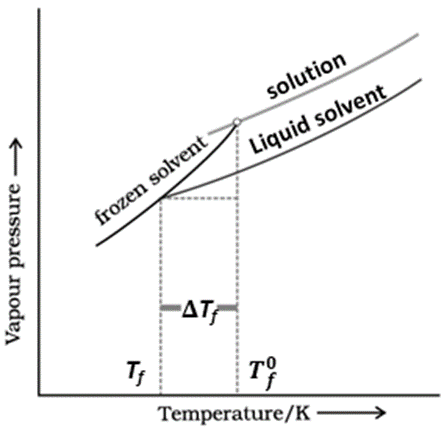 |
| 3. |  |
| 4. | None of the above |
The boiling point of benzene is 353.23 K. When 1.80 g of a non-volatile solute was dissolved in 90 g of benzene, the boiling point is raised to 354.11 K. The molar mass of the solute is:
Kb for benzene is 2.53 K kg mol–1
1. 55 g mol–1
2. 64 g mol–1
3. 58 g mol–1
4. 68 g mol–1
A set of solutions is prepared using 180 g of water as a solvent and 10 g of different non-volatile solutes A, B and C. The relative lowering of vapour pressure in the presence of these solutes are in the order:
[Given, molar mass of A = 100 g ; B = 200 g ; C = 10,000 g ]
| 1. | A > B > C | 2. | A > C > B |
| 3. | C > B > A | 4. | B > C > A |
In a mixture of A and B, components show negative deviations when:
| 1. | A-B interaction is stronger than A-A and B-B interaction |
| 2. | A-B interaction is weaker than A-A and B-B interaction |
| 3. | \(\Delta V_{\text {mix }}>0, \quad \Delta S_{\text {mix }}>0\) |
| 4. | \(\Delta V_{\text {mix }}=0, \quad \Delta S_{\text {mix }}>0\) |
| (A) | The mass of undissolved potassium nitrate will increase. |
| (B) | The concentration of the potassium nitrate solution remains the same. |
| (C) | The total mass of solvent present remains the same. |
| 1. | B and C only | 2. | A and C only |
| 3. | A only | 4. | B only |
| 1. | 1.45 atm | 2. | 5.07 atm |
| 3. | 3.46 atm | 4. | 4.01 atm |
